
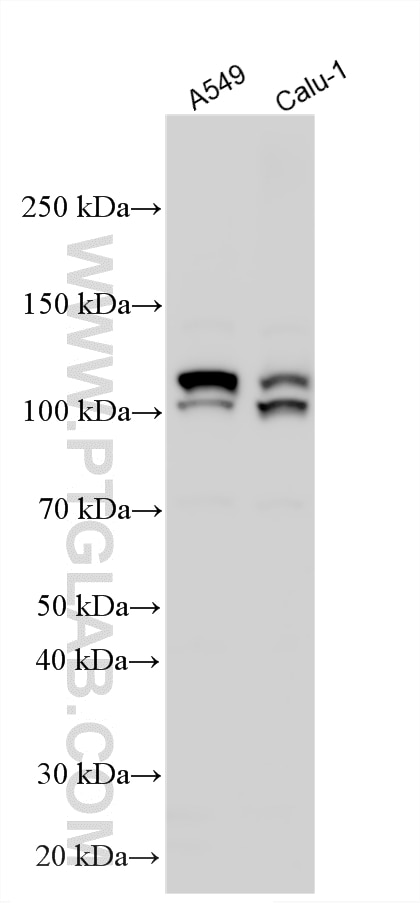
Tested Applications
| Positive WB detected in | A549 cells, Calu-1 cells |
Recommended dilution
| Application | Dilution |
|---|---|
| Western Blot (WB) | WB : 1:2000-1:10000 |
| It is recommended that this reagent should be titrated in each testing system to obtain optimal results. | |
| Sample-dependent, Check data in validation data gallery. | |
Product Information
17102-1-AP targets TDRD7 in WB, ELISA applications and shows reactivity with human samples.
| Tested Reactivity | human |
| Host / Isotype | Rabbit / IgG |
| Class | Polyclonal |
| Type | Antibody |
| Immunogen |
CatNo: Ag10773 Product name: Recombinant human TDRD7 protein Source: e coli.-derived, PGEX-4T Tag: GST Domain: 743-1098 aa of BC028694 Sequence: TSVKVSELREIPPRFLQEMIAIPPQAIKCCLADLPQSIGMWTPDAVLWLRDSVLNCSDCSIKVTKVDETRGIAHVYLFTPKNFPDPHRSINRQITNADLWKHQKDVFLSAISSGADSPNSKNGNMPMSGNTGENFRKNLTDVIKKSMVDHTSAFSTEELPPPVHLSKPGEHMDVYVPVACHPGYFVIQPWQEIHKLEVLMEEMILYYSVSEERHIAVEKDQVYAAKVENKWHRVLLKGILTNGLVSVYELDYGKHELVNIRKVQPLVDMFRKLPFQAVTAQLAGVKCNQWSEEASMVFRNHVEKKPLVALVQTVIENANPWDRKVVVYLVDTSLPDTDTWIHDFMSEYLIELSKVN Predict reactive species |
| Full Name | tudor domain containing 7 |
| Calculated Molecular Weight | 1098 aa, 124 kDa |
| Observed Molecular Weight | 115 kDa, 124 kDa |
| GenBank Accession Number | BC028694 |
| Gene Symbol | TDRD7 |
| Gene ID (NCBI) | 23424 |
| Conjugate | Unconjugated |
| Form | Liquid |
| Purification Method | Antigen affinity purification |
| UNIPROT ID | Q8NHU6 |
| Storage Buffer | PBS with 0.02% sodium azide and 50% glycerol, pH 7.3. |
| Storage Conditions | Store at -20°C. Stable for one year after shipment. Aliquoting is unnecessary for -20oC storage. 20ul sizes contain 0.1% BSA. |
Background Information
TDRD7 (Tudor domain-containing protein 7) is an RNA-binding protein characterized by multiple Tudor domains, which enable interactions with RNA-associated protein complexes involved in post-transcriptional gene regulation. TDRD7 is highly expressed in the lens, testis, and other developing tissues, where it plays critical roles in RNA granule formation, mRNA storage, and the regulation of gene expression during cellular differentiation. In the eye, TDRD7 is essential for lens development and transparency, helping maintain the proper expression of proteins required for lens fiber cell maturation. Mutations or loss of TDRD7 function are associated with congenital cataracts, often accompanied by developmental abnormalities of the eye. In addition, TDRD7 contributes to spermatogenesis through the regulation of germ cell RNA metabolism.
Protocols
| Product Specific Protocols | |
|---|---|
| WB protocol for TDRD7 antibody 17102-1-AP | Download protocol |
| Standard Protocols | |
|---|---|
| Click here to view our Standard Protocols |

