Anticorps Monoclonal anti-EPHA1-special
EPHA1-special Monoclonal Antibody for ELISA
Hôte / Isotype
Mouse / IgG1
Réactivité testée
Humain
Applications
ELISA
Conjugaison
Non conjugué
CloneNo.
5B9E8
N° de cat : 60155-1-Ig
Synonymes
Galerie de données de validation
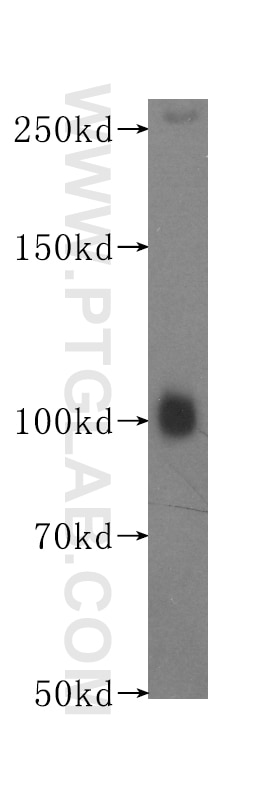
Informations sur le produit
60155-1-Ig cible EPHA1-special dans les applications de ELISA et montre une réactivité avec des échantillons Humain
| Réactivité | Humain |
| Hôte / Isotype | Mouse / IgG1 |
| Clonalité | Monoclonal |
| Type | Anticorps |
| Immunogène | Peptide |
| Nom complet | EPH receptor A1 |
| Masse moléculaire calculée | 108 kDa |
| Numéro d’acquisition GenBank | BC130291 |
| Symbole du gène | EPHA1 |
| Identification du gène (NCBI) | 2041 |
| Conjugaison | Non conjugué |
| Forme | Liquide |
| Méthode de purification | Purification par protéine G |
| Tampon de stockage | PBS with 0.02% sodium azide and 50% glycerol |
| Conditions de stockage | Stocker à -20°C. Stable pendant un an après l'expédition. L'aliquotage n'est pas nécessaire pour le stockage à -20oC Les 20ul contiennent 0,1% de BSA. |
Informations générales
EPHA1, also named as EPH, EPHT and EPHT1, belongs to ephrin receptor subfamily of the protein-tyrosine kinase family. EPH and EPH-related receptors have been implicated in mediating developmental events, particularly in the nervous system. Receptors in the EPH subfamily typically have a single kinase domain and an extracellular region containing a Cys-rich domain and 2 fibronectin type III repeats. Ligands in the ephrin-A subclass, including the prototype family member ephrin-A1 (B61), are membrane associated through glycosylphosphatidyl-inositol linkages, whereas ephrin-B subclass consists of ligands with transmembrane domains. The general role of the Eph family is in mediating repulsive cell-cell interaction.

