

Tested Applications
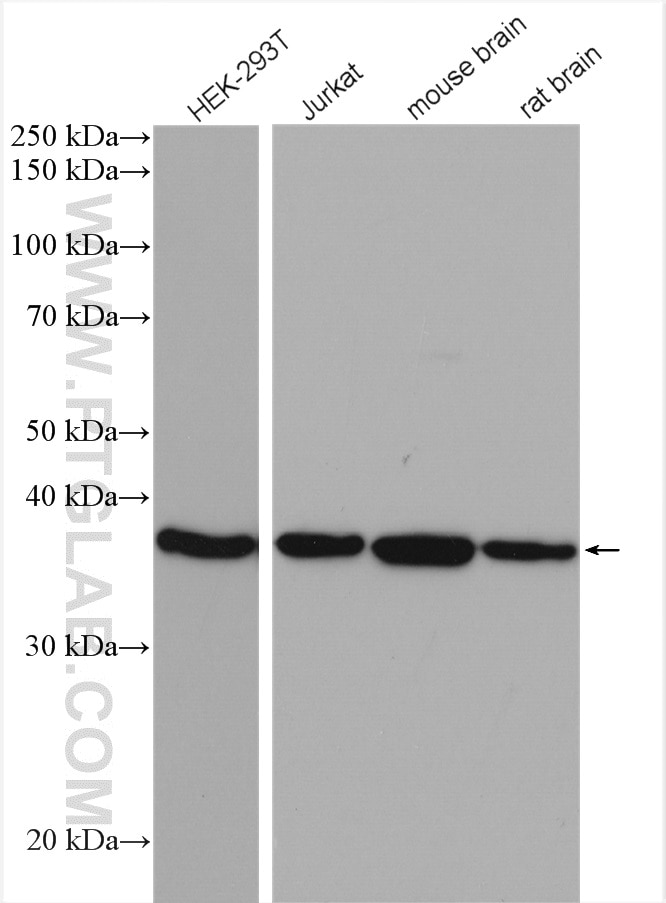
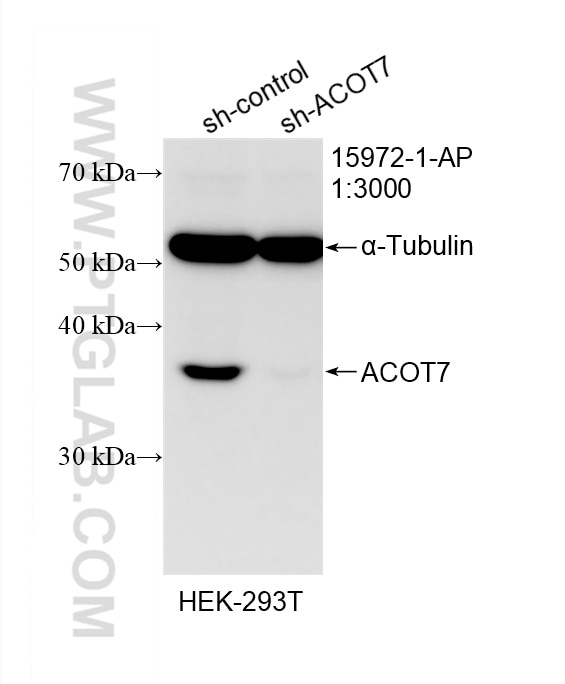
| Positive WB detected in | HEK-293T cells, mouse brain tissue, Jurkat cells, rat brain tissue |
Recommended dilution
| Application | Dilution |
|---|---|
| Western Blot (WB) | WB : 1:3000-1:10000 |
| It is recommended that this reagent should be titrated in each testing system to obtain optimal results. | |
| Sample-dependent, Check data in validation data gallery. | |
Product Information
15972-1-AP targets ACOT7 in WB, IHC, IF, ELISA applications and shows reactivity with human, mouse, rat samples.
| Tested Reactivity | human, mouse, rat |
| Cited Reactivity | human, mouse, bovine |
| Host / Isotype | Rabbit / IgG |
| Class | Polyclonal |
| Type | Antibody |
| Immunogen |
CatNo: Ag8759 Product name: Recombinant human ACOT7 protein Source: e coli.-derived, PGEX-4T Tag: GST Domain: 14-370 aa of BC017365 Sequence: PDTCALLQPPAASAAAAPSMSGPDVETPSAIQICRIMRPDDANVAGNVHGGTILKMIEEAGAIISTRHCNSQNGERCVAALARVERTDFLSPMCIGEVAHVSAEITYTSKHSVEVQVNVMSENILTGAKKLTNKATLWYVPLSLKNVDKVLEVPPVVYSRQEQEEEGRKRYEAQKLERMETKWRNGDIVQPVLNPEPNTVSYSQSSLIHLVGPSDCTLHGFVHGGVTMKLMDEVAGIVAARHCKTNIVTASVDAINFHDKIRKGCVITISGRMTFTSNKSMEIEVLVDADPVVDSSQKRYRAASAFFTYVSLSQEGRSLPVPQLVPETEDEKKRFEEGKGRYLQMKAKRQGHAEPQP Predict reactive species |
| Full Name | acyl-CoA thioesterase 7 |
| Calculated Molecular Weight | 370 aa, 40 kDa |
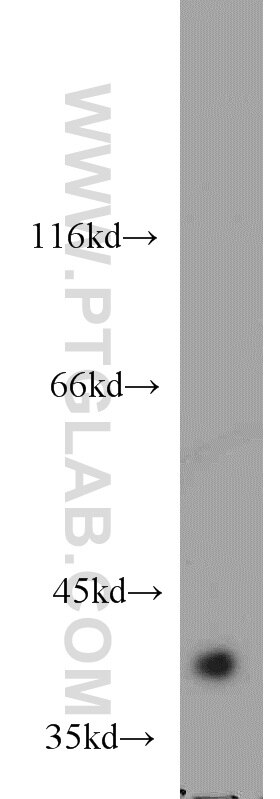
| Observed Molecular Weight | 37 kDa |
| GenBank Accession Number | BC017365 |
| Gene Symbol | ACOT7 |
| Gene ID (NCBI) | 11332 |
| RRID | AB_2221652 |
| Conjugate | Unconjugated |
| Form | Liquid |
| Purification Method | Antigen affinity purification |
| UNIPROT ID | O00154 |
| Storage Buffer | PBS with 0.02% sodium azide and 50% glycerol, pH 7.3. |
| Storage Conditions | Store at -20°C. Stable for one year after shipment. Aliquoting is unnecessary for -20oC storage. 20ul sizes contain 0.1% BSA. |
Background Information
Acyl-CoA thioesterases are a group of enzymes that catalyze the hydrolysis of acyl-CoAs to the free fatty acid and coenzyme A (CoASH), providing the potential to regulate intracellular levels of acyl-CoAs, free fatty acids and CoASH (PubMed:10578051). Acyl-coenzyme A thioesterase 7/ACOT7 preferentially hydrolyzes palmitoyl-CoA, but has a broad specificity acting on other fatty acyl-CoAs with chain-lengths of C8-C18 (PubMed:10578051). May play an important physiological function in brain (PubMed:10578051). ACOT7 has 7 isoforms between 27-40 kDa, we can detect a band at 37 kDa. ACOT7 is high homology with ACOT7L, this antibody may also detect ACOT7L.
Protocols
| Product Specific Protocols | |
|---|---|
| WB protocol for ACOT7 antibody 15972-1-AP | Download protocol |
| Standard Protocols | |
|---|---|
| Click here to view our Standard Protocols |
Publications
What published studies show
The ACOT7 Antibody (Cat# 15972-1-AP) has 10 total citations published in journals including Nature Communications, Acta Pharmacologica Sinica, Cell Chemical Biology, International Journal of Molecular Sciences, Scientific Reports, Journal of Proteomics, and others. Research fields encompass fatty acid metabolism, lipid peroxidation, and multiple cancer types—including hepatocellular carcinoma, non-small cell lung cancer, diffuse large B-cell lymphoma, triple-negative breast cancer, and cutaneous melanoma—as well as bovine mastitis and porcine fat deposition.
| Species | Application | Title |
|---|---|---|
Nat Commun Convergent genomic signatures of flight loss in birds suggest a switch of main fuel. | ||
Acta Pharmacol Sin Nobiletin and polydatin synergistically alleviate triple-negative breast cancer liver metastasis via suppressing ECM1a-mediated fatty acid biosynthesis. | ||
Cell Chem Biol Intracellular cyclization-coupled peptide library screening yields potent transcription factor antagonists. | ||
Int J Mol Sci Role of Acyl-CoA Thioesterase 7 in Regulating Fatty Acid Metabolism and Its Contribution to the Onset and Progression of Bovine Clinical Mastitis | ||
Sci Rep The SREBF2-ACOT7 axis promotes tumor progression and predicts prognosis in diffuse large b-cell lymphoma.
| ||
J Hepatocell Carcinoma Acyl-CoA Thioesterase 7 is Transcriptionally Activated by Krüppel-Like Factor 13 and Promotes the Progression of Hepatocellular Carcinoma. |

