



Tested Applications
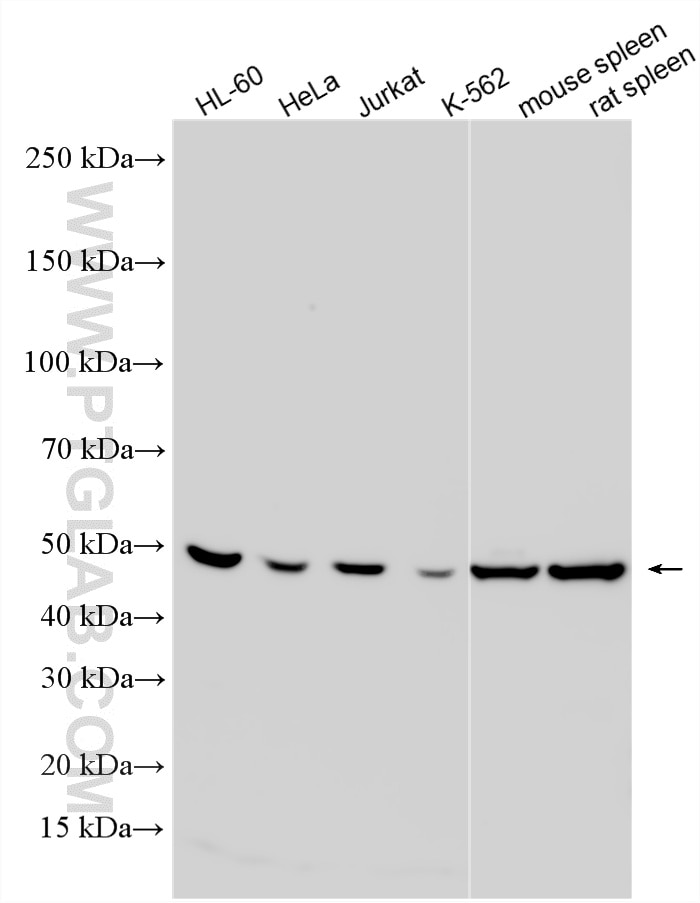
| Positive WB detected in | HL-60 cells, mouse spleen tissue, human liver tissue, A431 cells, A549 cells, HeLa cells, Jurkat cells, K-562 cells, PC-3 cells, rat spleen tissue |
| Positive IP detected in | mouse spleen tissue |
| Positive IHC detected in | human kidney tissue Note: suggested antigen retrieval with TE buffer pH 9.0; (*) Alternatively, antigen retrieval may be performed with citrate buffer pH 6.0 |
Recommended dilution
| Application | Dilution |
|---|---|
| Western Blot (WB) | WB : 1:5000-1:50000 |
| Immunoprecipitation (IP) | IP : 0.5-4.0 ug for 1.0-3.0 mg of total protein lysate |
| Immunohistochemistry (IHC) | IHC : 1:500-1:2000 |
| It is recommended that this reagent should be titrated in each testing system to obtain optimal results. | |
| Sample-dependent, Check data in validation data gallery. | |
Product Information
13822-1-AP targets ARP3/ARP3B in WB, IHC, IF, IP, ELISA applications and shows reactivity with human, mouse, rat samples.
| Tested Reactivity | human, mouse, rat |
| Cited Reactivity | human, mouse, rat |
| Host / Isotype | Rabbit / IgG |
| Class | Polyclonal |
| Type | Antibody |
| Immunogen |
CatNo: Ag4922 Product name: Recombinant human ACTR3 protein Source: e coli.-derived, PGEX-4T Tag: GST Domain: 156-418 aa of BC044590 Sequence: RQVGERTLTGTVIDSGDGVTHVIPVAEGYVIGSCIKHIPIAGRDITYFIQQLLRDREVGIPPEQSLETAKAVKERYSYVCPDLVKEFNKYDTDGSKWIKQYTGINAISKKEFSIDVGYERFLGPEIFFHPEFANPDFTQPISEVVDEVIQNCPIDVRRPLYKNIVLSGGSTMFRDFGRRLQRDLKRTVDARLKLSEELSGGRLKPKPIDVQVITHHMQRYAVWFGGSMLASTPEFYQVCHTKKDYEEIGPSICRHNPVFGVMS Predict reactive species |
| Full Name | ARP3 actin-related protein 3 homolog (yeast) |
| Calculated Molecular Weight | 418 aa 47 kDa |
| Observed Molecular Weight | 47 kDa |
| GenBank Accession Number | BC044590 |
| Gene Symbol | ARP3/ACTR3 |
| Gene ID (NCBI) | 10096 |
| RRID | AB_2221967 |
| Conjugate | Unconjugated |
| Form | Liquid |
| Purification Method | Antigen affinity purification |
| UNIPROT ID | P61158 |
| Storage Buffer | PBS with 0.02% sodium azide and 50% glycerol, pH 7.3. |
| Storage Conditions | Store at -20°C. Stable for one year after shipment. Aliquoting is unnecessary for -20oC storage. 20ul sizes contain 0.1% BSA. |
Background Information
ARP3 (also known as ACTR3) is a major constituent of the ARP2/3 complex that is necessary for nucleating actin polymerization at filament branches. ARP3 localizes to the lamellipodia of stationary and locomoting fibroblasts. Overexpression of ARP3 has been reported in several types of cancer cells. This antibody recognizes endogenous ARP3 and may cross-react with ATCR3B.
Protocols
| Product Specific Protocols | |
|---|---|
| IHC protocol for ARP3/ARP3B antibody 13822-1-AP | Download protocol |
| IP protocol for ARP3/ARP3B antibody 13822-1-AP | Download protocol |
| WB protocol for ARP3/ARP3B antibody 13822-1-AP | Download protocol |
| Standard Protocols | |
|---|---|
| Click here to view our Standard Protocols |
Publications
What published studies show
ARP3/ARP3B Polyclonal antibody (13822-1-AP) — Citation Summary
This antibody has 20 citations. It appears in high-impact journals including Nature, Nature Communications, ACS Nano, Advanced Science, Cell Death & Disease, Nature Structural & Molecular Biology, EMBO Reports, Cell Communication & Signaling, PLoS Genetics, and eLife, among others.
The cited research primarily focuses on cell biology and cytoskeleton dynamics — actin polymerization, Arp2/3-mediated branching, mitochondrial network organization, and membrane tubulation — as well as cancer biology (metastasis, DNA repair, drug resistance in glioblastoma, hepatocellular carcinoma, and gastric cancer) and tissue barrier function (blood-testis barrier in rats and mice).
| Species | Application | Title |
|---|---|---|
Nat Commun An interphase actin wave promotes mitochondrial content mixing and organelle homeostasis | ||
ACS Nano Oxidation of Reduced Graphene Oxide via Cellular Redox Signaling Modulates Actin-Mediated Neurotransmission. | ||
Adv Sci (Weinh) Low YTHDC1 Expression Upregulates FSCN1 to Promote Nuclear F-Actin Formation and Facilitate Double-strand DNA Breaks Repair in TMZ-Resistant Glioblastoma. | ||
Cell Death Dis LINC01133 promotes pancreatic ductal adenocarcinoma epithelial-mesenchymal transition mediated by SPP1 through binding to Arp3 |


