

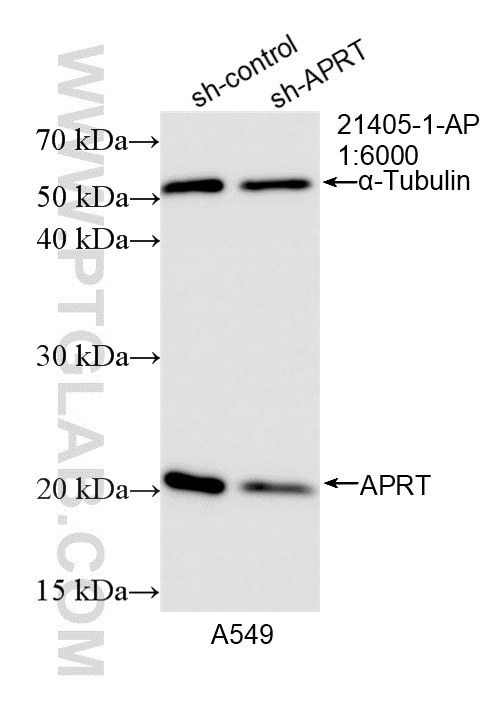



Tested Applications
| Positive WB detected in | A549 cells, A431 cells |
| Positive IF/ICC detected in | A549 cells |
Recommended dilution
| Application | Dilution |
|---|---|
| Western Blot (WB) | WB : 1:500-1:1000 |
| Immunofluorescence (IF)/ICC | IF/ICC : 1:200-1:800 |
| It is recommended that this reagent should be titrated in each testing system to obtain optimal results. | |
| Sample-dependent, Check data in validation data gallery. | |
Product Information
21405-1-AP targets APRT in WB, IF/ICC, ELISA applications and shows reactivity with human samples.
| Tested Reactivity | human |
| Cited Reactivity | human, mouse, rat |
| Host / Isotype | Rabbit / IgG |
| Class | Polyclonal |
| Type | Antibody |
| Immunogen |
CatNo: Ag16119 Product name: Recombinant human APRT protein Source: e coli.-derived, PGEX-4T Tag: GST Domain: 1-180 aa of BC106894 Sequence: MADSELQLVEQRIRSFPDFPTPGVVFRDISPVLKDPASFRAAIGLLARHLKATHGGRIDYIAGLDSRGFLFGPSLAQELGLGCVLIRKRGKLPGPTLWASYSLEYGKAELEIQKDALEPGQRVVVVDDLLATGGTMNAACELLGRLQAEVLECVSLVELTSLKGREKLAPVPFFSLLQYE Predict reactive species |
| Full Name | adenine phosphoribosyltransferase |
| Calculated Molecular Weight | 180 aa, 20 kDa |
| Observed Molecular Weight | 20 kDa |
| GenBank Accession Number | BC106894 |
| Gene Symbol | APRT |
| Gene ID (NCBI) | 353 |
| RRID | AB_10888630 |
| Conjugate | Unconjugated |
| Form | Liquid |
| Purification Method | Antigen affinity purification |
| UNIPROT ID | P07741 |
| Storage Buffer | PBS with 0.02% sodium azide and 50% glycerol, pH 7.3. |
| Storage Conditions | Store at -20°C. Stable for one year after shipment. Aliquoting is unnecessary for -20oC storage. 20ul sizes contain 0.1% BSA. |
Protocols
| Product Specific Protocols | |
|---|---|
| IF protocol for APRT antibody 21405-1-AP | Download protocol |
| WB protocol for APRT antibody 21405-1-AP | Download protocol |
| Standard Protocols | |
|---|---|
| Click here to view our Standard Protocols |
Publications
What published studies show
The APRT Polyclonal antibody (Cat# 21405-1-AP) has 6 total citations. These appear in Cell Metabolism, Nature Communications, Frontiers in Cell and Developmental Biology, Chemical Biology and Interactions, Journal of Molecular Medicine, and Kidney360. Research fields span purine metabolism, innate immunity, glioblastoma chemoresistance, liver urate production, hyperuricemia, and kidney injury.
| Species | Application | Title |
|---|---|---|
Nat Commun Hypoxanthine phosphoribosyl transferase 1 metabolizes temozolomide to activate AMPK for driving chemoresistance of glioblastomas
| ||
Front Cell Dev Biol Thyroid Hormone-Regulated Expression of Period2 Promotes Liver Urate Production. | ||
Chem Biol Interact Mechanistic insights into metformin's anti-hyperuricemic effect: Targeting PPP/DNPB/XOD-mediated purine pathway, purinosome assembly, and gut microbiota homostasis in rats. | ||
J Mol Med (Berl) 2,8-Dihydroxyadenine disrupts epithelial integrity and alters kidney cell phenotype in vitro. | ||
Kidney360 2,8-Dihydroxyadenine Crystal Nephropathy and Mediators of Kidney Injury in Adenine Phosphoribosyltransferase Deficiency. |


