



Tested Applications
| Positive WB detected in | mouse brain tissue, RAW264.7, PC-12 cells, rat brain tissue |
| Positive IP detected in | mouse brain tissue |
| Positive IHC detected in | human tonsil tissue, human malignant melanoma tissue, human colon cancer tissue, human spleen tissue Note: suggested antigen retrieval with TE buffer pH 9.0; (*) Alternatively, antigen retrieval may be performed with citrate buffer pH 6.0 |
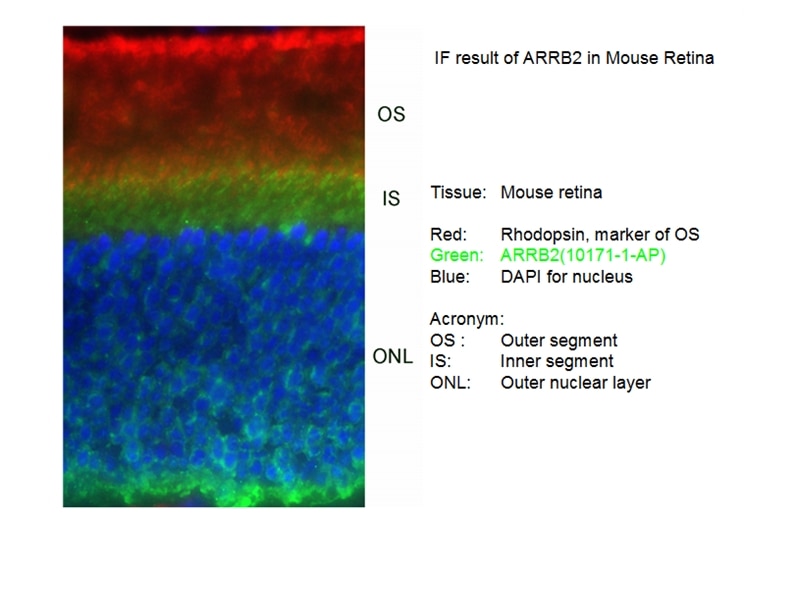
| Positive IF/ICC detected in | HeLa cells, mouse Retina tissue |
Recommended dilution
| Application | Dilution |
|---|---|
| Western Blot (WB) | WB : 1:500-1:2000 |
| Immunoprecipitation (IP) | IP : 0.5-4.0 ug for 1.0-3.0 mg of total protein lysate |
| Immunohistochemistry (IHC) | IHC : 1:50-1:500 |
| Immunofluorescence (IF)/ICC | IF/ICC : 1:200-1:800 |
| It is recommended that this reagent should be titrated in each testing system to obtain optimal results. | |
| Sample-dependent, Check data in validation data gallery. | |
Product Information
10171-1-AP targets Beta Arrestin 2 in WB, IHC, IF/ICC, IP, CoIP, ELISA applications and shows reactivity with human, mouse, rat samples.
| Tested Reactivity | human, mouse, rat |
| Cited Reactivity | human, mouse, rat, hamster, xenopus |
| Host / Isotype | Rabbit / IgG |
| Class | Polyclonal |
| Type | Antibody |
| Immunogen |
CatNo: Ag0227 Product name: Recombinant human Beta Arrestin 2 protein Source: e coli.-derived, PGEX-4T Tag: GST Domain: 163-409 aa of BC007427 Sequence: NSVRLVIRKVQFAPEKPGPQPSAETTRHFLMSDRSLHLEASLDKELYYHGEPLNVNVHVTNNSTKTVKKIKVSVRQYADICLFSTAQYKCPVAQLEQDDQVSPSSTFCKVYTITPLLSDNREKRGLALDGKLKHEDTNLASSTIVKEGANKEVLGILVSYRVKVKLVVSRGGDVSVELPFVLMHPKPHDHIPLPRPQSAAPETDVPVDTNLIEFDTNYATDDDIVFEDFARLRLKGMKDDDYDDQLC Predict reactive species |
| Full Name | arrestin, beta 2 |
| Calculated Molecular Weight | 46 kDa |
| Observed Molecular Weight | 50 kDa |
| GenBank Accession Number | BC007427 |
| Gene Symbol | Beta Arrestin 2 |
| Gene ID (NCBI) | 409 |
| RRID | AB_10644158 |
| Conjugate | Unconjugated |
| Form | Liquid |
| Purification Method | Antigen affinity purification |
| UNIPROT ID | P32121 |
| Storage Buffer | PBS with 0.02% sodium azide and 50% glycerol, pH 7.3. |
| Storage Conditions | Store at -20°C. Stable for one year after shipment. Aliquoting is unnecessary for -20oC storage. 20ul sizes contain 0.1% BSA. |
Background Information
Beta Arrestin 2 is a member of arrestin/beta-arrestin protein family, which are expressed at high levels in the central nervous system (CNS) and play a critical role in the regulation of G-protein coupled receptors (GPCRs) including MOR. Beta Arrestin 2 is an adaptor protein that is important for the regulation of receptors belonging to both dopaminergic and opioid systems. Besides the brain, a cDNA for arrestin beta 2 was isolated from thyroid gland, and thus it may also be involved in hormone-specific desensitization of TSH receptors.
Protocols
| Product Specific Protocols | |
|---|---|
| IF protocol for Beta Arrestin 2 antibody 10171-1-AP | Download protocol |
| IHC protocol for Beta Arrestin 2 antibody 10171-1-AP | Download protocol |
| IP protocol for Beta Arrestin 2 antibody 10171-1-AP | Download protocol |
| WB protocol for Beta Arrestin 2 antibody 10171-1-AP | Download protocol |
| Standard Protocols | |
|---|---|
| Click here to view our Standard Protocols |
Publications
What published studies show
I'll search for the citations for catalog number 10171-1-AP.Here are the citation details for Beta Arrestin 2 Polyclonal antibody (10171-1-AP):
Antibody: Beta Arrestin 2 (ARRB2) Polyclonal antibody
Catalog No.: 10171-1-AP
Total citations: 46
Journals: Cell, Nature Communications, Molecular Cell, Journal of Clinical Investigation, Autophagy, J Nanobiotechnology, Acta Pharm Sin B, Science Advances, Cell Reports Medicine, Cell Death & Differentiation, Biomaterials, Cell Death & Disease, J Neuroinflammation, J Pharm Anal, Leukemia, Cell Reports, Cell Chemical Biology, Frontiers in Immunology, J Cell Biology, Journal of Neurochemistry (via Neuropharmacology), PLoS One, and others.
Research fields: GPCR signaling and β-arrestin biology, cancer (prostate, colorectal, pancreatic, bladder), neurology (Parkinson's, depression, neuroprotection), kidney disease (diabetic nephropathy, fibrosis, acute kidney injury), cardiovascular disease, immunology/inflammation, and drug-resistance mechanisms.
| Species | Application | Title |
|---|---|---|
Nat Commun Gα(q) activation of free fatty acid receptor 4 suppresses metabolic dysfunction by disrupting Nr1h3-PPARγ axis. | ||
Mol Cell Dopamine Uses the DRD5-ARRB2-PP2A Signaling Axis to Block the TRAF6-Mediated NF-κB Pathway and Suppress Systemic Inflammation.
| ||
J Nanobiotechnology FNDC5/irisin-enriched sEVs conjugated with bone-targeting aptamer alleviate osteoporosis: a potential alternative to exercise
| ||
Acta Pharm Sin B Free fatty acid receptor-4 regulates T-cell-mediated allogeneic reaction through activating an aryl hydrocarbon receptor pathway |


