
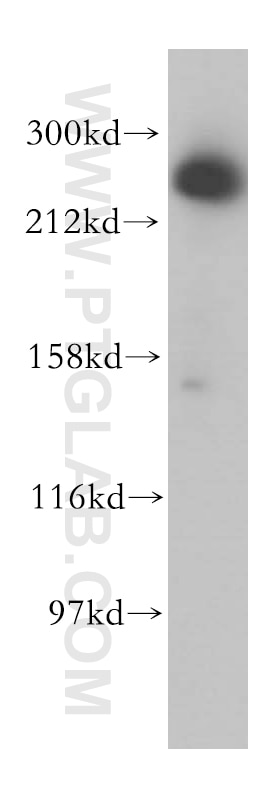
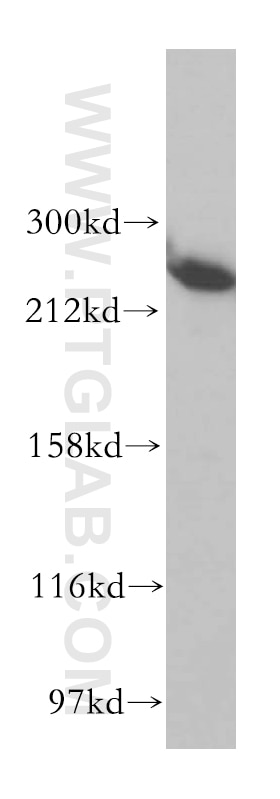
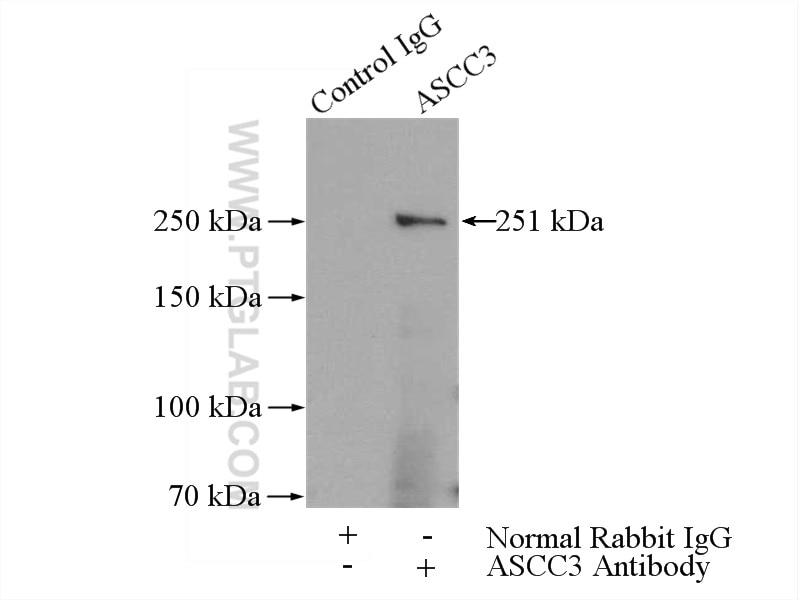

Tested Applications
| Positive WB detected in | HeLa cells, HepG2 cells |
| Positive IP detected in | HeLa cells |
Recommended dilution
| Application | Dilution |
|---|---|
| Western Blot (WB) | WB : 1:500-1:2400 |
| Immunoprecipitation (IP) | IP : 0.5-4.0 ug for 1.0-3.0 mg of total protein lysate |
| It is recommended that this reagent should be titrated in each testing system to obtain optimal results. | |
| Sample-dependent, Check data in validation data gallery. | |
Product Information
17627-1-AP targets ASCC3 in WB, IF, IP, ELISA applications and shows reactivity with human samples.
| Tested Reactivity | human |
| Cited Reactivity | human, mouse |
| Host / Isotype | Rabbit / IgG |
| Class | Polyclonal |
| Type | Antibody |
| Immunogen |
CatNo: Ag11848 Product name: Recombinant human ASCC3 protein Source: e coli.-derived, PGEX-4T Tag: GST Domain: 1-111 aa of BC050681 Sequence: MALPRLTGALRSFSNVTKQDNYNEEVADLKIKRSKLHEQVLDLGLTWKKIIKFLNEKLEKSKMQSINEDLKDILHAAKQIEVNCPFQKRRLDGKEEDEKMSRASDRFRGLR Predict reactive species |
| Full Name | activating signal cointegrator 1 complex subunit 3 |
| Calculated Molecular Weight | 111 aa, 13 kDa, 251 kDa |
| Observed Molecular Weight | 251 kDa |
| GenBank Accession Number | BC050681 |
| Gene Symbol | ASCC3 |
| Gene ID (NCBI) | 10973 |
| RRID | AB_2059474 |
| Conjugate | Unconjugated |
| Form | Liquid |
| Purification Method | Antigen affinity purification |
| UNIPROT ID | Q8N3C0 |
| Storage Buffer | PBS with 0.02% sodium azide and 50% glycerol, pH 7.3. |
| Storage Conditions | Store at -20°C. Stable for one year after shipment. Aliquoting is unnecessary for -20oC storage. 20ul sizes contain 0.1% BSA. |
Background Information
ASCC3 (Activating Signal Cointegrator 1 Complex Subunit 3) is a multifunctional protein involved in various cellular processes, including transcriptional regulation, DNA repair, and ribosome quality control. It is a member of the ASCC (Activating Signal Cointegrator 1 Complex) family, which functions as a bridge between co-repressors and co-activators in transcriptional regulation.
Protocols
| Product Specific Protocols | |
|---|---|
| IP protocol for ASCC3 antibody 17627-1-AP | Download protocol |
| WB protocol for ASCC3 antibody 17627-1-AP | Download protocol |
| Standard Protocols | |
|---|---|
| Click here to view our Standard Protocols |
Publications
What published studies show
The ASCC3 Polyclonal antibody (Cat# 17627-1-AP) has 12 citations. These appear in journals including Nature Communications, Cell Metabolism, Molecular Cell, Nucleic Acids Research, EMBO Journal, Cell Reports, Scientific Reports, and bioRxiv. The research fields span ribosome quality control, translation regulation, replication stress responses, and cancer biology—including lung adenocarcinoma and colorectal cancer. Applications cited are primarily Western blot, with several also using immunoprecipitation and immunofluorescence, across human and mouse species.
| Species | Application | Title |
|---|---|---|
Cell Metab Ribosome stalling is a signal for metabolic regulation by the ribotoxic stress response | ||
Nat Commun Extended DNA threading through a dual-engine motor module of the activating signal co-integrator 1 complex | ||
Nat Commun Stalled translation by mitochondrial stress upregulates a CNOT4-ZNF598 ribosomal quality control pathway important for tissue homeostasis | ||
Mol Cell Unresolved stalled ribosome complexes restrict cell-cycle progression after genotoxic stress. | ||
Nucleic Acids Res Ribosome Quality Control mitigates the cytotoxicity of ribosome collisions induced by 5-Fluorouracil |
Reviews
What customers say
Able is busy answering your previous question. Please try again later.
The reviews below have been submitted by verified Proteintech customers who received an incentive for providing their feedback.
Tom (Verified Customer) (10-24-2023) | (Already in contact with technical support, but was asked to submit a review here as well.) Immunoblotting for ASCC3 from fresh cell extracts did not work. Included samples of ASCC3-KD (siRNA) experiment, but only unspecific bands. Tested 1:1000 and 1:500 dilution. Tested different protein extraction buffers and conditions, used fresh cells each time. Transfer of large proteins was confirmed. Sadly, for us this antibody did not work.
|

