
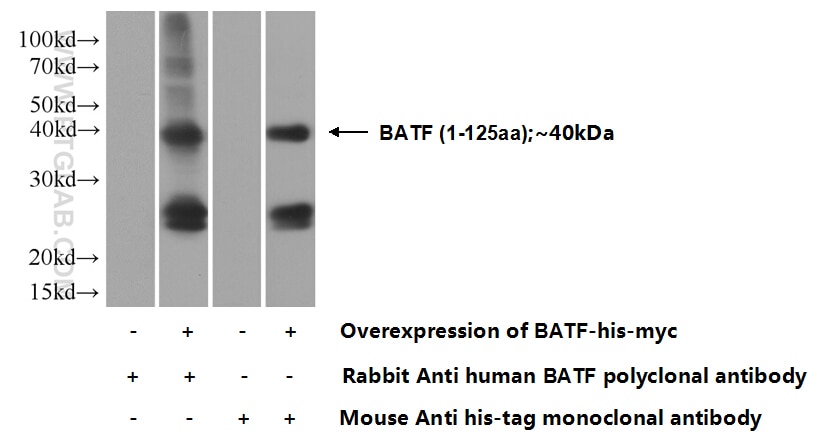
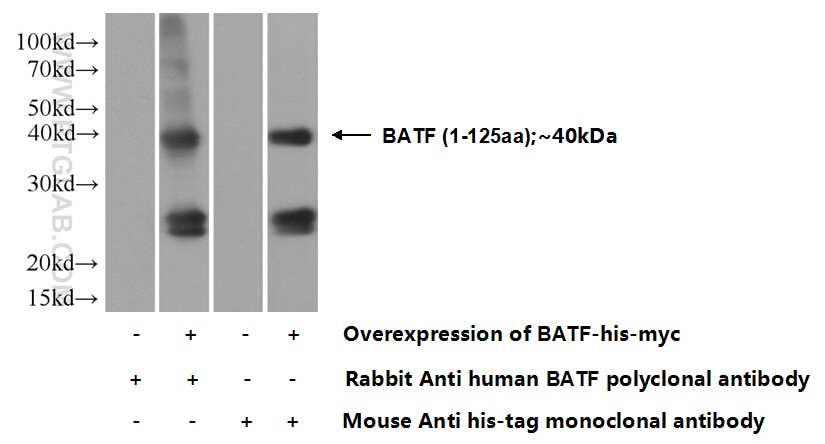
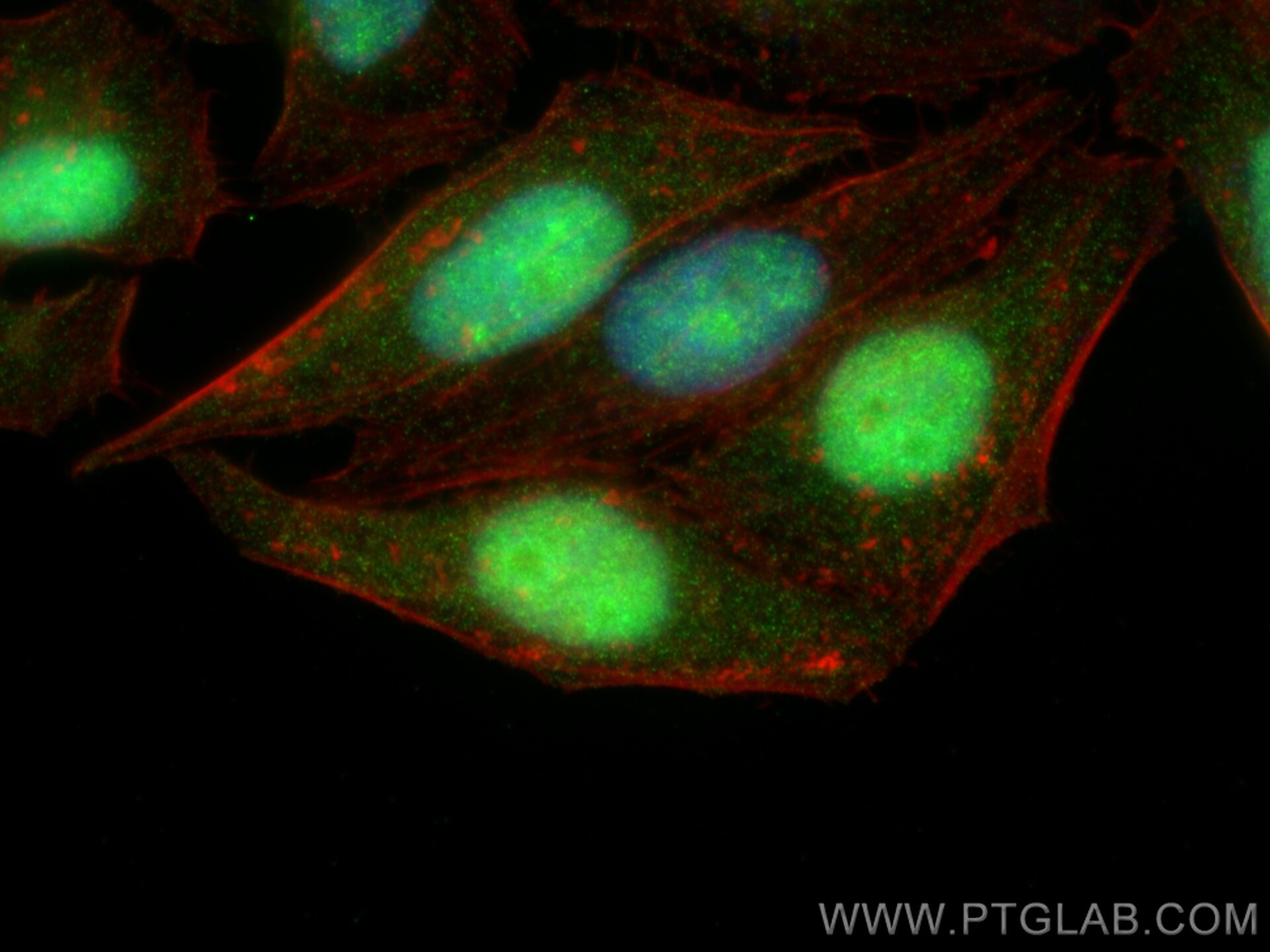

Tested Applications
| Positive IF/ICC detected in | HepG2 cells |
Recommended dilution
| Application | Dilution |
|---|---|
| Immunofluorescence (IF)/ICC | IF/ICC : 1:200-1:800 |
| It is recommended that this reagent should be titrated in each testing system to obtain optimal results. | |
| Sample-dependent, Check data in validation data gallery. | |
Product Information
13507-1-AP targets BATF in WB, IF/ICC, ELISA applications and shows reactivity with human, mouse, rat samples.
| Tested Reactivity | human, mouse, rat |
| Cited Reactivity | human, mouse, rat |
| Host / Isotype | Rabbit / IgG |
| Class | Polyclonal |
| Type | Antibody |
| Immunogen |
CatNo: Ag4418 Product name: Recombinant human BATF protein Source: e coli.-derived, PGEX-4T Tag: GST Domain: 1-125 aa of BC032294 Sequence: MPHSSDSSDSSFSRSPPPGKQDSSDDVRRVQRREKNRIAAQKSRQRQTQKADTLHLESEDLEKQNAALRKEIKQLTEELKYFTSVLNSHEPLCSVLAASTPSPPEVVYSAHAFHQPHVSSPRFQP Predict reactive species |
| Full Name | basic leucine zipper transcription factor, ATF-like |
| Calculated Molecular Weight | 125 aa, 14 kDa |
| GenBank Accession Number | BC032294 |
| Gene Symbol | BATF |
| Gene ID (NCBI) | 10538 |
| RRID | AB_10598158 |
| Conjugate | Unconjugated |
| Form | Liquid |
| Purification Method | Antigen affinity purification |
| UNIPROT ID | Q16520 |
| Storage Buffer | PBS with 0.02% sodium azide and 50% glycerol, pH 7.3. |
| Storage Conditions | Store at -20°C. Stable for one year after shipment. Aliquoting is unnecessary for -20oC storage. 20ul sizes contain 0.1% BSA. |
Background Information
basic leucine zipper transcription factor (BATF), also named B-cell-activating transcription factor, SF-HT-activated gene 2 protein. AP-1 family transcription factor that controls the differentiation of lineage-specific cells in the immune system: specifically mediates the differentiation of T-helper 17 cells (Th17), follicular T-helper cells (TfH), CD8(+) dendritic cells and class-switch recombination (CSR) in B-cells. Acts via the formation of a heterodimer with JUNB that recognizes and binds DNA sequence 5'-TGA[CG]TCA-3'. The BATF-JUNB heterodimer also forms a complex with IRF4 (or IRF8) in immune cells, leading to recognition of AICE sequence (5'-TGAnTCA/GAAA-3'), an immune-specific regulatory element, followed by cooperative binding of BATF and IRF4 (or IRF8) and activation of genes. Controls differentiation of T-helper cells producing interleukin-17 (Th17 cells) by binding to Th17-associated gene promoters: regulates expression of the transcription factor RORC itself and RORC target genes such as IL17 (IL17A or IL17B). Also involved in differentiation of follicular T-helper cells (TfH) by directing expression of BCL6 and MAF. In B-cells, involved in class-switch recombination (CSR) by controlling the expression of both AICDA and of germline transcripts of the intervening heavy-chain region and constant heavy-chain region (I(H)-C(H)). Following infection, can participate to CD8(+) dendritic cell differentiation via interaction with IRF4 and IRF8 to mediate cooperative gene activation. Regulates effector CD8(+) T-cell differentiation by regulating expression of SIRT1. Following DNA damage, part of a differentiation checkpoint that limits self-renewal of hematopoietic stem cells (HSCs): up-regulated by STAT3, leading to differentiation of HSCs, thereby restricting self-renewal of HSCs. The molecular mass of BATF is 14kd.
Protocols
| Product Specific Protocols | |
|---|---|
| IF protocol for BATF antibody 13507-1-AP | Download protocol |
| WB protocol for BATF antibody 13507-1-AP | Download protocol |
| Standard Protocols | |
|---|---|
| Click here to view our Standard Protocols |
Publications
What published studies show
The BATF Polyclonal antibody (catalog #13507-1-AP) has 5 total citations, all using Western blot. They appear in Cancer Cell (IF 56.1), Life Sciences (6.4), Toxicology (5.2), Biochemical and Biophysical Research Communications (2.5), and Regulatory Peptides (2.06). The research fields span cancer immunology (tumor-initiating cell immune privilege, colorectal cancer prognosis), gastrointestinal inflammation (Helicobacter pylori gastritis and macrophage polarization), toxicology (erythroid differentiation inhibition), and immunology/signaling (Th17 development regulation).
| Species | Application | Title |
|---|---|---|
Cancer Cell Targeting the immune privilege of tumor-initiating cells to enhance cancer immunotherapy | ||
Life Sci Berberine regulates macrophage polarization through IL-4-STAT6 signaling pathway in Helicobacter pylori-induced chronic atrophic gastritis. | ||
Toxicology c-Jun targets miR-451a to regulate HQ-induced inhibition of erythroid differentiation via the BATF/SETD5/ARHGEF3 axis. | ||
Biochem Biophys Res Commun Prognostic significance of BATF family genes and correlation with immune infiltration in colorectal cancer
| ||
Regul Pept Atrial natriuretic peptide suppresses Th17 development through regulation of cGMP-dependent protein kinase and PI3K-Akt signaling pathways. |

