



Tested Applications
| Positive WB detected in | mouse testis tissue |
| Positive IP detected in | mouse testis tissue |
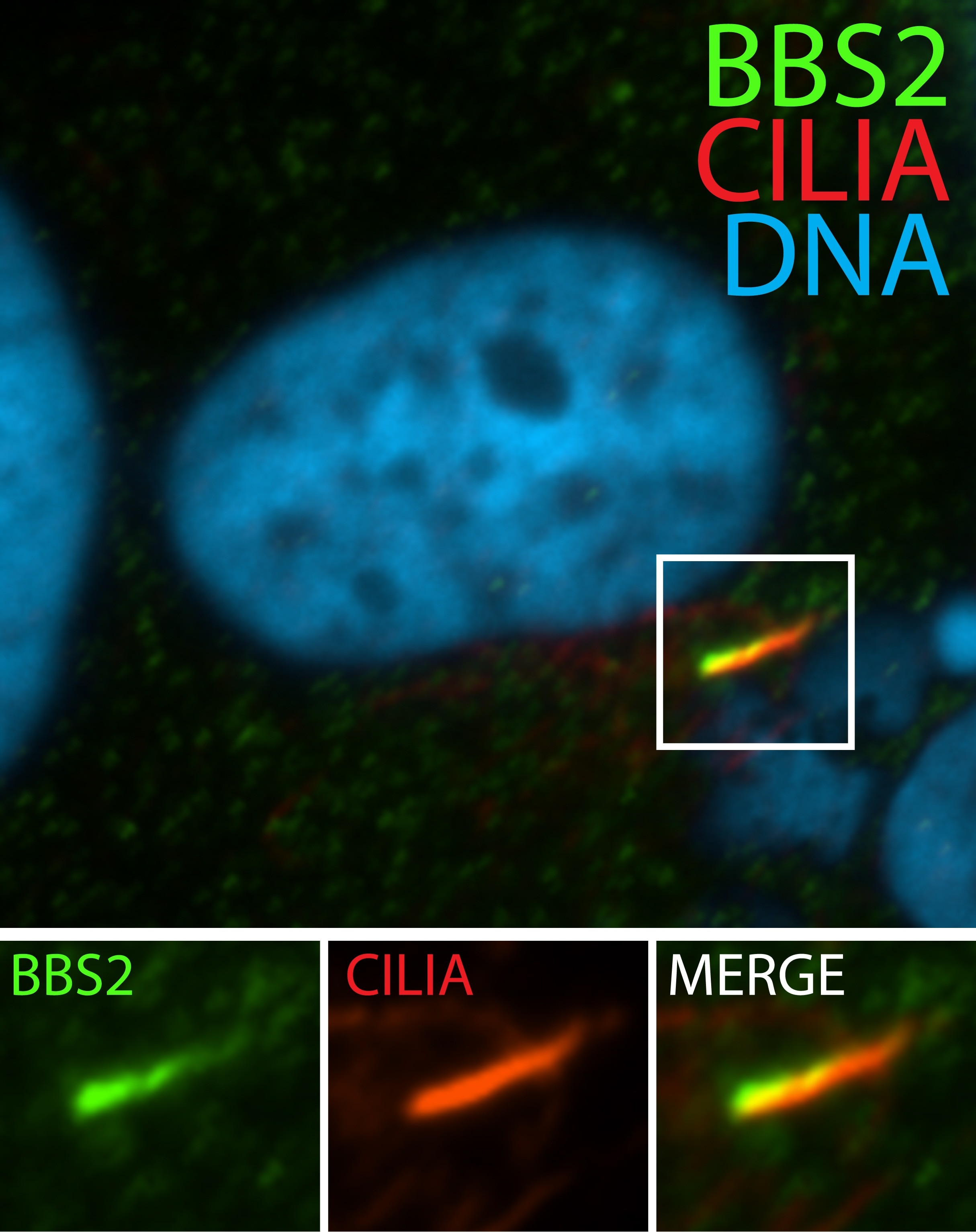
| Positive IF/ICC detected in | hTERT-RPE1 cells |
Recommended dilution
| Application | Dilution |
|---|---|
| Western Blot (WB) | WB : 1:500-1:3000 |
| Immunoprecipitation (IP) | IP : 0.5-4.0 ug for 1.0-3.0 mg of total protein lysate |
| Immunofluorescence (IF)/ICC | IF/ICC : 1:20-1:200 |
| It is recommended that this reagent should be titrated in each testing system to obtain optimal results. | |
| Sample-dependent, Check data in validation data gallery. | |
Product Information
11188-2-AP targets BBS2 in WB, IHC, IF/ICC, IP, ELISA applications and shows reactivity with human, mouse, rat samples.
| Tested Reactivity | human, mouse, rat |
| Cited Reactivity | human, mouse, rat |
| Host / Isotype | Rabbit / IgG |
| Class | Polyclonal |
| Type | Antibody |
| Immunogen |
CatNo: Ag1662 Product name: Recombinant human BBS2 protein Source: e coli.-derived, PGEX-4T Tag: GST Domain: 1-325 aa of BC014140 Sequence: MLLPVFTLKLRHKISPRMVAIGRYDGTHPCLAAATQTGKVFIHNPHTRNQHVSASRVFQSPLESDVSLLNINQAVSCLTAGVLNPELGYDALLVGTQTNLLAYDVYNNSDLFYREVADGANVVVLGTLGDISSPLAIIGGNCALQGFNHEGSDLFWTVTGDNVNSLALCDFDGDGKKELLVGSEDFDIRVFKEDEIVAEMTETEIVTSLCPMYGSRFGYALSNGTVGVYDKTSRYWRIKSKNHAMSIHAFDLNSDGVNELITGWSNGKVDARSDRTGEVIFKDNFSSAIAGVVEGDYRMDGHIQLICCSVDGEIRGYLPGTAEMR Predict reactive species |
| Full Name | Bardet-Biedl syndrome 2 |
| Calculated Molecular Weight | 80 kDa |
| Observed Molecular Weight | 80 kDa |
| GenBank Accession Number | BC014140 |
| Gene Symbol | BBS2 |
| Gene ID (NCBI) | 583 |
| RRID | AB_2064971 |
| Conjugate | Unconjugated |
| Form | Liquid |
| Purification Method | Antigen affinity purification |
| UNIPROT ID | Q9BXC9 |
| Storage Buffer | PBS with 0.02% sodium azide and 50% glycerol, pH 7.3. |
| Storage Conditions | Store at -20°C. Stable for one year after shipment. Aliquoting is unnecessary for -20oC storage. 20ul sizes contain 0.1% BSA. |
Background Information
BBS2 is one of seven BBS proteins that form the stable core of a protein complex (BBSome complex, 438kd) which is required for ciliogenesis but is dispensable for centriolar satellite function.
Protocols
| Product Specific Protocols | |
|---|---|
| IP protocol for BBS2 antibody 11188-2-AP | Download protocol |
| WB protocol for BBS2 antibody 11188-2-AP | Download protocol |
| Standard Protocols | |
|---|---|
| Click here to view our Standard Protocols |
Publications
What published studies show
The BBS2 Polyclonal antibody (Cat# 11188-2-AP) has 17 citations spanning journals including Cell, Cell Stem Cell, PLoS Biology, J Cell Biol, FASEB J, PLoS Genetics, Sci Rep, Hum Mol Genet, Mol Biol Cell, and others. Research fields covered include cilia biology, Bardet-Biedl syndrome, Hedgehog signaling, intraflagellar transport, retinal degeneration, obesity/energy homeostasis, neural stem cell biology, polycystic kidney disease, and cochlear function. Applications cited include IF, WB, and IHC in human, mouse, and rat samples.
| Species | Application | Title |
|---|---|---|
Cell The conserved Bardet-Biedl syndrome proteins assemble a coat that traffics membrane proteins to cilia. | ||
Cell Stem Cell Asymmetric segregation of the double-stranded RNA binding protein Staufen2 during mammalian neural stem cell divisions promotes lineage progression. | ||
PLoS Biol Melanocortin 1 receptor mediates melanin production by interacting with the BBSome in primary cilia | ||
J Cell Biol Ubiquitin links smoothened to intraflagellar transport to regulate Hedgehog signaling. | ||
Invest Ophthalmol Vis Sci Essential Role of the Chaperonin CCT in Rod Outer Segment Biogenesis. | ||
Function (Oxf) POMC Neuron BBSome Regulation of Body Weight is Independent of its Ciliary Function
|
Reviews
What customers say
Able is busy answering your previous question. Please try again later.
The reviews below have been submitted by verified Proteintech customers who received an incentive for providing their feedback.
Deng (Verified Customer) (07-30-2019) | This antibody stained primary cilia in cultured IMCD3 cells.
 |


