

Tested Applications
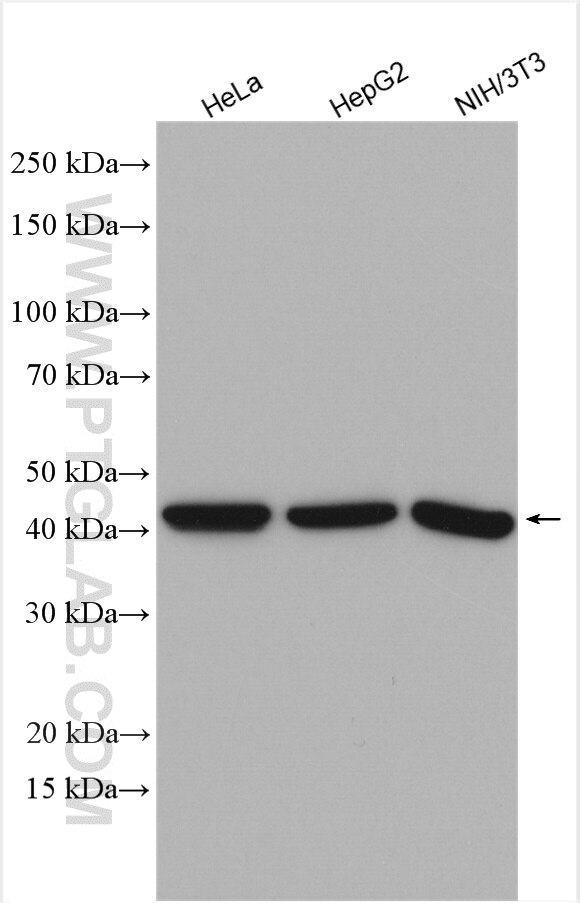
| Positive WB detected in | HeLa cells, HepG2 cells, NIH/3T3 cells |
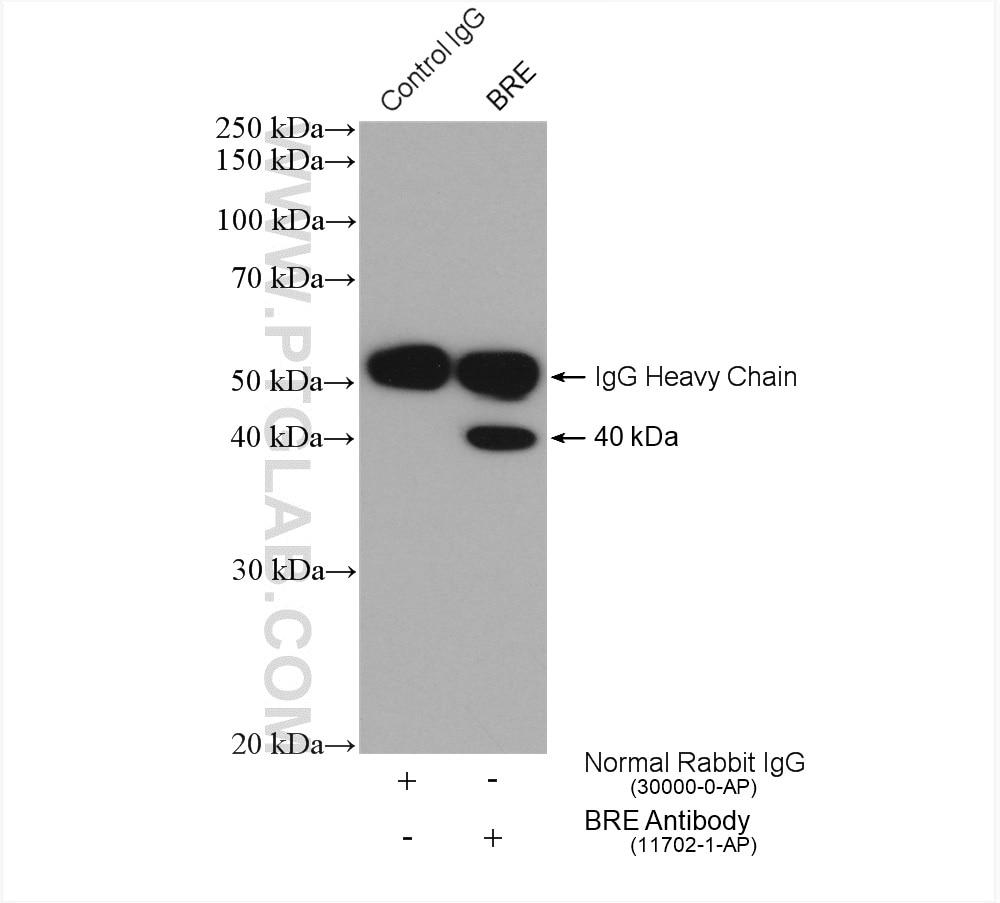
| Positive IP detected in | HeLa cells |
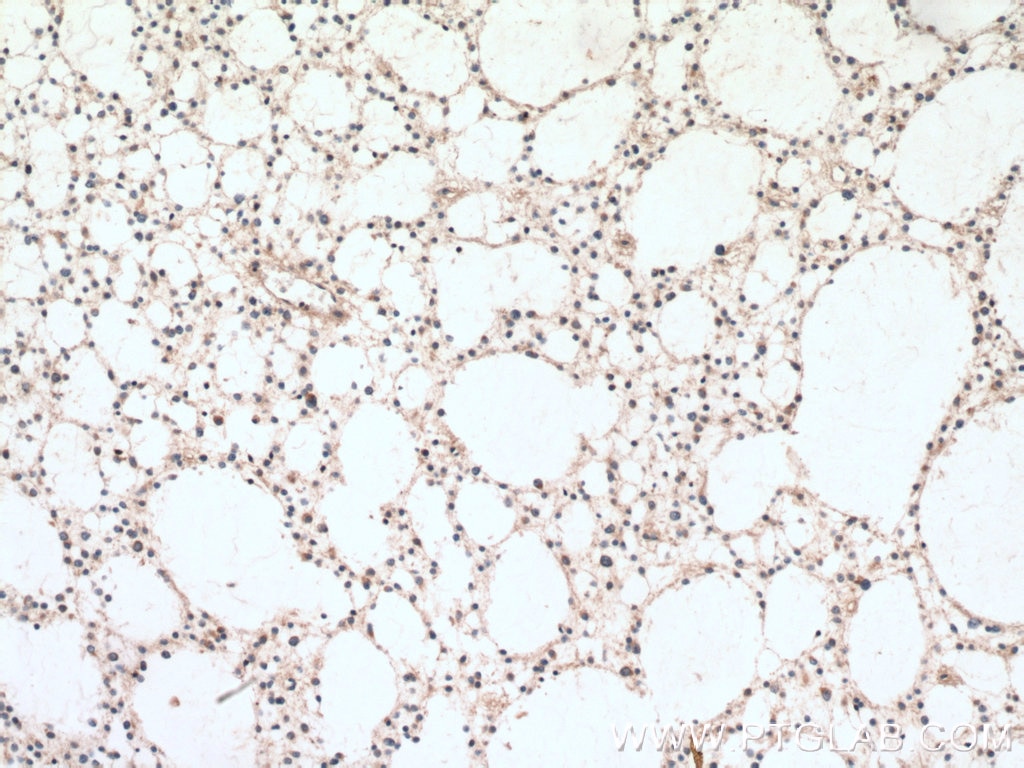
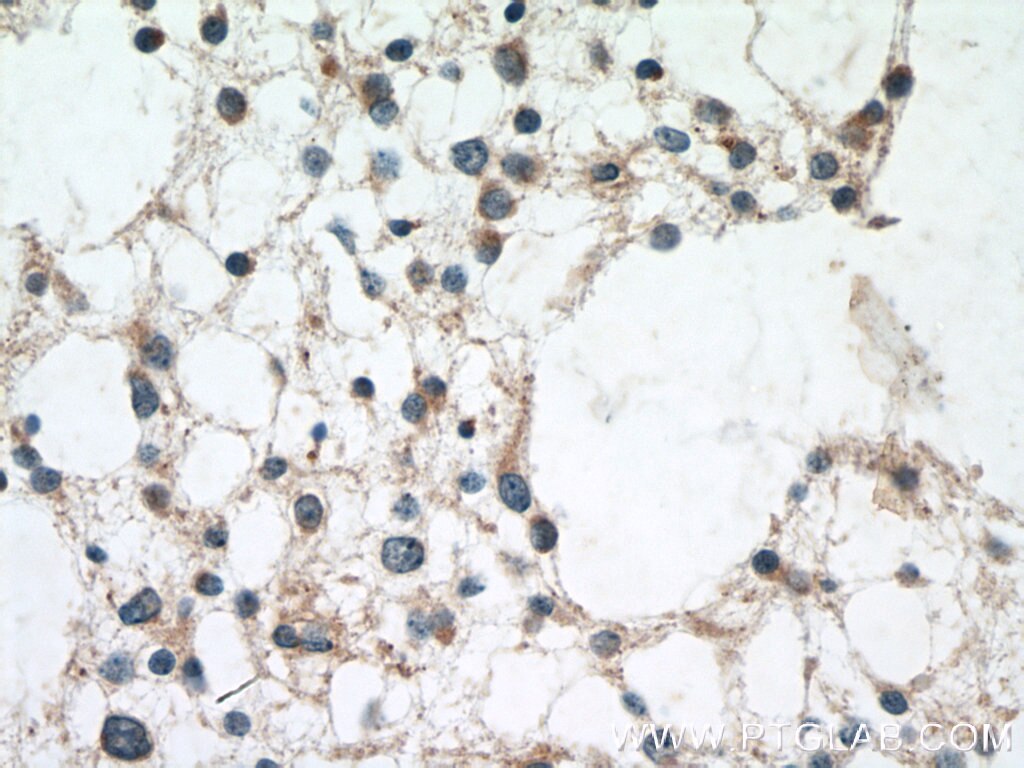
| Positive IHC detected in | human gliomas tissue Note: suggested antigen retrieval with TE buffer pH 9.0; (*) Alternatively, antigen retrieval may be performed with citrate buffer pH 6.0 |
Recommended dilution
| Application | Dilution |
|---|---|
| Western Blot (WB) | WB : 1:500-1:3000 |
| Immunoprecipitation (IP) | IP : 0.5-4.0 ug for 1.0-3.0 mg of total protein lysate |
| Immunohistochemistry (IHC) | IHC : 1:50-1:500 |
| It is recommended that this reagent should be titrated in each testing system to obtain optimal results. | |
| Sample-dependent, Check data in validation data gallery. | |
Product Information
11702-1-AP targets BRE in WB, IP, IHC, ELISA applications and shows reactivity with human, mouse samples.
| Tested Reactivity | human, mouse |
| Cited Reactivity | human |
| Host / Isotype | Rabbit / IgG |
| Class | Polyclonal |
| Type | Antibody |
| Immunogen |
CatNo: Ag2256 Product name: Recombinant human BRE protein Source: e coli.-derived, PGEX-4T Tag: GST Domain: 94-383 aa of BC001251 Sequence: PDPSALQNLASWNPSNPECLLLVVKELVQQYHQFQCSRLRESSRLMFEYQTLLEEPQYGENMEIYAGKKNNWTGEFSARFLLKLPVDFSNIPTYLLKDVNEDPGEDVALLSVSFEDTEATQVYPKLYLSPRIEHALGGSSALHIPAFPGGGCLIDYVPQVCHLLTNKVQYVIQGYHKRREYIAAFLSHFGTGVVEYDAEGFTKLTLLLMWKDFCFLVHIDLPLFFPRDQPTLTFQSVYHFTNSGQLYSQAQKNYPYSPRWDGNEMAKRAKAYFKTFVPQFQEAAFANGKL Predict reactive species |
| Full Name | brain and reproductive organ-expressed (TNFRSF1A modulator) |
| Calculated Molecular Weight | 383 aa, 44 kDa |
| Observed Molecular Weight | 40-44 kDa |
| GenBank Accession Number | BC001251 |
| Gene Symbol | BRE |
| Gene ID (NCBI) | 9577 |
| RRID | AB_2066049 |
| Conjugate | Unconjugated |
| Form | Liquid |
| Purification Method | Antigen affinity purification |
| UNIPROT ID | Q9NXR7 |
| Storage Buffer | PBS with 0.02% sodium azide and 50% glycerol, pH 7.3. |
| Storage Conditions | Store at -20°C. Stable for one year after shipment. Aliquoting is unnecessary for -20oC storage. 20ul sizes contain 0.1% BSA. |
Background Information
BRE, also named as BRCC45, is a death receptor-associated antiapoptotic protein, which is also involved in DNA-damage repair, and K63-specific deubiquitination. BRE and its XIAP-sustaining mechanism could represent novel targets for anti-cancer therapy. BRE may regulate TNF-alpha signaling through its interactions with TNFRSF1A. It plays a role in homeostasis or cellular differentiation in cells of neural, epithelial and germline origins. BRE gene has four isoforms with MW 42-47 kDa.
Protocols
| Product Specific Protocols | |
|---|---|
| IHC protocol for BRE antibody 11702-1-AP | Download protocol |
| IP protocol for BRE antibody 11702-1-AP | Download protocol |
| WB protocol for BRE antibody 11702-1-AP | Download protocol |
| Standard Protocols | |
|---|---|
| Click here to view our Standard Protocols |
Publications
What published studies show
The BRE Polyclonal antibody (Catalog No. 11702-1-AP) has 3 total citations. These appear in Molecular Cell, International Journal of Biological Sciences, and Genes & Development. The associated research fields include ubiquitin signaling, non-small cell lung cancer progression and antiapoptosis, and DNA damage resistance with checkpoint control. All cited applications were Western blot in human samples.
| Species | Application | Title |
|---|---|---|
Int J Biol Sci PPDPF Promotes the Progression and acts as an Antiapoptotic Protein in Non-Small Cell Lung Cancer. | ||
Genes Dev NBA1, a new player in the Brca1 A complex, is required for DNA damage resistance and checkpoint control. |

