
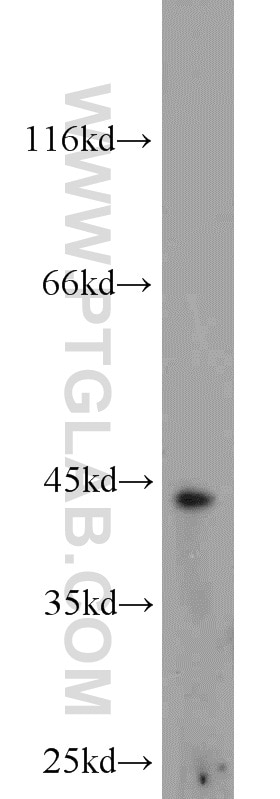
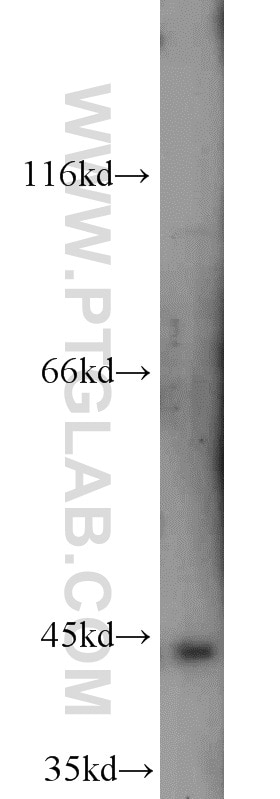

Tested Applications
| Positive WB detected in | mouse liver tissue |
Recommended dilution
| Application | Dilution |
|---|---|
| Western Blot (WB) | WB : 1:500-1:1000 |
| It is recommended that this reagent should be titrated in each testing system to obtain optimal results. | |
| Sample-dependent, Check data in validation data gallery. | |
Product Information
20741-1-AP targets TBXT in WB, IF, ELISA applications and shows reactivity with human, mouse samples.
| Tested Reactivity | human, mouse |
| Cited Reactivity | human |
| Host / Isotype | Rabbit / IgG |
| Class | Polyclonal |
| Type | Antibody |
| Immunogen |
Peptide Predict reactive species |
| Full Name | T, brachyury homolog (mouse) |
| Calculated Molecular Weight | 47 kDa |
| Observed Molecular Weight | 44 kDa |
| GenBank Accession Number | NM_003181 |
| Gene Symbol | TBXT |
| Gene ID (NCBI) | 6862 |
| RRID | AB_2878730 |
| Conjugate | Unconjugated |
| Form | Liquid |
| Purification Method | Antigen affinity purification |
| UNIPROT ID | O15178 |
| Storage Buffer | PBS with 0.02% sodium azide and 50% glycerol, pH 7.3. |
| Storage Conditions | Store at -20°C. Stable for one year after shipment. Aliquoting is unnecessary for -20oC storage. 20ul sizes contain 0.1% BSA. |
Background Information
Brachyury T is involved in the transcriptional regulation of genes required for mesoderm formation and differentiation. It binds to a palindromic site (called T site) and activates gene transcription when bound to such a site. Genetic variations in T are associated with susceptibility to neural tube defects (NTD). The antibody is specific to Brachyury T.
Protocols
| Product Specific Protocols | |
|---|---|
| WB protocol for TBXT antibody 20741-1-AP | Download protocol |
| Standard Protocols | |
|---|---|
| Click here to view our Standard Protocols |
Publications
What published studies show
The TBXT (Brachyury T) polyclonal antibody (Cat# 20741-1-AP) has 1 total citation. It appears in Journal of Neurochemistry (IF 4.6), published in 2026. The cited study investigates how a TFG p.G269V mutation disrupts motor neuron function in iPSC-derived models through Wnt signaling dysregulation, placing this antibody's use in the fields of neurochemistry, stem cell biology, and developmental signaling pathways. The application used was immunofluorescence (IF) in human samples.
| Species | Application | Title |
|---|---|---|
J Neurochem TFG p.G269V Mutation Disrupts Motor Neuron Function in iPSC-Derived Models via Wnt Signaling Dysregulation. |

