
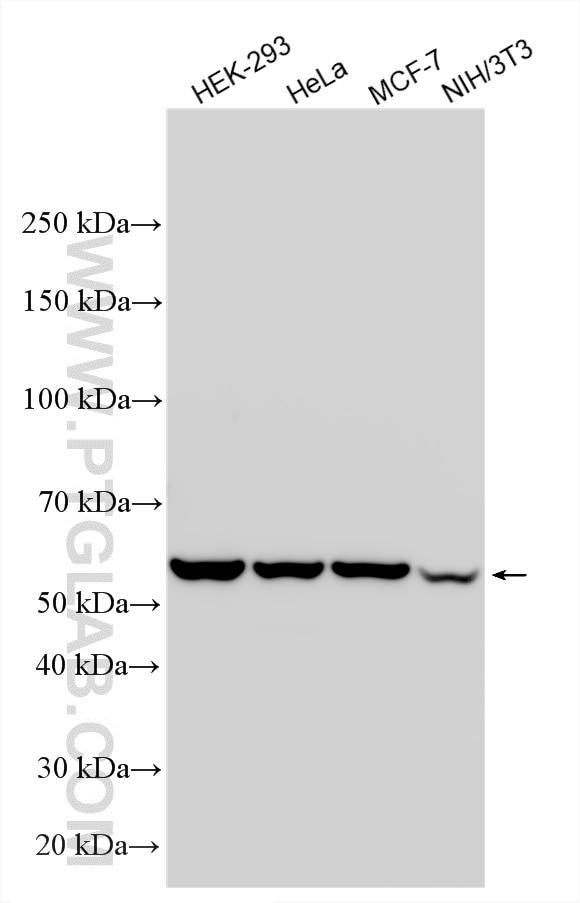



Tested Applications
| Positive WB detected in | HEK-293 cells, HeLa cells, MCF-7 cells, MDA-MB-231 cells, NIH/3T3 cells |
| Positive IP detected in | HEK-293 cells |
| Positive IF/ICC detected in | MCF-7 cells |
Recommended dilution
| Application | Dilution |
|---|---|
| Western Blot (WB) | WB : 1:5000-1:50000 |
| Immunoprecipitation (IP) | IP : 0.5-4.0 ug for 1.0-3.0 mg of total protein lysate |
| Immunofluorescence (IF)/ICC | IF/ICC : 1:400-1:1600 |
| It is recommended that this reagent should be titrated in each testing system to obtain optimal results. | |
| Sample-dependent, Check data in validation data gallery. | |
Product Information
15994-1-AP targets TCP1 eta in WB, IHC, IF/ICC, IP, CoIP, ELISA applications and shows reactivity with human, mouse, rat samples.
| Tested Reactivity | human, mouse, rat |
| Cited Reactivity | human, mouse, rat, chicken |
| Host / Isotype | Rabbit / IgG |
| Class | Polyclonal |
| Type | Antibody |
| Immunogen |
CatNo: Ag8868 Product name: Recombinant human CCT7 protein Source: e coli.-derived, PGEX-4T Tag: GST Domain: 240-543 aa of BC019296 Sequence: LNVELELKAEKDNAEIRVHTVEDYQAIVDAEWNILYDKLEKIHHSGAKVVLSKLPIGDVATQYFADRDMFCAGRVPEEDLKRTMMACGGSIQTSVNALSADVLGRCQVFEETQIGGERYNFFTGCPKAKTCTFILRGGAEQFMEETERSLHDAIMIVRRAIKNDSVVAGGGAIEMELSKYLRDYSRTIPGKQQLLIGAYAKALEIIPRQLCDNAGFDATNILNKLRARHAQGGTWYGVDINNEDIADNFEAFVWEPAMVRINALTAASEAACLIVSVDETIKNPRSTVDAPTAAGRGRGRGRPH Predict reactive species |
| Full Name | chaperonin containing TCP1, subunit 7 (eta) |
| Calculated Molecular Weight | 543 aa, 59 kDa |
| Observed Molecular Weight | 59 kDa |
| GenBank Accession Number | BC019296 |
| Gene Symbol | CCT7 |
| Gene ID (NCBI) | 10574 |
| RRID | AB_2073903 |
| Conjugate | Unconjugated |
| Form | Liquid |
| Purification Method | Antigen affinity purification |
| UNIPROT ID | Q99832 |
| Storage Buffer | PBS with 0.02% sodium azide and 50% glycerol, pH 7.3. |
| Storage Conditions | Store at -20°C. Stable for one year after shipment. Aliquoting is unnecessary for -20oC storage. 20ul sizes contain 0.1% BSA. |
Background Information
CCT7 is a subunit of CCT complex-a large cytosolic chaperonin complex composed of two hetero-oligomeric stacked rings able to interact with nascent polypeptides, which mediates protein folding in an ATP-dependent manner and prevents aggregation in eukaryotes. Each ring consists of eight different subunits (CCT1 to CCT8). CCT7 is involved in preventing aggregation of GPCRs and in regulating their expression, maturation, and transport to the cell surface.
Protocols
| Product Specific Protocols | |
|---|---|
| IF protocol for TCP1 eta antibody 15994-1-AP | Download protocol |
| IP protocol for TCP1 eta antibody 15994-1-AP | Download protocol |
| WB protocol for TCP1 eta antibody 15994-1-AP | Download protocol |
| Standard Protocols | |
|---|---|
| Click here to view our Standard Protocols |
Publications
What published studies show
I'll search for citations for the TCP1 eta Polyclonal antibody (15994-1-AP).The TCP1 eta Polyclonal antibody (catalog #15994-1-AP) has a total of 14 citations. It appears in several high-impact journals including Cell, Nature Communications, Molecular Cell, Journal of Clinical Investigation, Aging (Albany NY), Journal of Cellular and Molecular Medicine, Clinical Proteomics, Frontiers in Veterinary Science, Virology, Journal of Molecular Histology, and Medicine. The associated research fields include protein quality control and aggrephagy, aging and proteome profiling, RNA-protein complex biology, host-pathogen interactions and viral replication, DNA damage signaling, cilia/flagella studies, multiple sclerosis inflammation, and cancer biomarker studies—particularly hepatocellular carcinoma, lung adenocarcinoma, and colonic adenocarcinoma prognosis and immune infiltration.
| Species | Application | Title |
|---|---|---|
Cell Comprehensive human proteome profiles across a 50-year lifespan reveal aging trajectories and signatures | ||
Nat Commun Tick extracellular vesicles enable arthropod feeding and promote distinct outcomes of bacterial infection. | ||
Nat Commun Purification of cross-linked RNA-protein complexes by phenol-toluol extraction. | ||
Mol Cell FACS-based genome-wide CRISPR screens define key regulators of DNA damage signaling pathways |


