

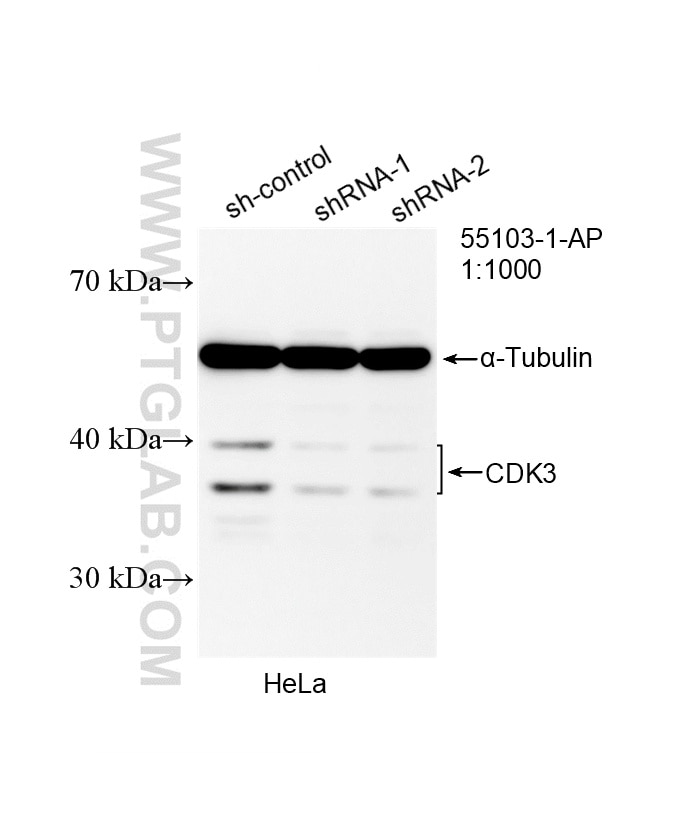



Tested Applications
| Positive WB detected in | mouse brain tissue, HeLa cells, Jurkat cells, MCF-7 cells, rat brain tissue |
| Positive IHC detected in | human breast cancer tissue Note: suggested antigen retrieval with TE buffer pH 9.0; (*) Alternatively, antigen retrieval may be performed with citrate buffer pH 6.0 |
| Positive IF/ICC detected in | HeLa cells |
| Positive FC (Intra) detected in | HeLa cells |
Recommended dilution
| Application | Dilution |
|---|---|
| Western Blot (WB) | WB : 1:1000-1:4000 |
| Immunohistochemistry (IHC) | IHC : 1:100-1:400 |
| Immunofluorescence (IF)/ICC | IF/ICC : 1:200-1:800 |
| Flow Cytometry (FC) (INTRA) | FC (INTRA) : 0.25 ug per 10^6 cells in a 100 ul suspension |
| It is recommended that this reagent should be titrated in each testing system to obtain optimal results. | |
| Sample-dependent, Check data in validation data gallery. | |
Product Information
55103-1-AP targets CDK3 in WB, IHC, IF/ICC, FC (Intra), ELISA applications and shows reactivity with human, mouse, rat samples.
| Tested Reactivity | human, mouse, rat |
| Cited Reactivity | human, mouse |
| Host / Isotype | Rabbit / IgG |
| Class | Polyclonal |
| Type | Antibody |
| Immunogen |
Peptide Predict reactive species |
| Full Name | cyclin-dependent kinase 3 |
| Calculated Molecular Weight | 35 kDa |
| Observed Molecular Weight | 40-45 kDa |
| GenBank Accession Number | NM_001258 |
| Gene Symbol | CDK3 |
| Gene ID (NCBI) | 1018 |
| RRID | AB_10804352 |
| Conjugate | Unconjugated |
| Form | Liquid |
| Purification Method | Antigen affinity purification |
| UNIPROT ID | Q00526 |
| Storage Buffer | PBS with 0.02% sodium azide and 50% glycerol, pH 7.3. |
| Storage Conditions | Store at -20°C. Stable for one year after shipment. Aliquoting is unnecessary for -20oC storage. 20ul sizes contain 0.1% BSA. |
Background Information
CDK3 belongs to the protein kinase superfamily, CMGC Ser/Thr protein kinase family and CDC2/CDKX subfamily. It is probably involved in the control of the cell cycle. CDK3 interacts with a yet unknown type of cyclin. It can phosphorylate histone H1. Endogenous Cyclin C/Cdk3 complexes are critical to promote exit from quiescence in an Rb-dependent manner. Cyclin C/Cdk3 complexes is a key regulators of cell cycle reentry in human cells. (PMID: 15130482 )The antibody is specific to CDK3.
Protocols
| Product Specific Protocols | |
|---|---|
| FC protocol for CDK3 antibody 55103-1-AP | Download protocol |
| IF protocol for CDK3 antibody 55103-1-AP | Download protocol |
| IHC protocol for CDK3 antibody 55103-1-AP | Download protocol |
| WB protocol for CDK3 antibody 55103-1-AP | Download protocol |
| Standard Protocols | |
|---|---|
| Click here to view our Standard Protocols |
Publications
What published studies show
The CDK3 Polyclonal antibody (55103-1-AP) has 6 citations. The citations appear in the following journals: Cell Death Discovery, Cell Chemical Biology, RSC Medicinal Chemistry, Cancer Medicine (two separate papers), and The Protein Journal. The associated research fields span oncology and cancer biology, including renal cancer proliferation, colon/colorectal cancer, osteosarcoma, and lung adenocarcinoma, as well as drug discovery (PROTAC degraders targeting CDK2/cyclin E and CDK8/cyclin C) and exosome protein profiling studies.
| Species | Application | Title |
|---|---|---|
Cell Death Discov Up-regulation of SLC27A2 suppresses the proliferation and invasion of renal cancer by down-regulating CDK3-mediated EMT. | ||
Cell Chem Biol CDK2 heterobifunctional degraders co-degrade CDK2 and cyclin E resulting in efficacy in CCNE1-amplified and overexpressed cancers | ||
RSC Med Chem Discovery of a potent dual-target CDK8 and cyclin C PROTAC degrader for the treatment of colorectal cancer. | ||
Cancer Med Identification of an EMT-related gene-based prognostic signature in osteosarcoma | ||


