

Tested Applications
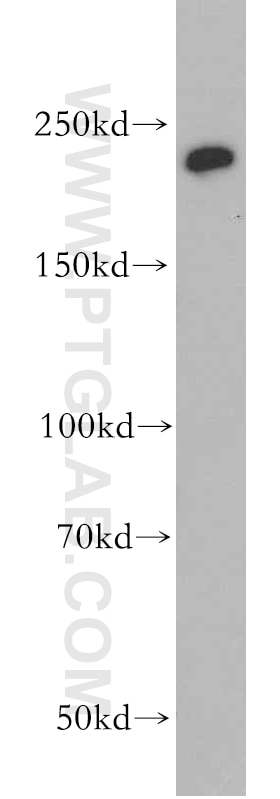
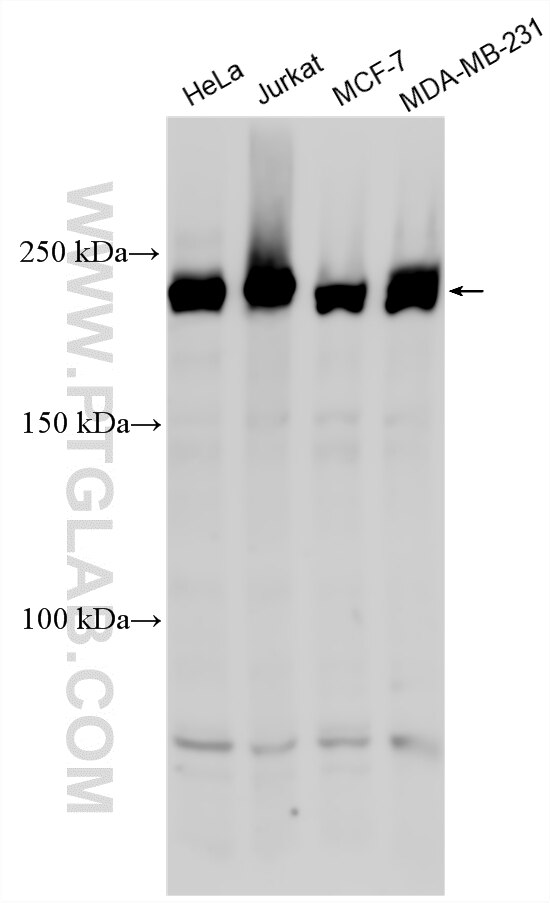
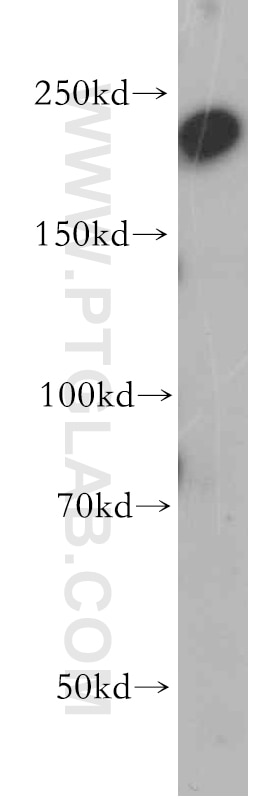
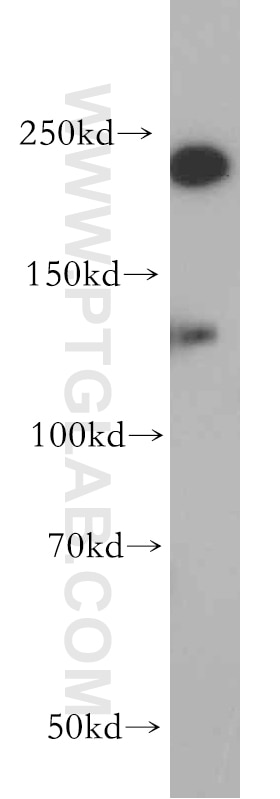
| Positive WB detected in | HeLa cells, A431 cells, human brain tissue, Jurkat cells, MCF-7 cells, MDA-MB-231 cells |
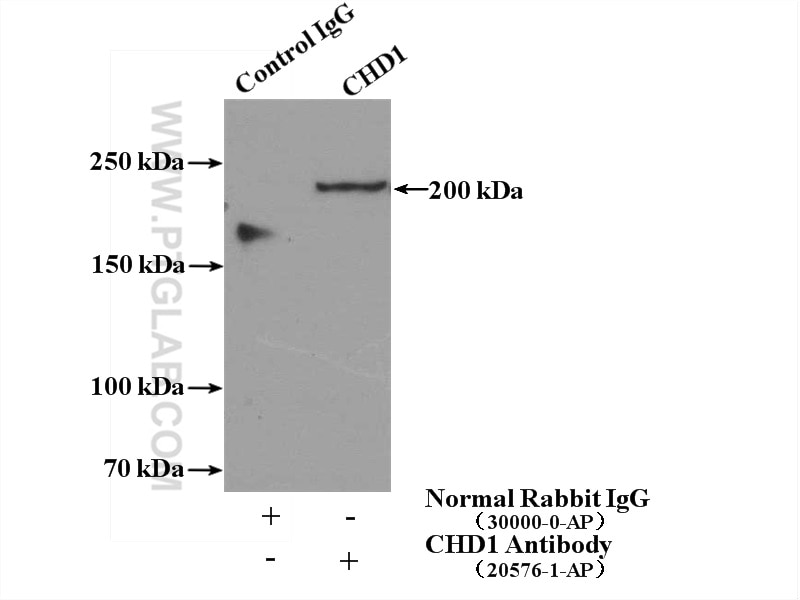
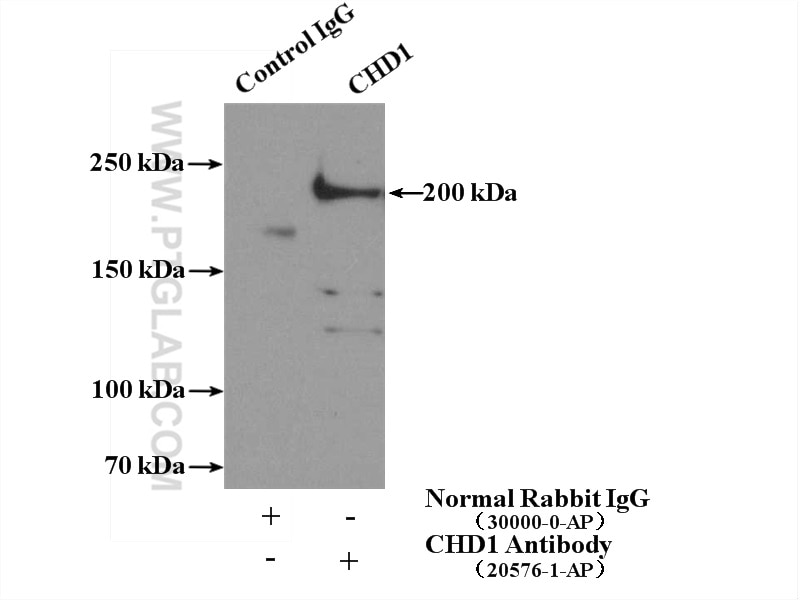
| Positive IP detected in | HeLa cells |
Recommended dilution
| Application | Dilution |
|---|---|
| Western Blot (WB) | WB : 1:200-1:1000 |
| Immunoprecipitation (IP) | IP : 0.5-4.0 ug for 1.0-3.0 mg of total protein lysate |
| It is recommended that this reagent should be titrated in each testing system to obtain optimal results. | |
| Sample-dependent, Check data in validation data gallery. | |
Product Information
20576-1-AP targets CHD1 in WB, IF, IP, ELISA applications and shows reactivity with human, mouse, rat samples.
| Tested Reactivity | human, mouse, rat |
| Cited Reactivity | human, mouse |
| Host / Isotype | Rabbit / IgG |
| Class | Polyclonal |
| Type | Antibody |
| Immunogen |
Peptide Predict reactive species |
| Full Name | chromodomain helicase DNA binding protein 1 |
| Calculated Molecular Weight | 197 kDa |
| Observed Molecular Weight | 200 kDa |
| GenBank Accession Number | NM_001270 |
| Gene Symbol | CHD1 |
| Gene ID (NCBI) | 1105 |
| RRID | AB_10694288 |
| Conjugate | Unconjugated |
| Form | Liquid |
| Purification Method | Antigen affinity purification |
| UNIPROT ID | O14646 |
| Storage Buffer | PBS with 0.02% sodium azide and 50% glycerol, pH 7.3. |
| Storage Conditions | Store at -20°C. Stable for one year after shipment. Aliquoting is unnecessary for -20oC storage. 20ul sizes contain 0.1% BSA. |
Background Information
CHD1 belongs to the SNF2/RAD54 helicase family. CHD1 is an aTP-dependent chromatin-remodeling factor which functions as substrate recognition component of the transcription regulatory histone acetylation (HAT) complex SAGA. CHD1 regulates polymerase II transcription. It is required for efficient transcription by RNA polymerase I, and more specifically the polymerase I transcription termination step. CHD1 regulates negatively DNA replication. It is required to maintain a specific chromatin configuration across the genome. It is associated with histone deacetylase (HDAC) activity. CHD1 is required for the bridging of SNF2, the FACT complex, the PAF complex as well as the U2 snRNP complex to H3K4me3. It functions to modulate the efficiency of pre-mRNA splicing in part through physical bridging of spliceosomal components to H3K4me3. It is required for maintaining open chromatin and pluripotency in embryonic stem cells. In PTEN-deficient prostate and breast cancers, CHD1 depletion profoundly and specifically suppressed cell proliferation, cell survival and tumorigenic potential. The antibody is specific to CHD1.
Protocols
| Product Specific Protocols | |
|---|---|
| IP protocol for CHD1 antibody 20576-1-AP | Download protocol |
| WB protocol for CHD1 antibody 20576-1-AP | Download protocol |
| Standard Protocols | |
|---|---|
| Click here to view our Standard Protocols |
Publications
What published studies show
The CHD1 Polyclonal antibody (Cat# 20576-1-AP) has 9 citations across journals including Adv Sci, EMBO J, Cell Prolif, Biochem Pharmacol, Sci Rep, Front Mol Neurosci, Front Behav Neurosci, Behav Brain Res, and Dev Dyn. Research fields span meiosis, nucleotide excision repair, glioma progression, sepsis/inflammation, embryonic stem cell differentiation, learning and memory, anxiety/fear extinction, chromatin remodeling, and neurotrophic/metabolic pathway disruption. Applications are primarily WB and IF in human and mouse models.
| Species | Application | Title |
|---|---|---|
Adv Sci (Weinh) m6A Reader hnRNPA2B1 Modulates Late Pachytene Progression in Male Meiosis Through Post-Transcriptional Control | ||
EMBO J Chromatin remodeler CHD1 promotes XPC-to-TFIIH handover of nucleosomal UV lesions in nucleotide excision repair.
| ||
Cell Prolif MATN1-AS1 promotes glioma progression by functioning as ceRNA of miR-200b/c/429 to regulate CHD1 expression. | ||
Biochem Pharmacol CHD1 regulates the inflammatory response in macrophages and functions as a pharmacological target during sepsis. | ||

