
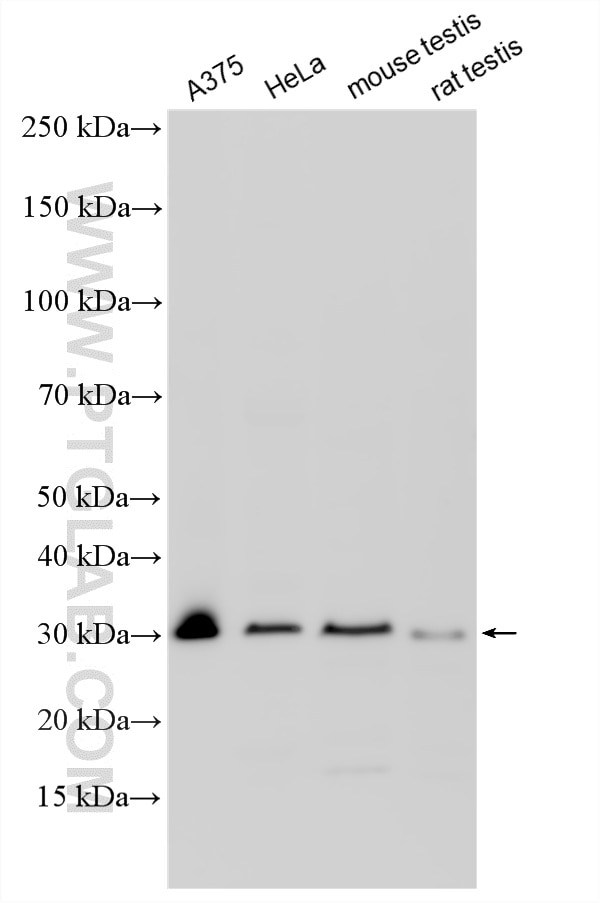



Tested Applications
| Positive WB detected in | A375 cells, HeLa cells, mouse testis tissue, rat testis tissue |
| Positive IP detected in | mouse testis tissue |
| Positive IHC detected in | human stomach tissue, human colon cancer Note: suggested antigen retrieval with TE buffer pH 9.0; (*) Alternatively, antigen retrieval may be performed with citrate buffer pH 6.0 |
Recommended dilution
| Application | Dilution |
|---|---|
| Western Blot (WB) | WB : 1:1000-1:4000 |
| Immunoprecipitation (IP) | IP : 0.5-4.0 ug for 1.0-3.0 mg of total protein lysate |
| Immunohistochemistry (IHC) | IHC : 1:50-1:500 |
| It is recommended that this reagent should be titrated in each testing system to obtain optimal results. | |
| Sample-dependent, Check data in validation data gallery. | |
Product Information
16278-1-AP targets CHMP6 in WB, IHC, IF, IP, ELISA applications and shows reactivity with human, mouse, rat samples.
| Tested Reactivity | human, mouse, rat |
| Cited Reactivity | human, mouse, canine |
| Host / Isotype | Rabbit / IgG |
| Class | Polyclonal |
| Type | Antibody |
| Immunogen |
CatNo: Ag9357 Product name: Recombinant human CHMP6 protein Source: e coli.-derived, PGEX-4T Tag: GST Domain: 1-201 aa of BC010108 Sequence: MGNLFGRKKQSRVTEQDKAILQLKQQRDKLRQYQKRIAQQLERERALARQLLRDGRKERAKLLLKKKRYQEQLLDRTENQISSLEAMVQSIEFTQIEMKVMEGLQFGNECLNKMHQVMSIEEVERILDETQEAVEYQRQIDELLAGSFTQEDEDAILEELSAITQEQIELPEVPSEPLPEKIPENVPVKARPRQAELVAAS Predict reactive species |
| Full Name | chromatin modifying protein 6 |
| Calculated Molecular Weight | 201 aa, 23 kDa |
| Observed Molecular Weight | 28-30 kDa |
| GenBank Accession Number | BC010108 |
| Gene Symbol | CHMP6 |
| Gene ID (NCBI) | 79643 |
| RRID | AB_2079498 |
| Conjugate | Unconjugated |
| Form | Liquid |
| Purification Method | Antigen affinity purification |
| UNIPROT ID | Q96FZ7 |
| Storage Buffer | PBS with 0.02% sodium azide and 50% glycerol, pH 7.3. |
| Storage Conditions | Store at -20°C. Stable for one year after shipment. Aliquoting is unnecessary for -20oC storage. 20ul sizes contain 0.1% BSA. |
Background Information
CHMP6 (charged multivesicular body protein 6) is a protein that plays a significant role in the formation of multivesicular bodies (MVBs) within cells. It is a component of the endosomal sorting complex required for transport III (ESCRT-III), which is involved in the sorting and transport of proteins within the cell. CHMP6 has been identified as a novel prognostic biomarker in bladder cancer, where it enhances cell survival and migration by regulating the cell cycle. (PMID: 40630215)
Protocols
| Product Specific Protocols | |
|---|---|
| IHC protocol for CHMP6 antibody 16278-1-AP | Download protocol |
| IP protocol for CHMP6 antibody 16278-1-AP | Download protocol |
| WB protocol for CHMP6 antibody 16278-1-AP | Download protocol |
| Standard Protocols | |
|---|---|
| Click here to view our Standard Protocols |
Publications
What published studies show
The CHMP6 polyclonal antibody (catalog number 16278-1-AP) has a total of 9 citations. These appear in Nature Cell Biology, Autophagy, Nature Communications, Molecular Cell, Current Biology, Journal of Cell Biology, the Journal of Virology (two papers), and bioRxiv. The research fields span ESCRT biology and membrane biology, including intra-luminal vesicle formation, lysosomal repair in acute kidney injury, xenophagy membrane repair, exosome sorting, cytokine abscission, and viral spread and non-envelopment roles of the ESCRT-III complex during HCMV infection.
| Species | Application | Title |
|---|---|---|
Nat Cell Biol Endosomal membrane tension regulates ESCRT-III-dependent intra-lumenal vesicle formation. | ||
Autophagy ESCRT iii-mediated lysosomal repair improve renal tubular cell injury in cisplatin-induced AKI | ||
Nat Commun Rab41-mediated ESCRT machinery repairs membrane rupture by a bacterial toxin in xenophagy
| ||
Mol Cell α-Synuclein aggregates inhibit ESCRT-III through sequestration and collateral degradation | ||
Curr Biol A Septin Double Ring Controls the Spatiotemporal Organization of the ESCRT Machinery in Cytokinetic Abscission. | ||


