
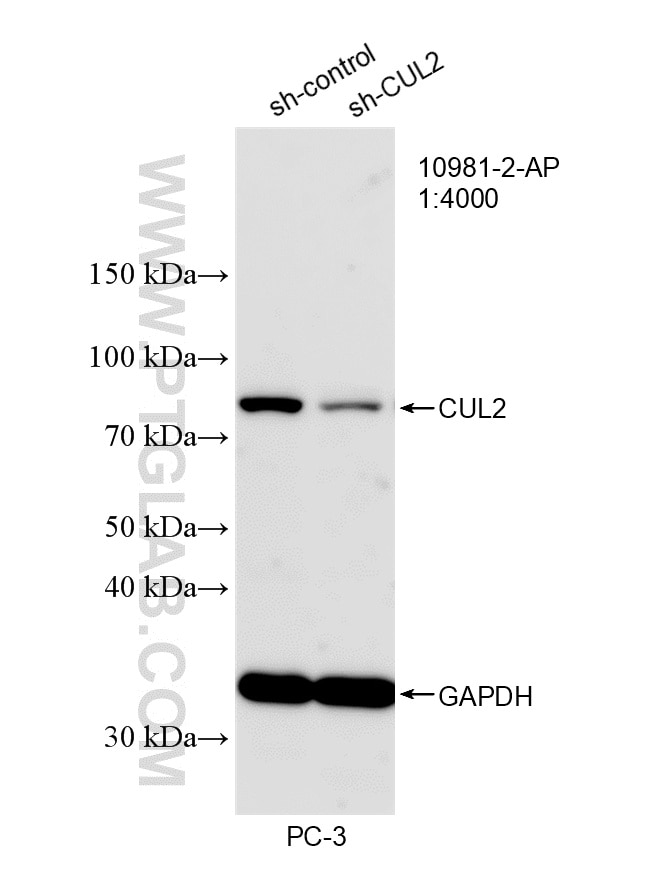



Tested Applications
| Positive WB detected in | HEK-293 cells, PC-3 cells, HeLa cells, HepG2 cells |
| Positive IP detected in | HeLa cells |
| Positive IHC detected in | human prostate cancer tissue Note: suggested antigen retrieval with TE buffer pH 9.0; (*) Alternatively, antigen retrieval may be performed with citrate buffer pH 6.0 |
Recommended dilution
| Application | Dilution |
|---|---|
| Western Blot (WB) | WB : 1:1000-1:6000 |
| Immunoprecipitation (IP) | IP : 0.5-4.0 ug for 1.0-3.0 mg of total protein lysate |
| Immunohistochemistry (IHC) | IHC : 1:50-1:500 |
| It is recommended that this reagent should be titrated in each testing system to obtain optimal results. | |
| Sample-dependent, Check data in validation data gallery. | |
Product Information
10981-2-AP targets CUL2 in WB, IHC, IP, CoIP, ELISA applications and shows reactivity with human samples.
| Tested Reactivity | human |
| Cited Reactivity | human, mouse, rat |
| Host / Isotype | Rabbit / IgG |
| Class | Polyclonal |
| Type | Antibody |
| Immunogen |
CatNo: Ag1434 Product name: Recombinant human CUL2 protein Source: e coli.-derived, PGEX-4T Tag: GST Domain: 341-745 aa of BC009591 Sequence: ESVLEVHGKFVQLINTVLNGDQHFMSALDKALTSVVNYREPKSVCKAPELLAKYCDNLLKKSAKGMTENEVEDRLTSFITVFKYIDDKDVFQKFYARMLAKRLIHGLSMSMDSEEAMINKLKQACGYEFTSKLHRMYTDMSVSADLNNKFNNFIKNQDTVIDLGISFQIYVLQAGAWPLTQAPSSTFAIPQELEKSVQMFELFYSQHFSGRKLTWLHYLCTGEVKMNYLGKPYVAMVTTYQMAVLLAFNNSETVSYKELQDSTQMNEKELTKTIKSLLDVKMINHDSEKEDIDAESSFSLNMNFSSKRTKFKITTSMQKDTPQEMEQTRSAVDEDRKMYLQAAIVRIMKARKVLRHNALIQEVISQSRARFNPSISMIKKCIEVLIDKQYIERSQASADEYSYVA Predict reactive species |
| Full Name | cullin 2 |
| Calculated Molecular Weight | 87 kDa |
| Observed Molecular Weight | 87 kDa |
| GenBank Accession Number | BC009591 |
| Gene Symbol | CUL2 |
| Gene ID (NCBI) | 8453 |
| RRID | AB_2086422 |
| Conjugate | Unconjugated |
| Form | Liquid |
| Purification Method | Antigen affinity purification |
| UNIPROT ID | Q13617 |
| Storage Buffer | PBS with 0.02% sodium azide and 50% glycerol, pH 7.3. |
| Storage Conditions | Store at -20°C. Stable for one year after shipment. Aliquoting is unnecessary for -20oC storage. 20ul sizes contain 0.1% BSA. |
Background Information
The cullin family proteins are scaffold proteins for the Ring finger type E3 ligases, participating in the proteolysis through the ubiquitin-proteasome pathway. Humans express seven cullin proteins: CUL1-3, CUL4A, CUL4B, CUL5, and CUL7. Each cullin protein can form an E3 ligase similar to the prototype Ring-type E3 ligase Skp1-CUL1-F-box complex. The Cullin-RING-finger type E3 ligases are important regulators in early embryonic development, as highlighted by genetic studies demonstrating that knock-out of CUL1, CUL3, or CUL4A in mice results in early embryonic lethality.
Protocols
| Product Specific Protocols | |
|---|---|
| IHC protocol for CUL2 antibody 10981-2-AP | Download protocol |
| IP protocol for CUL2 antibody 10981-2-AP | Download protocol |
| WB protocol for CUL2 antibody 10981-2-AP | Download protocol |
| Standard Protocols | |
|---|---|
| Click here to view our Standard Protocols |
Publications
What published studies show
The CUL2 Polyclonal antibody (Cat# 10981-2-AP) has 18 citations. These appear in journals including Theranostics, Cell Death & Differentiation, Journal of Controlled Release, Cancer Letters, Developmental Cell, Oncogene, Aging, International Immunopharmacology, FEBS Journal, Journal of Cell Science, Frontiers in Cardiovascular Medicine, Microvascular Research, Molecular and Cellular Biology, Hereditas, Cell Physiology and Biochemistry, and Biochemical and Biophysical Research Communications. Research fields span cancer biology (glioblastoma, colorectal, gastric, hepatocellular carcinoma), ubiquitination/proteasomal degradation, autophagy, ferroptosis, angiogenesis, hypoxia/HIF-1α signaling, and lung disease.
| Species | Application | Title |
|---|---|---|
Theranostics The N6-methyladenosine-mediated lncRNA WEE2-AS1 promotes glioblastoma progression by stabilizing RPN2
| ||
Cell Death Differ CRL2-KLHDC3 E3 ubiquitin ligase complex suppresses ferroptosis through promoting p14ARF degradation. | ||
Cell Death Differ USP51 facilitates colorectal cancer stemness and chemoresistance by forming a positive feed-forward loop with HIF1A | ||
J Control Release The HSP90-dependent bioorthogonal PROTAC prodrug system enables tumor-selective and enhanced protein degradation. | ||
Cancer Lett LINC01186-mediated deubiquitination of ACSL4 reprograms lipid metabolism to increase autophagy-mediated angiogenesis in colorectal cancer. | ||
Dev Cell AMBRA1 interplay with cullin E3 ubiquitin ligases regulates autophagy dynamics.
|


