
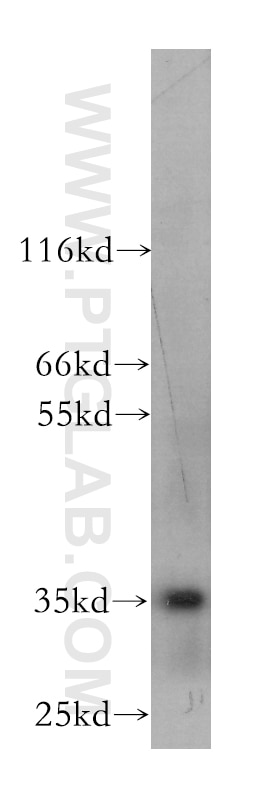
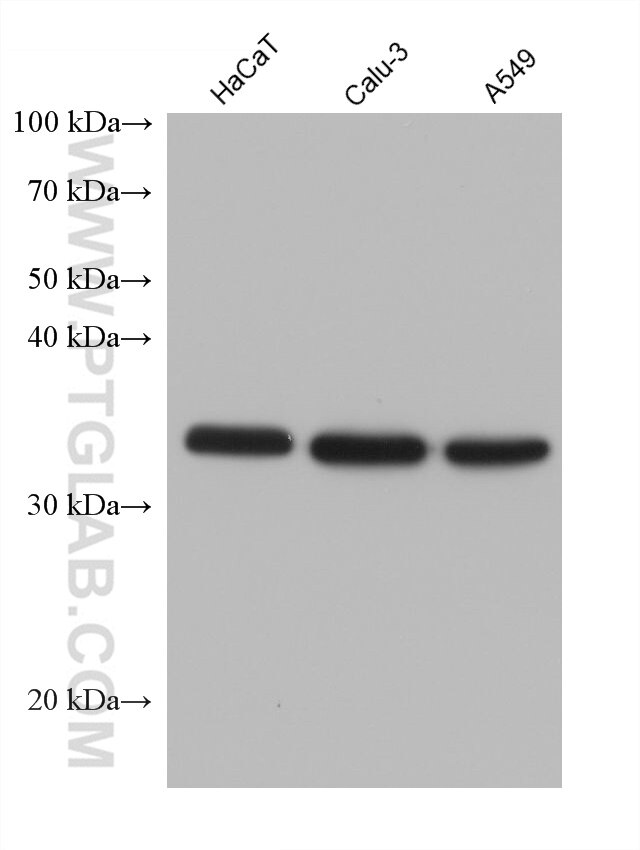

Tested Applications
| Positive WB detected in | HaCaT cells, SH-SY5Y cells, Calu-3 cells, A549 cells |
Recommended dilution
| Application | Dilution |
|---|---|
| Western Blot (WB) | WB : 1:500-1:2000 |
| It is recommended that this reagent should be titrated in each testing system to obtain optimal results. | |
| Sample-dependent, Check data in validation data gallery. | |
Product Information
60123-1-Ig targets CXCL16 in WB, IHC, IF, CoIP, ELISA applications and shows reactivity with human samples.
| Tested Reactivity | human |
| Cited Reactivity | human, mouse, rat |
| Host / Isotype | Mouse / IgG2a |
| Class | Monoclonal |
| Type | Antibody |
| Immunogen |
CatNo: Ag4883 Product name: Recombinant human CXCL16 protein Source: e coli.-derived, PET28a Tag: 6*His Domain: 46-225 aa of BC017588 Sequence: GNGNEGSVTGSCYCGKRISSDSPPSVQFMNRLRKHLRAYHRCLYYTRFQLLSWSVCGGNKDPWVQELMSCLDLKECGHAYSGIVAHQKHLLPTSPPISQASEGASSDIHTPAQMLLSTLQSTQRPTLPVGSLSSDKELTRPNETTIHTAGHSLAAGPEAGENQKQPEKNAGPTARTSATV Predict reactive species |
| Full Name | chemokine (C-X-C motif) ligand 16 |
| Calculated Molecular Weight | 273 aa, 30 kDa |
| Observed Molecular Weight | 35 kDa |
| GenBank Accession Number | BC017588 |
| Gene Symbol | CXCL16 |
| Gene ID (NCBI) | 58191 |
| RRID | AB_2086188 |
| Conjugate | Unconjugated |
| Form | Liquid |
| Purification Method | Protein A purification |
| UNIPROT ID | Q9H2A7 |
| Storage Buffer | PBS with 0.02% sodium azide and 50% glycerol, pH 7.3. |
| Storage Conditions | Store at -20°C. Stable for one year after shipment. Aliquoting is unnecessary for -20oC storage. 20ul sizes contain 0.1% BSA. |
Background Information
CXCL16 is a recently discovered cytokine belonging to the CXC chemokine family, which is synthesised in plasmacytoid dendritic cell as a transmembrane molecule. It exists in a transmembrane and soluble form. The transmembrane form of CXCL16 functions as an adhesion molecule for CXCR6-expressing cells, whereas the soluble form of CXCL16 mediates infiltration of circulating cells into sites of injury. CXCL16, has been proposed as an important pathogenic mediator in inflammatory diseases, including rheumatoid arthritis, glomerulonephritis, or prostate cancer. CXCL16 has been implicated in some forms of renal disease such as lupus nephritis and antiglomerular basement membrane nephritis. CXCL16 also plays a pivotal role in the pathogenesis of angiotensin II-induced renal injury and fibrosis through regulation of macrophage and T cell infiltration and bone marrow-derived fibroblast accumulation.
Protocols
| Product Specific Protocols | |
|---|---|
| WB protocol for CXCL16 antibody 60123-1-Ig | Download protocol |
| Standard Protocols | |
|---|---|
| Click here to view our Standard Protocols |
Publications
What published studies show
The CXCL16 Monoclonal antibody (60123-1-Ig) has 14 citations across journals including Cancer Communications, Experimental & Molecular Medicine, Neuron, Cardiovascular Diabetology, Journal for ImmunoTherapy of Cancer, British Journal of Pharmacology, Chinese Journal of Natural Medicines, Hepatology Communications, Journal of Zhejiang University Science B, Inflammation, Molecular Medicine Reports, FASEB Journal, Cell Biochemistry and Biophysics, and Frontiers in Pharmacology. Research fields span oncology (hepatocellular/prostate/head and neck cancers), immunology, diabetes/kidney disease, liver fibrosis, cardiovascular disease, neuroinflammation, and immunology-focused studies. Applications include WB, IF, IHC, and CoIP across human, mouse, and rat samples.
| Species | Application | Title |
|---|---|---|
Cancer Commun (Lond) Activation of Piezo1 contributes to matrix stiffness-induced angiogenesis in hepatocellular carcinoma | ||
Exp Mol Med H3K18 lactylation in cancer-associated fibroblasts drives malignant pleural effusion progression via TNFR2(+) T(reg) recruitment. | ||
Neuron Metabolic reprogramming through histone lactylation in microglia and macrophages recruits CD8+ T lymphocytes and aggravates spinal cord injury | ||
Cardiovasc Diabetol Klotho inhibits renal ox-LDL deposition via IGF-1R/RAC1/OLR1 signaling to ameliorate podocyte injury in diabetic kidney disease | ||
J Immunother Cancer Dual regulation of CXCR6(+)CD8(+) T cells modulates cytotoxic and exhaustion-associated programs during prostate cancer progression. | ||
Chin J Nat Med Picroside II promotes HSC apoptosis and inhibits the cholestatic liver fibrosis in Mdr2-/- mice by polarizing M1 macrophages and balancing immune responses |

