
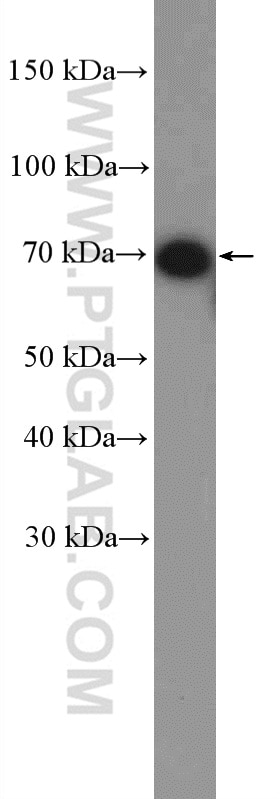
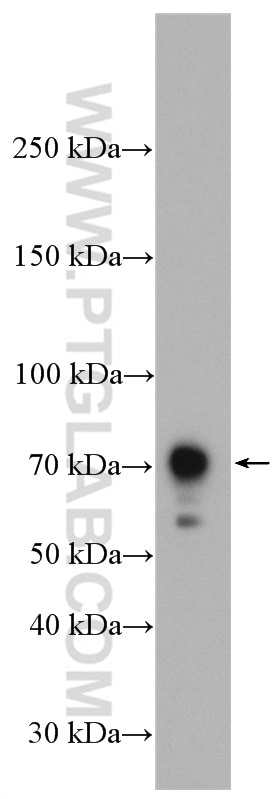
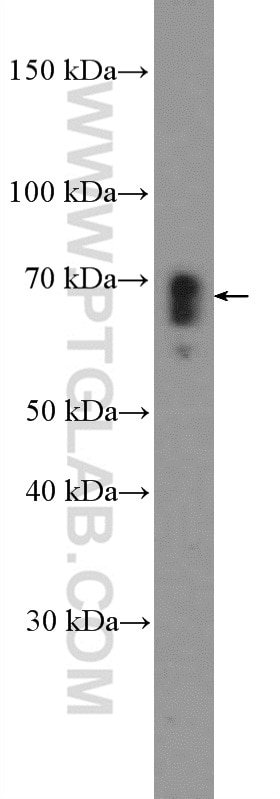
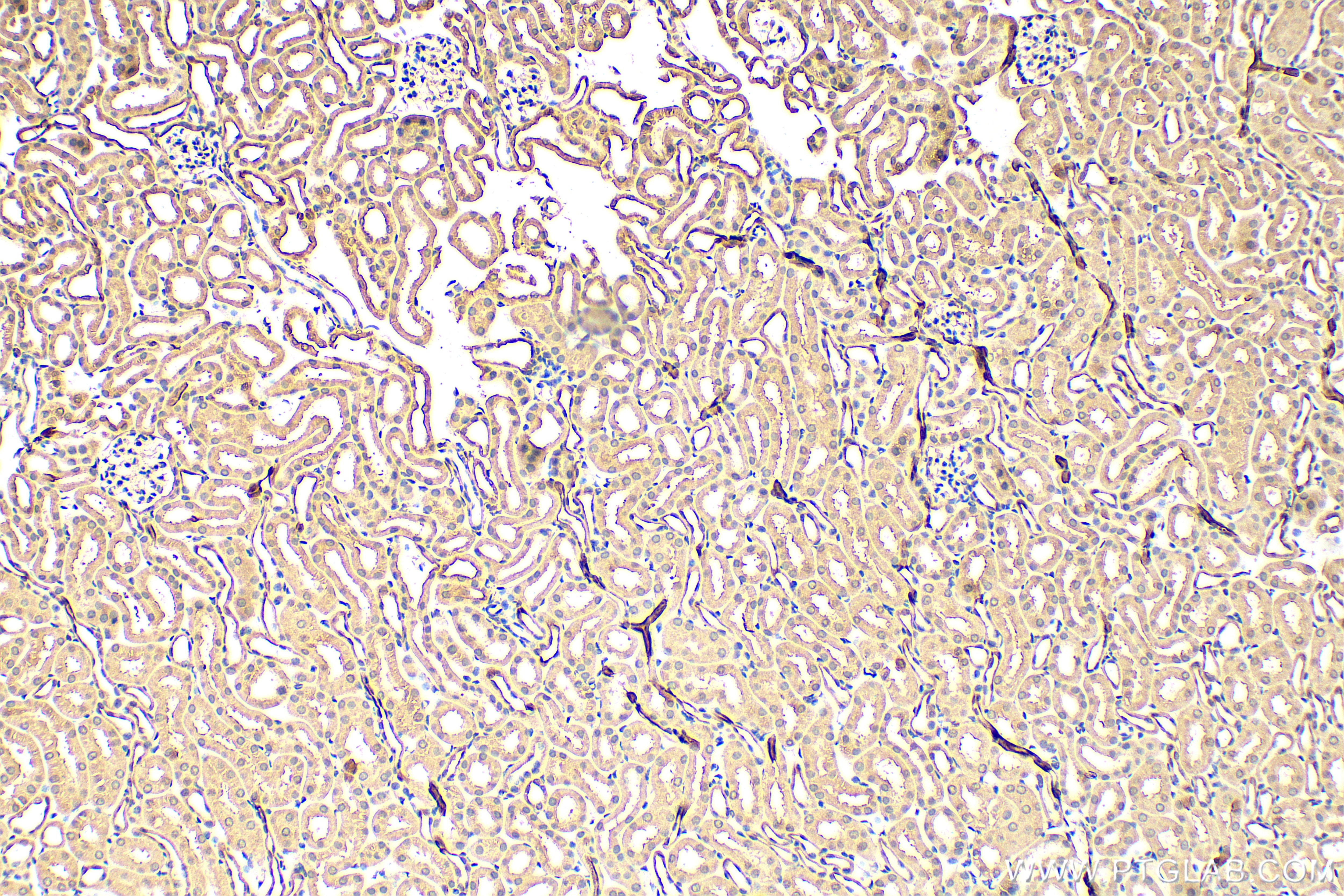

Tested Applications
| Positive WB detected in | HepG2 cells, Jurkat cells, mouse liver tissue |
| Positive IHC detected in | mouse kidney tissue Note: suggested antigen retrieval with TE buffer pH 9.0; (*) Alternatively, antigen retrieval may be performed with citrate buffer pH 6.0 |
Recommended dilution
| Application | Dilution |
|---|---|
| Western Blot (WB) | WB : 1:500-1:3000 |
| Immunohistochemistry (IHC) | IHC : 1:50-1:500 |
| It is recommended that this reagent should be titrated in each testing system to obtain optimal results. | |
| Sample-dependent, Check data in validation data gallery. | |
Product Information
26756-1-AP targets CXCR3 in WB, IHC, IF, ELISA applications and shows reactivity with human, mouse samples.
| Tested Reactivity | human, mouse |
| Cited Reactivity | human, mouse, rat |
| Host / Isotype | Rabbit / IgG |
| Class | Polyclonal |
| Type | Antibody |
| Immunogen |
CatNo: Ag25056 Product name: Recombinant human CXCR3 protein Source: e coli.-derived, PET30a Tag: 6*His Domain: 1-53 aa of BC034403 Sequence: MVLEVSDHQVLNDAEVAALLENFSSSYDYGENESDSCCTSPPCPQDFSLNFDR Predict reactive species |
| Full Name | chemokine (C-X-C motif) receptor 3 |
| Calculated Molecular Weight | 368 aa, 41 kDa |
| Observed Molecular Weight | 41kDa, 70 kDa |
| GenBank Accession Number | BC034403 |
| Gene Symbol | CXCR3 |
| Gene ID (NCBI) | 2833 |
| RRID | AB_2880623 |
| Conjugate | Unconjugated |
| Form | Liquid |
| Purification Method | Antigen affinity purification |
| UNIPROT ID | P49682 |
| Storage Buffer | PBS with 0.02% sodium azide and 50% glycerol, pH 7.3. |
| Storage Conditions | Store at -20°C. Stable for one year after shipment. Aliquoting is unnecessary for -20oC storage. 20ul sizes contain 0.1% BSA. |
Background Information
CXCR3 (C-X-C chemokine receptor type 3) is a G-protein-coupled seven-transmembrane domain chemokine receptor that is expressed on the surface of a number of cell types, including activated CD4+ and CD8+ T cells, NK and NK-T cells, plasmacytoid dendritic cells, and some B cells. CXCR3 is activated by three related chemokines (CXCL9, CXCL10, and CXCL11) and plays an important role in effector T-cell and NK cell trafficking. CXCR3 has three isoforms termed CXCR3-A, CXCR3-B, and CXCR3-alt with the calculated molecular mass of 41kDa, 46kDa, and 29kDa respectively. The apparent molecular mass of CXCR3 detected by some scientists is 70kDa, but 45kDa by others. (PMID: 16847335, 15150261, 22885102, 19151743)
Protocols
| Product Specific Protocols | |
|---|---|
| IHC protocol for CXCR3 antibody 26756-1-AP | Download protocol |
| WB protocol for CXCR3 antibody 26756-1-AP | Download protocol |
| Standard Protocols | |
|---|---|
| Click here to view our Standard Protocols |
Publications
What published studies show
The CXCR3 Polyclonal antibody (Cat# 26756-1-AP) has accumulated 33 citations across journals including Bioactive Materials, Advanced Science, Science Advances, Small, Free Radical Biology and Medicine, Frontiers in Immunology, FASEB Journal, Journal of Immunology, Stem Cell Research & Therapy, and Journal of Cell Science. Associated research fields span immunology, oncology, neurology, ferroptosis, liver disease, dermatology, reproductive medicine, cardiovascular biology, diabetes, inflammatory bowel disease, rheumatology, wound healing, and ophthalmology.
| Species | Application | Title |
|---|---|---|
Bioact Mater Microenvironment-educated MSC-EVs loaded injectable smart hydrogel for targeting senescent nucleus pulposus cells and inhibiting ferroptosis against intervertebral disc degeneration. | ||
Adv Sci (Weinh) CHB-Induced Immune Zonation Chaos Elicited LXRα-mediated Lipid Metabolism Disorders in Kupffer Cells to Induce Cancer Stem Cell Formation. | ||
Adv Sci (Weinh) Electret-Inspired Charge-Injected Hydrogel for Scar-Free Healing of Bacterially Infected Burns Through Bioelectrical Stimulation and Immune Modulation | ||
Sci Adv Astrocytic TDP-43 dysregulation impairs memory by modulating antiviral pathways and interferon-inducible chemokines | ||
Small An Engineered Cytokine-Induced Killer Cell-Derived Nanovesicle Featuring Multiplexed Immune Activation Performances for Enhanced Tumor Therapy. | ||
J Eur Acad Dermatol Venereol Type 1 interferon signature and cytotoxic T lymphocyte activation targeted against sweat ducts in inflammatory acquired idiopathic generalized anhidrosis |

