



Tested Applications
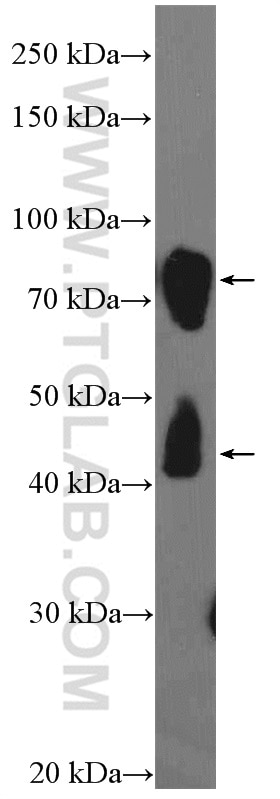
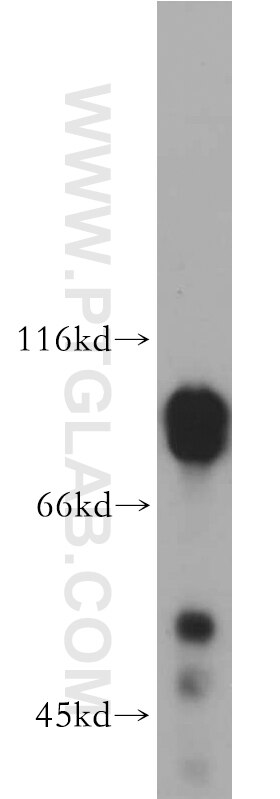
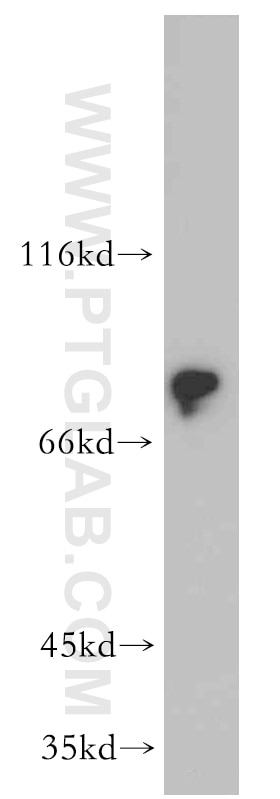
| Positive WB detected in | rat brain tissue, human brain tissue, mouse brain tissue |
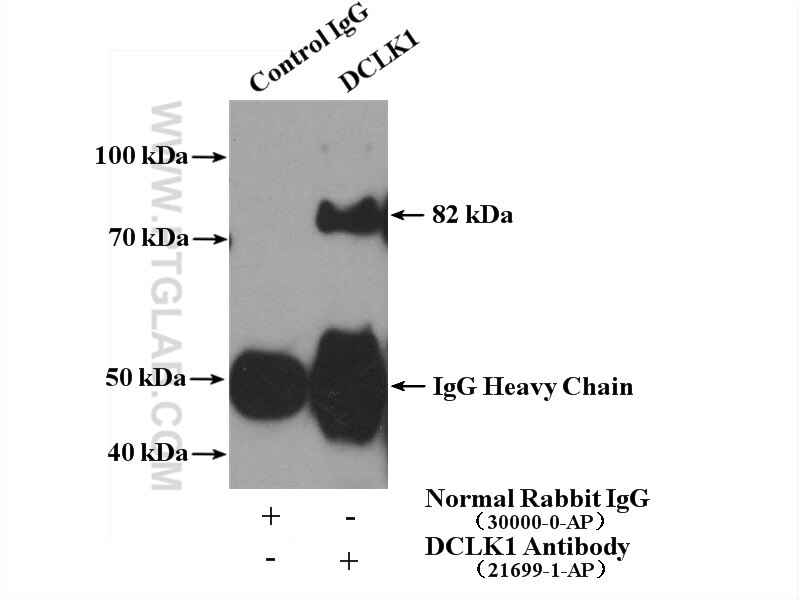
| Positive IP detected in | rat brain tissue |
| Positive IHC detected in | human pancreas cancer tissue Note: suggested antigen retrieval with TE buffer pH 9.0; (*) Alternatively, antigen retrieval may be performed with citrate buffer pH 6.0 |
| Positive IF-P detected in | mouse brain tissue |
| Positive IF-Fro detected in | rat brain tissue, mouse brain tissue |
Recommended dilution
| Application | Dilution |
|---|---|
| Western Blot (WB) | WB : 1:500-1:3000 |
| Immunoprecipitation (IP) | IP : 0.5-4.0 ug for 1.0-3.0 mg of total protein lysate |
| Immunohistochemistry (IHC) | IHC : 1:200-1:800 |
| Immunofluorescence (IF)-P | IF-P : 1:50-1:500 |
| Immunofluorescence (IF)-FRO | IF-FRO : 1:50-1:500 |
| It is recommended that this reagent should be titrated in each testing system to obtain optimal results. | |
| Sample-dependent, Check data in validation data gallery. | |
Product Information
21699-1-AP targets DCLK1 in WB, IHC, IF-P, IF-Fro, IP, CoIP, ELISA applications and shows reactivity with human, mouse, rat samples.
| Tested Reactivity | human, mouse, rat |
| Cited Reactivity | human, mouse |
| Host / Isotype | Rabbit / IgG |
| Class | Polyclonal |
| Type | Antibody |
| Immunogen |
CatNo: Ag16292 Product name: Recombinant human DCLK1 protein Source: e coli.-derived, PGEX-4T Tag: GST Domain: 623-729 aa of BC152456 Sequence: LITMMLLVDVDQRFSAVQVLEHPWVNDDGLPENEHQLSVAGKIKKHFNTGPKPNSTAAGVSVIALDHGFTIKRSGSLDYYQQPGMYWIRPPLLIRRGRFSDEDATRM Predict reactive species |
| Full Name | doublecortin-like kinase 1 |
| Calculated Molecular Weight | 729 aa, 81 kDa |
| Observed Molecular Weight | 48 kDa, 82 kDa |
| GenBank Accession Number | BC152456 |
| Gene Symbol | DCLK1 |
| Gene ID (NCBI) | 9201 |
| RRID | AB_10859251 |
| Conjugate | Unconjugated |
| Form | Liquid |
| Purification Method | Antigen affinity purification |
| UNIPROT ID | O15075 |
| Storage Buffer | PBS with 0.02% sodium azide and 50% glycerol, pH 7.3. |
| Storage Conditions | Store at -20°C. Stable for one year after shipment. Aliquoting is unnecessary for -20oC storage. 20ul sizes contain 0.1% BSA. |
Background Information
DCLK1 (Serine/threonine-protein kinase DCLK1) is also named as DCAMKL1, DCDC3A, KIAA0369 and belongs to the CAMK Ser/Thr protein kinase family. It is a microtubule-associated kinase that can undergo autophosphorylation and it also has microtubule-polymerizing activity that is independent of its protein kinase activity (PMID: 11124993). It plays a unique role in mitotic spindle integrity during early neurogenesis in radial glial cell proliferation and their radial process stability. DCLK1 is a unique marker for distinguishing tumor stem cells from intestinal normal stem cells (PMID: 23202126). This protein has 4 isoforms produced by alternative splicing with the molecular weight of 82 kDa, 81 kDa, 47 kDa and 48 kDa.
Protocols
| Product Specific Protocols | |
|---|---|
| IF protocol for DCLK1 antibody 21699-1-AP | Download protocol |
| IHC protocol for DCLK1 antibody 21699-1-AP | Download protocol |
| IP protocol for DCLK1 antibody 21699-1-AP | Download protocol |
| WB protocol for DCLK1 antibody 21699-1-AP | Download protocol |
| Standard Protocols | |
|---|---|
| Click here to view our Standard Protocols |
Publications
What published studies show
DCLK1 Polyclonal Antibody (21699-1-AP) — Rabbit polyclonal against human DCLK1, with 22 total citations (per Proteintech database).
Journals: Immunity, Nature Communications, Redox Biology, Journal of Translational Medicine, Developmental Cell, Clinical and Translational Medicine, Cell Proliferation, Frontiers in Immunology, Cell & Bioscience, Life Sciences, Journal of Gastroenterology, International Immunopharmacology, Frontiers in Pharmacology, mBio, Journal of Nutritional Biochemistry, BBA Mol Cell Res, FASEB Journal, Naunyn-Schmiedeberg's Arch Pharmacol, Frontiers in Oncology, Cellular Physiology and Biochemistry.
Research fields: intestinal stem cell and tuft cell biology, colorectal/pancreatic/gastric/gallbladder/breast/lung cancer, neurobiology (Parkinson's, brain), colitis and antimicrobial immunity.
| Species | Application | Title |
|---|---|---|
Immunity Intestinal Tuft-2 cells exert antimicrobial immunity via sensing bacterial metabolite N-undecanoylglycine. | ||
Redox Biol FUT2-dependent fucosylation of HYOU1 protects intestinal stem cells against inflammatory injury by regulating unfolded protein response | ||
J Transl Med Chronic sleep deprivation induces plasma exosome-derived miR-150-5p downregulation as a novel mechanism involved in Parkinson's disease progression by targeting DCLK1 | ||
J Transl Med Paneth cell-derived iNOS is required to maintain homeostasis in the intestinal stem cell niche | ||
Dev Cell Impaired VLCFA-peroxisome-mediated intestinal epithelial repair causes gastrointestinal sequelae of long COVID. |


