
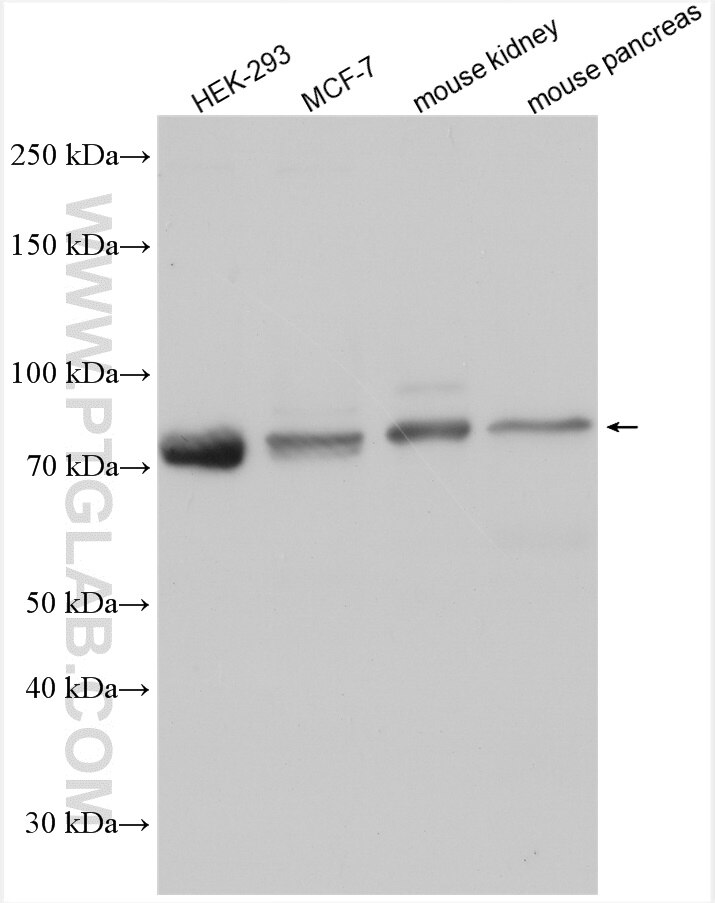

Tested Applications
| Positive WB detected in | HEK-293 cells, MCF-7 cells, mouse kidney tissue, mouse pancreas tissue |
Recommended dilution
| Application | Dilution |
|---|---|
| Western Blot (WB) | WB : 1:500-1:1000 |
| It is recommended that this reagent should be titrated in each testing system to obtain optimal results. | |
| Sample-dependent, Check data in validation data gallery. | |
Product Information
12001-1-AP targets Dymeclin in WB, ELISA applications and shows reactivity with human, mouse, rat samples.
| Tested Reactivity | human, mouse, rat |
| Cited Reactivity | mouse |
| Host / Isotype | Rabbit / IgG |
| Class | Polyclonal |
| Type | Antibody |
| Immunogen |
CatNo: Ag2600 Product name: Recombinant human DYM protein Source: e coli.-derived, PGEX-4T Tag: GST Domain: 242-590 aa of BC001252 Sequence: PSSIPHAFQINFNSLYTALCEQQTSDQATLLLYTLLHQNSNIRTYMLARTDMENLVLPILEILYHVEERNSHHVYMALIILLILTEDDGFNRSIHEVILKNITWYSERVLTEISLGSLLILVVIRTIQYNMTRTRDKYLHTNCLAALANMSAQFRSLHQYAAQRIISLFSLLSKKHNKVLEQATQSLRGSLSSNDVPLPDYAQDLNVIEEVIRMMLEIINSCLTNSLHHNPNLVYALLYKRDLFEQFRTHPSFQDIMQNIDLVISFFSSRLLQAGAELSVERVLEIIKQGVVALPKDRLKKFPELKFKYVEEEQPEEFFIPYVWSLVYNSAVGLYWNPQDIQLFTMDSD Predict reactive species |
| Full Name | dymeclin |
| Calculated Molecular Weight | 669 aa, 76 kDa |
| Observed Molecular Weight | 76-80 kDa |
| GenBank Accession Number | BC001252 |
| Gene Symbol | Dymeclin |
| Gene ID (NCBI) | 54808 |
| RRID | AB_2246056 |
| Conjugate | Unconjugated |
| Form | Liquid |
| Purification Method | Antigen affinity purification |
| UNIPROT ID | Q7RTS9 |
| Storage Buffer | PBS with 0.02% sodium azide and 50% glycerol, pH 7.3. |
| Storage Conditions | Store at -20°C. Stable for one year after shipment. Aliquoting is unnecessary for -20oC storage. 20ul sizes contain 0.1% BSA. |
Background Information
Human Dymeclin is encoded by DYM gene, defects in which are the cause of Dyggve-Melchior-Clausen syndrome (DMC) and Smith-McCort dysplasia (SMC). DMC is a rare autosomal recessive disorder characterized by short trunk dwarfism, microcephaly and psychomotor retardation, with cutaneous cells containing dilated rough endoplasmic reticulum, enlarged and aberrant vacuoles and numerous vesicles [PubMed: 12491225]. Distinct with features of DMS, SMC is a rare osteochondrodysplasia characterized by short limbs and trunk with barrel-shaped chest [PubMed: 19005420]. Dymeclin is a not a stably anchored transmembrane protein with a transmembrane domain, but it shuttles between Golgi and cytosol, which is necessary for correct organization of Golgi apparatus [PubMed: 18996921].
Protocols
| Product Specific Protocols | |
|---|---|
| WB protocol for Dymeclin antibody 12001-1-AP | Download protocol |
| Standard Protocols | |
|---|---|
| Click here to view our Standard Protocols |
Publications
What published studies show
The Dymeclin Polyclonal antibody (Cat# 12001-1-AP) has 1 citation to date, published in Molecular Medicine (Impact Factor 8.3). The study investigates Dymeclin's role in chronic unpredictable mild stress-induced depression, focusing on maintaining Golgi apparatus structure and regulating NLRP3 inflammasome activation in mouse models. The research fields encompass neuroscience (depression), organelle biology (Golgi apparatus), and immunology (inflammasome signaling). The antibody was validated by Western blot in this publication.
| Species | Application | Title |
|---|---|---|
Mol Med The role of Dymeclin in chronic unpredictable mild stress-induced depression: maintaining the Golgi apparatus structure and regulating NLRP3 inflammasome activation. |

