
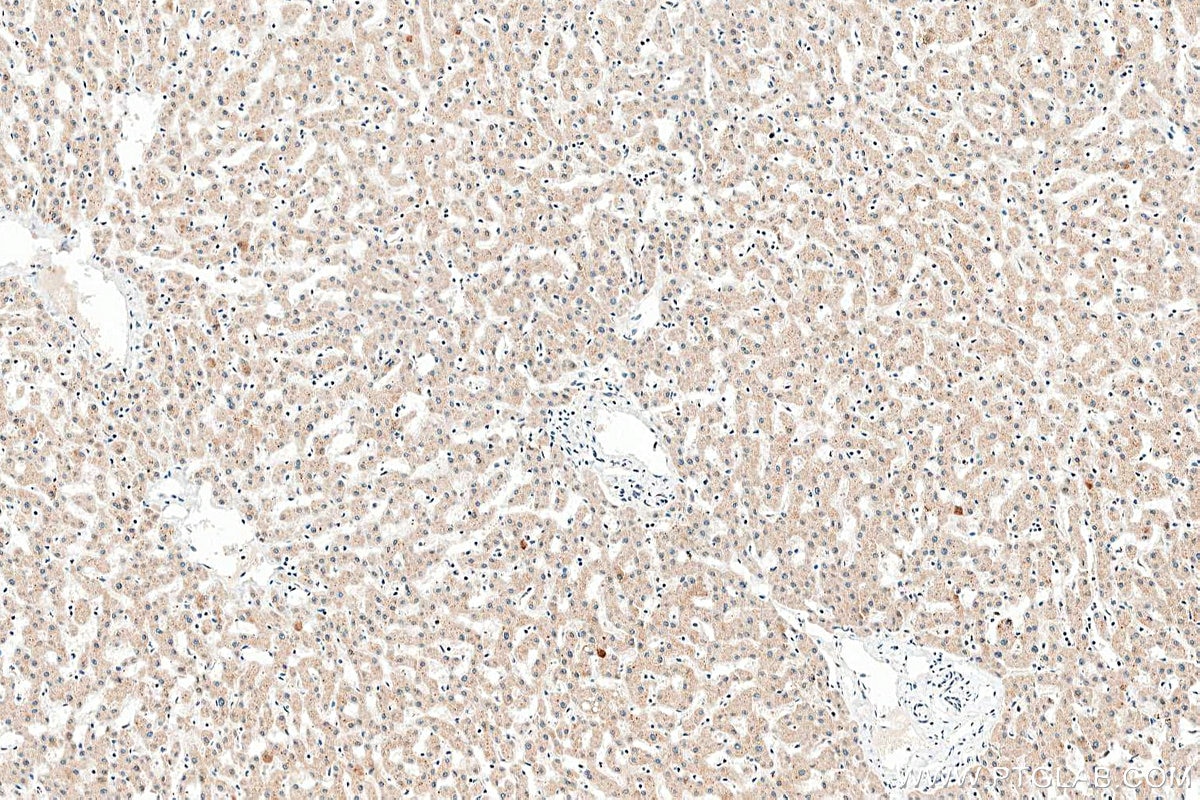
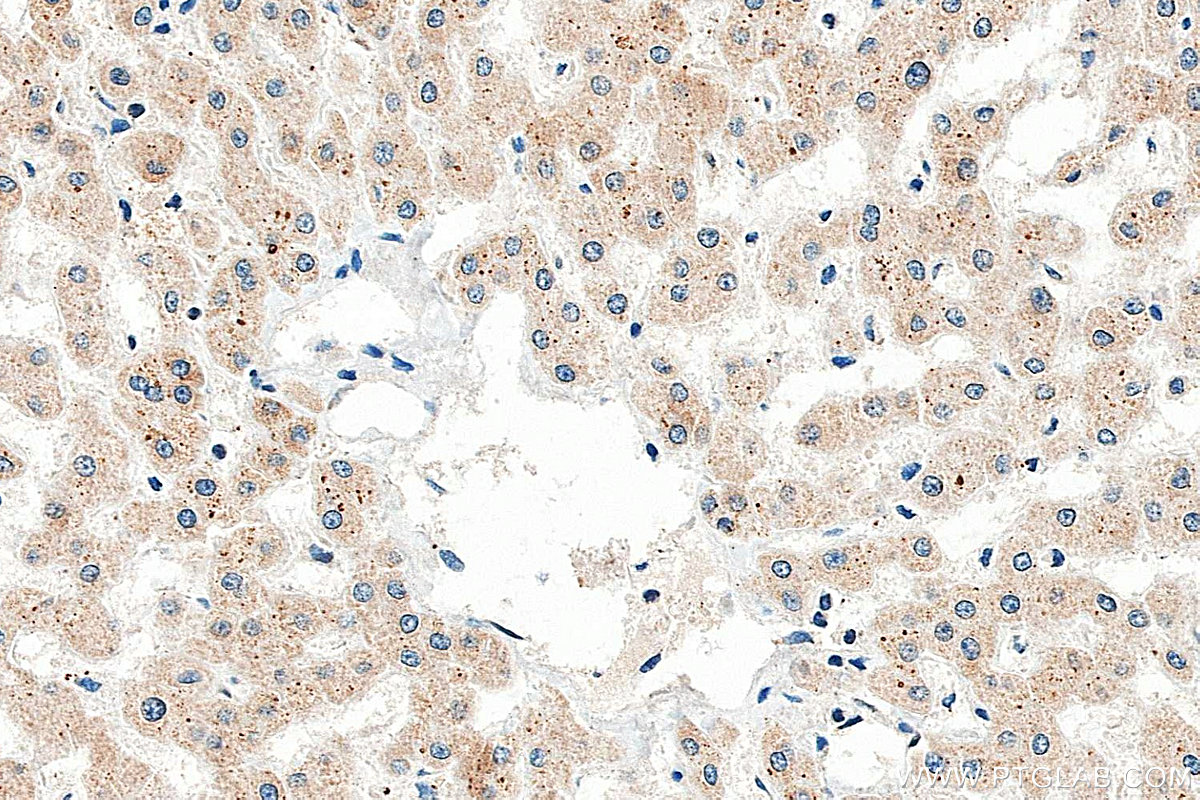
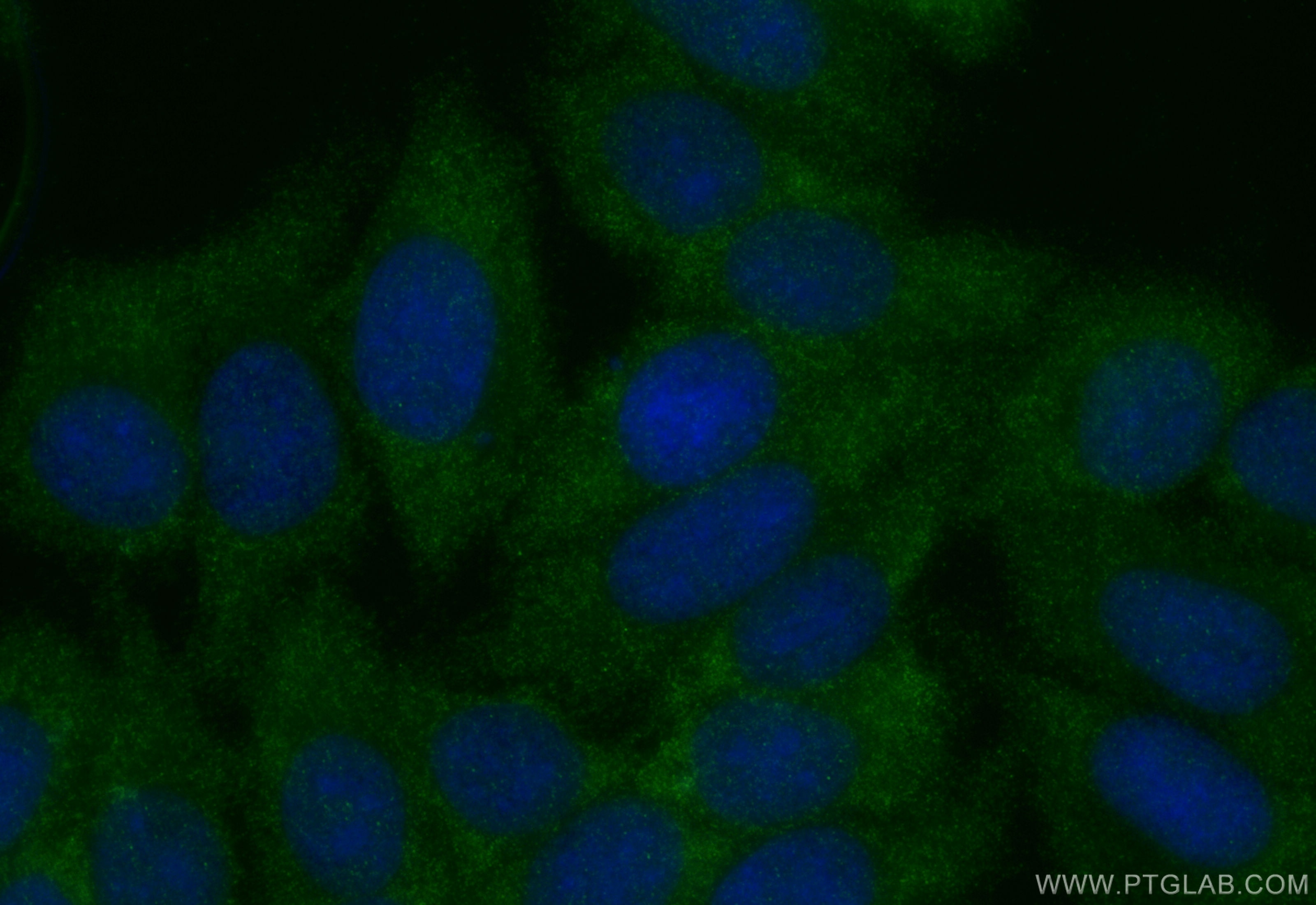

Tested Applications
| Positive IHC detected in | human liver tissue Note: suggested antigen retrieval with TE buffer pH 9.0; (*) Alternatively, antigen retrieval may be performed with citrate buffer pH 6.0 |
| Positive IF/ICC detected in | HepG2 cells |
Recommended dilution
| Application | Dilution |
|---|---|
| Immunohistochemistry (IHC) | IHC : 1:50-1:500 |
| Immunofluorescence (IF)/ICC | IF/ICC : 1:50-1:500 |
| It is recommended that this reagent should be titrated in each testing system to obtain optimal results. | |
| Sample-dependent, Check data in validation data gallery. | |
Product Information
13934-1-AP targets FBXL14 in IHC, IF/ICC, ELISA applications and shows reactivity with human samples.
| Tested Reactivity | human |
| Cited Reactivity | human, mouse |
| Host / Isotype | Rabbit / IgG |
| Class | Polyclonal |
| Type | Antibody |
| Immunogen |
CatNo: Ag4975 Product name: Recombinant human FBXL14 protein Source: e coli.-derived, PET28a Tag: 6*His Domain: 1-418 aa of BC028132 Sequence: METHISCLFPELLAMIFGYLDVRDKGRAAQVCTAWRDAAYHKSVWRGVEAKLHLRRANPSLFPSLQARGIRRVQILSLRRSLSYVIQGMANIESLNLSGCYNLTDNGLGHAFVQEIGSLRALNLSLCKQITDSSLGRIAQYLKGLEVLELGGCSNITNTGLLLIAWGLQRLKSLNLRSCRHLSDVGIGHLAGMTRSAAEGCLGLEQLTLQDCQKLTDLSLKHISRGLTGLRLLNLSFCGGISDAGLLHLSHMGSLRSLNLRSCDNISDTGIMHLAMGSLRLSGLDVSFCDKVGDQSLAYIAQGLDGLKSLSLCSCHISDDGINRMVRQMHGLRTLNIGQCVRITDKGLELIAEHLSQLTGIDLYGCTRITKRGLERITQLPCLKVLNLGLWQMTDSEKEARGDFSPLFTVRTRGSSRR Predict reactive species |
| Full Name | F-box and leucine-rich repeat protein 14 |
| Calculated Molecular Weight | 418 aa, 46 kDa |
| Observed Molecular Weight | 46 kDa |
| GenBank Accession Number | BC028132 |
| Gene Symbol | FBXL14 |
| Gene ID (NCBI) | 144699 |
| RRID | AB_10547838 |
| Conjugate | Unconjugated |
| Form | Liquid |
| Purification Method | Antigen affinity purification |
| UNIPROT ID | Q8N1E6 |
| Storage Buffer | PBS with 0.02% sodium azide and 50% glycerol, pH 7.3. |
| Storage Conditions | Store at -20°C. Stable for one year after shipment. Aliquoting is unnecessary for -20oC storage. 20ul sizes contain 0.1% BSA. |
Background Information
FBXL14(F-box/LRR-repeat protein 14) is also named as FBL14 and belongs to the the F-box protein family,which are characterized by an approximately 40-amino acid F-box motif. It is part of a SCF (SKP1-cullin-F-box) ubiquitin-protein ligase complex. SNAIL1 is an unstable transcription factor that is phosphorylated by GSK3-beta in the nucleus, which triggers its nuclear export and subsequent ubiquitination and proteasomal degradation. FBXL14 is directed ubiquitination and degradation of SNAIL1 in human and mouse cell lines(PMID:19955572).
Protocols
| Product Specific Protocols | |
|---|---|
| IF protocol for FBXL14 antibody 13934-1-AP | Download protocol |
| IHC protocol for FBXL14 antibody 13934-1-AP | Download protocol |
| Standard Protocols | |
|---|---|
| Click here to view our Standard Protocols |
Publications
What published studies show
The FBXL14 Polyclonal antibody (Cat# 13934-1-AP) has 3 citations. These appear in Nature Communications, Cell Death & Disease, and Communications Biology. The associated research fields include ubiquitin-proteasome system regulation (SCF E3 ligase and F-box protein-mediated degradation), innate immunity in experimental pneumonia, and cancer biology—specifically chemoresistance in small cell lung cancer.
| Species | Application | Title |
|---|---|---|
Nat Commun The deubiquitinase USP4 stabilizes the SCF(FBXO24) ubiquitin E3 ligase to regulate immunity in experimental pneumonia. | ||
Cell Death Dis F-box protein Fbxl18 mediates polyubiquitylation and proteasomal degradation of the pro-apoptotic SCF subunit Fbxl7. | ||
Commun Biol The germline factor DDX4 contributes to the chemoresistance of small cell lung cancer cells |

