




Tested Applications
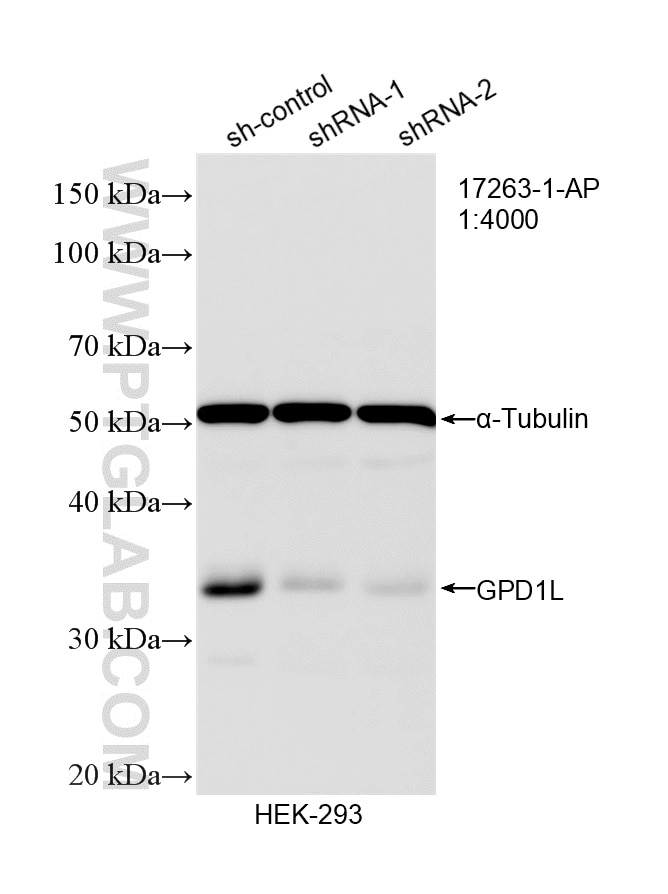
| Positive WB detected in | mouse heart tissue, human skeletal muscle tissue, human brain tissue, HEK-293 cells |
Recommended dilution
| Application | Dilution |
|---|---|
| Western Blot (WB) | WB : 1:500-1:2000 |
| It is recommended that this reagent should be titrated in each testing system to obtain optimal results. | |
| Sample-dependent, Check data in validation data gallery. | |
Product Information
17263-1-AP targets GPD1L in WB, IHC, IF, ELISA applications and shows reactivity with human, mouse, rat samples.
| Tested Reactivity | human, mouse, rat |
| Cited Reactivity | human, mouse, rat |
| Host / Isotype | Rabbit / IgG |
| Class | Polyclonal |
| Type | Antibody |
| Immunogen |
CatNo: Ag10977 Product name: Recombinant human GPD1L protein Source: e coli.-derived, PGEX-4T Tag: GST Domain: 1-351 aa of BC028726 Sequence: MAAAPLKVCIVGSGNWGSAVAKIIGNNVKKLQKFASTVKMWVFEETVNGRKLTDIINNDHENVKYLPGHKLPENVVAMSNLSEAVQDADLLVFVIPHQFIHRICDEITGRVPKKALGITLIKGIDEGPEGLKLISDIIREKMGIDISVLMGANIANEVAAEKFCETTIGSKVMENGLLFKELLQTPNFRITVVDDADTVELCGALKNIVAVGAGFCDGLRCGDNTKAAVIRLGLMEMIAFARIFCKGQVSTATFLESCGVADLITTCYGGRNRRVAEAFARTGKTIEELEKEMLNGQKLQGPQTSAEVYRILKQKGLLDKFPLFTAVYQICYESRPVQEMLSCLQSHPEHT Predict reactive species |
| Full Name | glycerol-3-phosphate dehydrogenase 1-like |
| Calculated Molecular Weight | 351 aa, 38 kDa |
| Observed Molecular Weight | 38-40 kDa |
| GenBank Accession Number | BC028726 |
| Gene Symbol | GPD1L |
| Gene ID (NCBI) | 23171 |
| RRID | AB_2112359 |
| Conjugate | Unconjugated |
| Form | Liquid |
| Purification Method | Antigen affinity purification |
| UNIPROT ID | Q8N335 |
| Storage Buffer | PBS with 0.02% sodium azide and 50% glycerol, pH 7.3. |
| Storage Conditions | Store at -20°C. Stable for one year after shipment. Aliquoting is unnecessary for -20oC storage. 20ul sizes contain 0.1% BSA. |
Background Information
Glycerol-3-phosphate dehydrogenase 1-like (GPD1L) is encoded by the gene GPD1L, which is located on chromosome 3p22.3. GPD1L is responsible for catalyzing the conversion of sn-glycerol 3-phosphate to glycerone phosphate. GPD1L displayed a dysregulated state in a wide variety of cancers.
Protocols
| Product Specific Protocols | |
|---|---|
| WB protocol for GPD1L antibody 17263-1-AP | Download protocol |
| Standard Protocols | |
|---|---|
| Click here to view our Standard Protocols |
Publications
What published studies show
The GPD1L Polyclonal antibody (Cat# 17263-1-AP) has 13 citations. These appear in journals including Signal Transduction and Targeted Therapy, Cell Metabolism, Nature Cell Biology, Molecular Cell, Cell Death & Disease, Journal of Translational Medicine, PNAS, EMBO Reports, Respiratory Research, and Discovery Oncology. Research fields span cancer metabolism (hepatocellular, renal, lung, and breast cancers), glycerol-3-phosphate/lipid metabolism, mitochondrial disease, ferroptosis, the Warburg effect, and metabolic crosstalk. Applications are primarily Western blot, with some IHC and IF.
| Species | Application | Title |
|---|---|---|
Signal Transduct Target Ther VCP downstream metabolite glycerol-3-phosphate (G3P) inhibits CD8+T cells function in the HCC microenvironment | ||
Signal Transduct Target Ther D-lactate and glycerol as potential biomarkers of sorafenib activity in hepatocellular carcinoma | ||
Cell Metab Glycerol-3-phosphate biosynthesis regenerates cytosolic NAD+ to alleviate mitochondrial disease. | ||
Nat Cell Biol AMPK-regulated glycerol excretion maintains metabolic crosstalk between reductive and energetic stress | ||
Mol Cell Uncoupled glycerol-3-phosphate shuttle in kidney cancer reveals that cytosolic GPD is essential to support lipid synthesis
| ||
Mol Cell Saturation of the mitochondrial NADH shuttles drives aerobic glycolysis in proliferating cells |


