
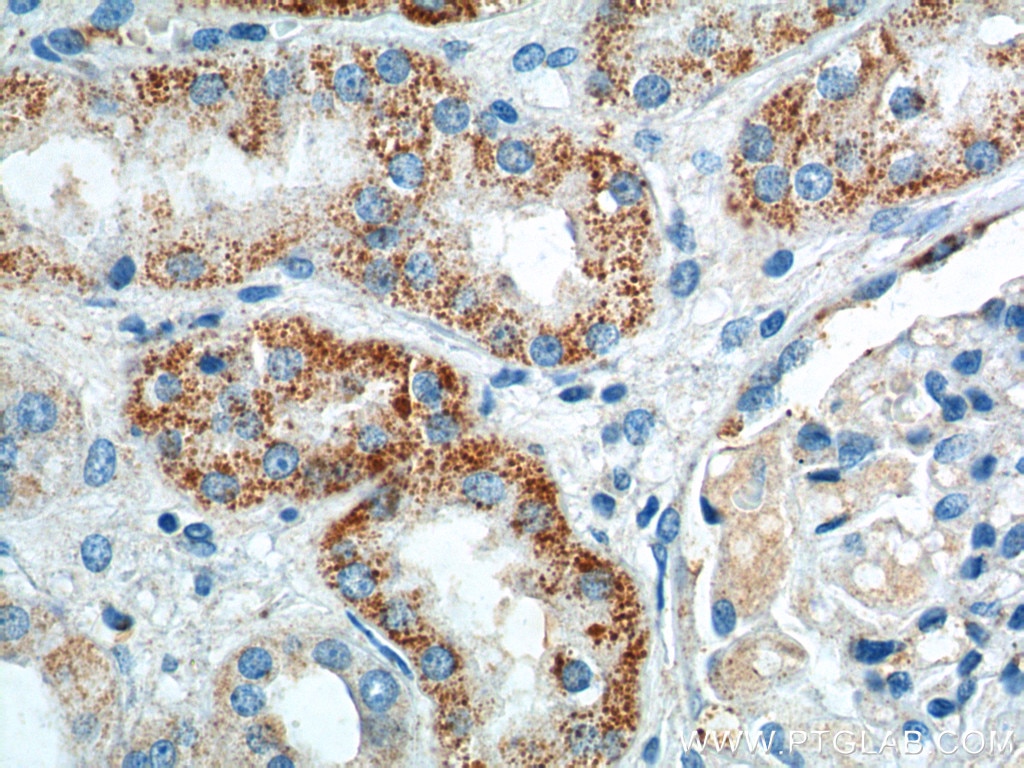

Tested Applications
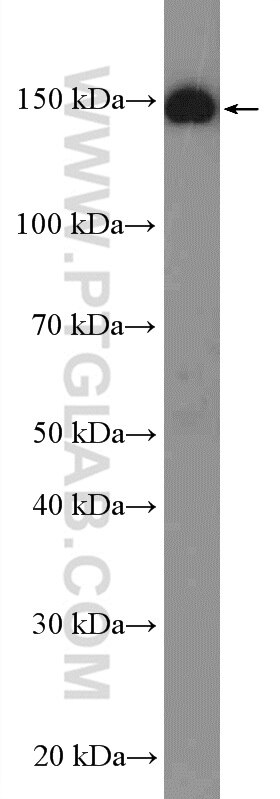
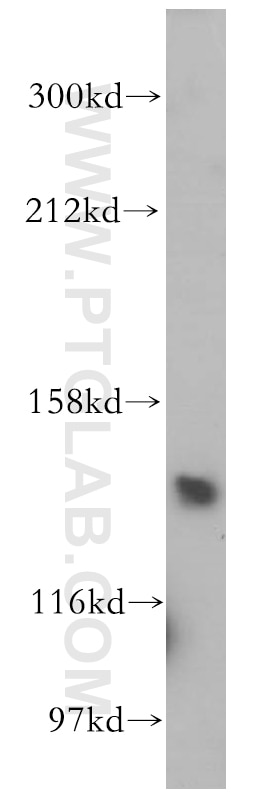
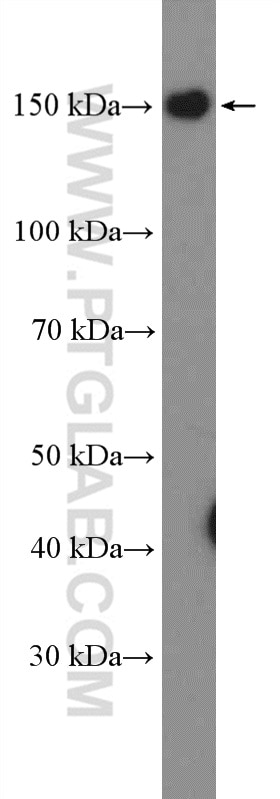
| Positive WB detected in | HEK-293 cells, HeLa cells, Y79 cells |
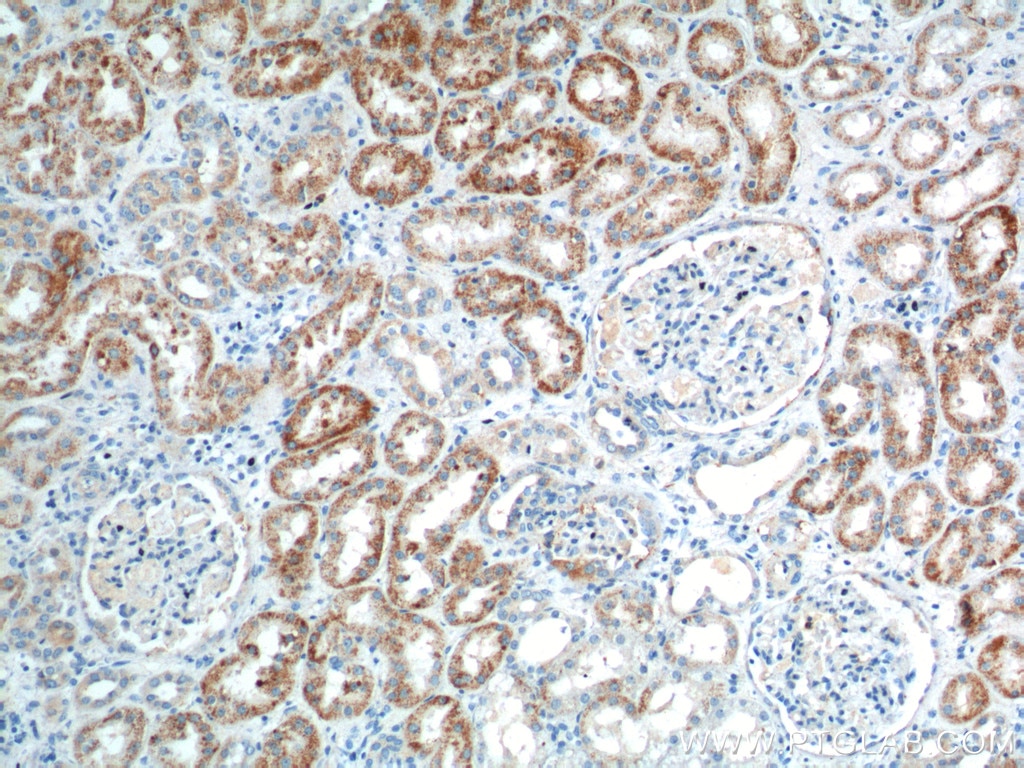
| Positive IHC detected in | human kidney tissue Note: suggested antigen retrieval with TE buffer pH 9.0; (*) Alternatively, antigen retrieval may be performed with citrate buffer pH 6.0 |
Recommended dilution
| Application | Dilution |
|---|---|
| Western Blot (WB) | WB : 1:500-1:1000 |
| Immunohistochemistry (IHC) | IHC : 1:50-1:500 |
| It is recommended that this reagent should be titrated in each testing system to obtain optimal results. | |
| Sample-dependent, Check data in validation data gallery. | |
Product Information
14047-1-AP targets GPR116 in WB, IHC, IF, ELISA applications and shows reactivity with human samples.
| Tested Reactivity | human |
| Cited Reactivity | human, mouse |
| Host / Isotype | Rabbit / IgG |
| Class | Polyclonal |
| Type | Antibody |
| Immunogen |
CatNo: Ag5214 Product name: Recombinant human GPR116 protein Source: e coli.-derived, PGEX-4T Tag: GST Domain: 34-349 aa of BC066121 Sequence: LSLHEHEPAGEEALRQKRAVATKSPTAEEYTVNIEISFENASFLDPIKAYLNSLSFPIHGNNTDQITDILSINVTTVCRPAGNEIWCSCETGYGWPRERCLHNLICQERDVFLPGHHCSCLKELPPNGPFCLLQEDVTLNMRVRLNVGFQEDLMNTSSALYRSYKTDLETAFRKGYGILPGFKGVTVTGFKSGSVVVTYEVKTTPPSLELIHKANEQVVQSLNQTYKMDYNSFQAVTINESNFFVTPEIIFEGDTVSLVCEKEVLSSNVSWRYEEQQLEIQNSSRFSIYTALFNNMTSVSKLTIHNITPGDAGEYV Predict reactive species |
| Full Name | G protein-coupled receptor 116 |
| Calculated Molecular Weight | 1346 aa, 149 kDa |
| Observed Molecular Weight | 149 kDa |
| GenBank Accession Number | BC066121 |
| Gene Symbol | GPR116 |
| Gene ID (NCBI) | 221395 |
| RRID | AB_2113095 |
| Conjugate | Unconjugated |
| Form | Liquid |
| Purification Method | Antigen affinity purification |
| UNIPROT ID | Q8IZF2 |
| Storage Buffer | PBS with 0.02% sodium azide and 50% glycerol, pH 7.3. |
| Storage Conditions | Store at -20°C. Stable for one year after shipment. Aliquoting is unnecessary for -20oC storage. 20ul sizes contain 0.1% BSA. |
Background Information
GRP116 (ADGRF5) is an adhesion-type G protein-coupled receptor expressed mainly in lung epithelium and vascular endothelium, where it governs surfactant homeostasis, vascular integrity, and epithelial signaling. Its unique GAIN/GPS-mediated autoproteolysis and 7TM signaling domains enable integration of mechanical and chemical cues into GPCR-mediated pathways. Dysregulation of GRP116 contributes to pulmonary dysfunction, tumor progression, and vascular pathologies, underscoring its importance at the intersection of adhesion, signaling, and tissue homeostasis. (PMID: 26394398)
Protocols
| Product Specific Protocols | |
|---|---|
| IHC protocol for GPR116 antibody 14047-1-AP | Download protocol |
| WB protocol for GPR116 antibody 14047-1-AP | Download protocol |
| Standard Protocols | |
|---|---|
| Click here to view our Standard Protocols |
Publications
What published studies show
The GPR116 Polyclonal antibody (Cat# 14047-1-AP) has 5 citations published in Nature Genetics, Cell Reports Medicine, Oncotarget, Scientific Reports, and Medicine (Baltimore). The associated research fields include esophageal squamous cell carcinoma, rare kidney tumors, colorectal carcinoma, periodontitis with lipid metabolism, and gastric cancer. Applications span IF, IHC, and WB in both mouse and human samples.
| Species | Application | Title |
|---|---|---|
Nat Genet Single-cell multi-omic and spatial profiling of esophageal squamous cell carcinoma reveals the immunosuppressive role of GPR116+ pericytes in cancer metastasis | ||
Oncotarget High expression of GPR116 indicates poor survival outcome and promotes tumor progression in colorectal carcinoma. | ||
Sci Rep Exploring the role of lipid metabolism related genes and immune microenvironment in periodontitis by integrating machine learning and bioinformatics analysis | ||
Medicine (Baltimore) GPR116 overexpression correlates with poor prognosis in gastric cancer. |

