

Tested Applications
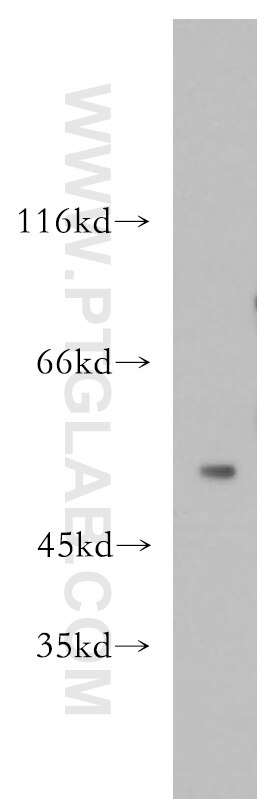
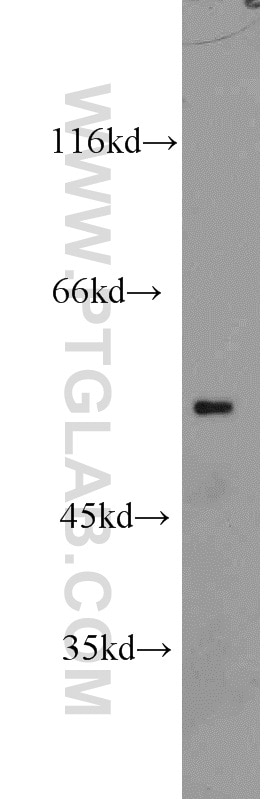
| Positive WB detected in | SH-SY5Y cells |
Recommended dilution
| Application | Dilution |
|---|---|
| Western Blot (WB) | WB : 1:500-1:1000 |
| It is recommended that this reagent should be titrated in each testing system to obtain optimal results. | |
| Sample-dependent, Check data in validation data gallery. | |
Product Information
18820-1-AP targets GPR142 in WB, ELISA applications and shows reactivity with human samples.
| Tested Reactivity | human |
| Host / Isotype | Rabbit / IgG |
| Class | Polyclonal |
| Type | Antibody |
| Immunogen |
Peptide Predict reactive species |
| Full Name | G protein-coupled receptor 142 |
| Calculated Molecular Weight | 462 aa, 51 kDa |
| Observed Molecular Weight | 51-55 kDa |
| GenBank Accession Number | BC152987 |
| Gene Symbol | GPR142 |
| Gene ID (NCBI) | 350383 |
| RRID | AB_10597384 |
| Conjugate | Unconjugated |
| Form | Liquid |
| Purification Method | Antigen affinity purification |
| UNIPROT ID | Q7Z601 |
| Storage Buffer | PBS with 0.02% sodium azide and 50% glycerol, pH 7.3. |
| Storage Conditions | Store at -20°C. Stable for one year after shipment. Aliquoting is unnecessary for -20oC storage. 20ul sizes contain 0.1% BSA. |
Background Information
GPR142, also named as PGR2, belongs to the G-protein coupled receptor 1 family. It is an orphan receptor. This antibody recognizes the 51-kDa GRP142.
Protocols
| Product Specific Protocols | |
|---|---|
| WB protocol for GPR142 antibody 18820-1-AP | Download protocol |
| Standard Protocols | |
|---|---|
| Click here to view our Standard Protocols |
Publications
What published studies show
The GPR142 Polyclonal antibody (catalog number 18820-1-AP) has a total of 1 citation. It appears in the journal BMC Genomics, in a study on Tibetan cashmere goat fiber diameter traits governed by stress, hypoxic, and metabolic adaptations, using an integrative proteome and transcriptome approach. The antibody was applied in Western Blot (WB). The associated research field is genomics and proteomics, specifically related to animal genetics and metabolic adaptation.
| Species | Application | Title |
|---|---|---|
BMC Genomics The fiber diameter traits of Tibetan cashmere goats are governed by the inherent differences in stress, hypoxic, and metabolic adaptations: an integrative study of proteome and transcriptome. |

