
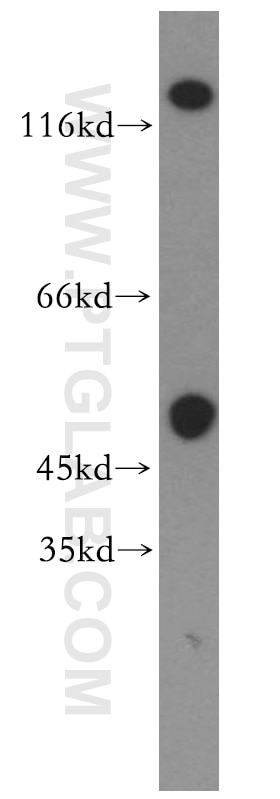

Tested Applications
| Positive WB detected in | human brain tissue |
Recommended dilution
| Application | Dilution |
|---|---|
| Western Blot (WB) | WB : 1:500-1:1000 |
| It is recommended that this reagent should be titrated in each testing system to obtain optimal results. | |
| Sample-dependent, Check data in validation data gallery. | |
Product Information
13597-1-AP targets GRIK2 in WB, IF, ELISA applications and shows reactivity with human, mouse, rat samples.
| Tested Reactivity | human, mouse, rat |
| Cited Reactivity | human |
| Host / Isotype | Rabbit / IgG |
| Class | Polyclonal |
| Type | Antibody |
| Immunogen |
CatNo: Ag4516 Product name: Recombinant human GRIK2 protein Source: e coli.-derived, PGEX-4T Tag: GST Domain: 27-353 aa of BC037954 Sequence: GYSQGTTHVLRFGGIFEYVESGPMGAEELAFRFAVNTINRNRTLLPNTTLTYDTQKINLYDSFEASKKACDQLSLGVAAIFGPSHSSSANAVQSICNALGVPHIQTRWKHQVSDNKDSFYVSLYPDFSSLSRAILDLVQFFKWKTVTVVYDDSTGLIRLQELIKAPSRYNLRLKIRQLPADTKDAKPLLKEMKRGKEFHVIFDCSHEMAAGILKQALAMGMMTEYYHYIFTTLDLFALDVEPYRYSGVNMTGFRILNTENTQVSSIIEKWSMERLQAPPKPDSGLLDGFMTMEFHSCCPGWSAMARSHLTATSASWVQAILLPQPPE Predict reactive species |
| Full Name | glutamate receptor, ionotropic, kainate 2 |
| Calculated Molecular Weight | 908 aa, 103 kDa |
| Observed Molecular Weight | 93-120 kDa |
| GenBank Accession Number | BC037954 |
| Gene Symbol | GRIK2 |
| Gene ID (NCBI) | 2898 |
| RRID | AB_10640301 |
| Conjugate | Unconjugated |
| Form | Liquid |
| Purification Method | Antigen affinity purification |
| UNIPROT ID | Q13002 |
| Storage Buffer | PBS with 0.02% sodium azide and 50% glycerol, pH 7.3. |
| Storage Conditions | Store at -20°C. Stable for one year after shipment. Aliquoting is unnecessary for -20oC storage. 20ul sizes contain 0.1% BSA. |
Protocols
| Product Specific Protocols | |
|---|---|
| WB protocol for GRIK2 antibody 13597-1-AP | Download protocol |
| Standard Protocols | |
|---|---|
| Click here to view our Standard Protocols |
Publications
What published studies show
The GRIK2 Polyclonal antibody (Cat# 13597-1-AP) has 2 total citations. One appears in Development Cell (IF 9.2), studying pulmonary cold sensing and adipose thermogenesis in obesity. The other is in Molecular Medicine (IF 8.3), investigating differentiation of human retinal pigment epithelial cells into dopaminergic-like cells. Research fields span metabolic regulation and neural stem cell biology.
| Species | Application | Title |
|---|---|---|
Dev Cell Pulmonary cold sensing through Club cells triggers adipose thermogenesis to ameliorate obesity. | ||
Mol Med Differentiation of adult human retinal pigment epithelial cells into dopaminergic-like cells in vitro and in the recipient monkey brain. |

