

Tested Applications
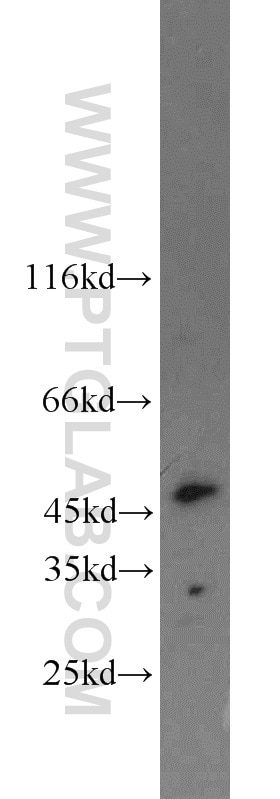
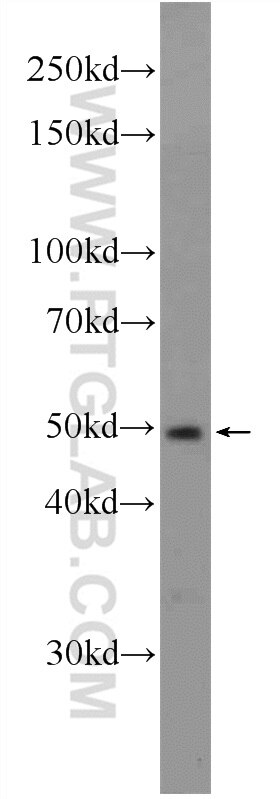
| Positive WB detected in | mouse uterus tissue, HepG2 cells |
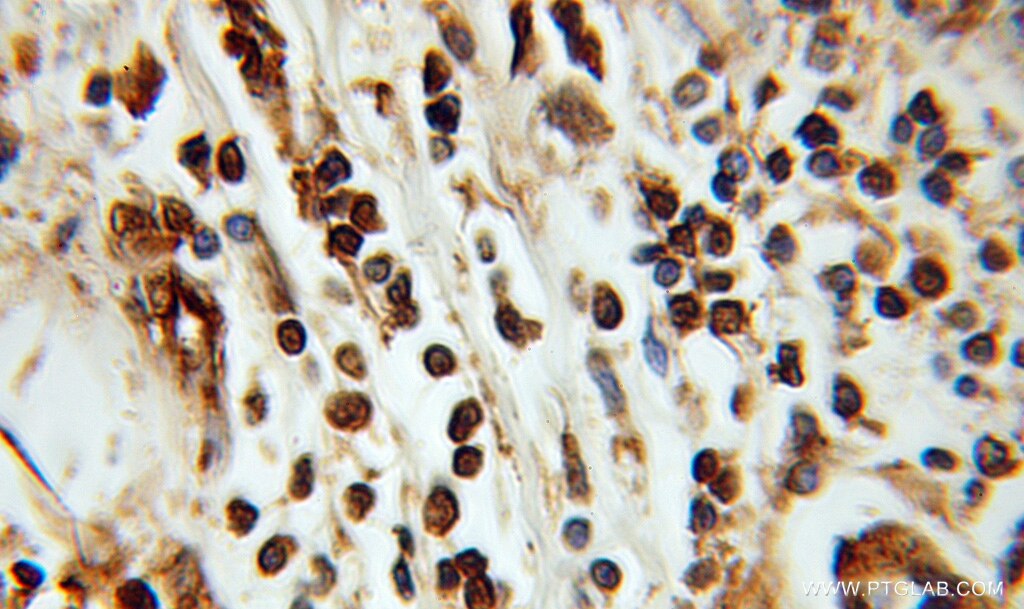
| Positive IHC detected in | human breast cancer tissue Note: suggested antigen retrieval with TE buffer pH 9.0; (*) Alternatively, antigen retrieval may be performed with citrate buffer pH 6.0 |
Recommended dilution
| Application | Dilution |
|---|---|
| Western Blot (WB) | WB : 1:500-1:1000 |
| Immunohistochemistry (IHC) | IHC : 1:20-1:200 |
| It is recommended that this reagent should be titrated in each testing system to obtain optimal results. | |
| Sample-dependent, Check data in validation data gallery. | |
Product Information
10905-1-AP targets ING3 in WB, IHC, IP, ELISA applications and shows reactivity with human, mouse samples.
| Tested Reactivity | human, mouse |
| Cited Reactivity | human |
| Host / Isotype | Rabbit / IgG |
| Class | Polyclonal |
| Type | Antibody |
| Immunogen |
CatNo: Ag1357 Product name: Recombinant human ING3 protein Source: e coli.-derived, PGEX-4T Tag: GST Domain: 1-92 aa of BC009777 Sequence: MLYLEDYLEMIEQLPMDLRDRFTEMREMDLQVQNAMDQLEQRVSEFFMNAKKNKPEWREEQMASIKKDYYKALEDADEKVQLANQIYDLQHF Predict reactive species |
| Full Name | inhibitor of growth family, member 3 |
| Calculated Molecular Weight | 46 kDa |
| Observed Molecular Weight | 47 kDa |
| GenBank Accession Number | BC009777 |
| Gene Symbol | ING3 |
| Gene ID (NCBI) | 54556 |
| RRID | AB_2127780 |
| Conjugate | Unconjugated |
| Form | Liquid |
| Purification Method | Antigen affinity purification |
| UNIPROT ID | Q9NXR8 |
| Storage Buffer | PBS with 0.02% sodium azide and 50% glycerol, pH 7.3. |
| Storage Conditions | Store at -20°C. Stable for one year after shipment. Aliquoting is unnecessary for -20oC storage. 20ul sizes contain 0.1% BSA. |
Background Information
Members of inhibitor of growth (ING) family function in inhibiting cell growth and inducing apoptosis. They are sequence homologous proteins. ING3 can activate p53 trans-activated promoters, including promoters of p21/waf1 and bax. This antibody is specifically against p47ING3.
Protocols
| Product Specific Protocols | |
|---|---|
| IHC protocol for ING3 antibody 10905-1-AP | Download protocol |
| WB protocol for ING3 antibody 10905-1-AP | Download protocol |
| Standard Protocols | |
|---|---|
| Click here to view our Standard Protocols |
Publications
What published studies show
The ING3 Polyclonal antibody (Cat# 10905-1-AP) has 7 citations published in journals including Clinical Cancer Research, Oncogene, Molecular Cancer Research, Carcinogenesis, Frontiers in Oncology, Molecular and Cellular Biology, and Indian Journal of Medical Research. The associated research fields span cancer biology—covering cutaneous melanoma, prostate cancer, colorectal cancer, and breast cancer—as well as cell signaling and protein degradation pathways, including ubiquitin-proteasome regulation and RSK-mediated survival signaling.
| Species | Application | Title |
|---|---|---|
Clin Cancer Res Prognostic significance of nuclear ING3 expression in human cutaneous melanoma. | ||
Oncogene The tumor suppressor ING3 is degraded by SCF(Skp2)-mediated ubiquitin-proteasome system.
| ||
Mol Cancer Res RSK Promotes Prostate Cancer Progression in Bone through ING3, CKAP2 and PTK6-mediated Cell Survival. | ||
Carcinogenesis The ubiquitin E3 ligase MDM2 induces chemoresistance in colorectal cancer by degradation of ING3 | ||
Front Oncol Nuclear ING3 Expression Is Correlated With a Good Prognosis of Breast Cancer. | ||
Mol Cell Biol p90 RSK2 mediates antianoikis signals by both transcription-dependent and -independent mechanisms. |

