

Tested Applications
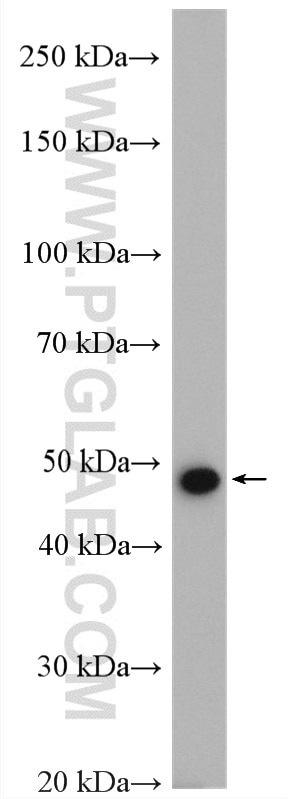
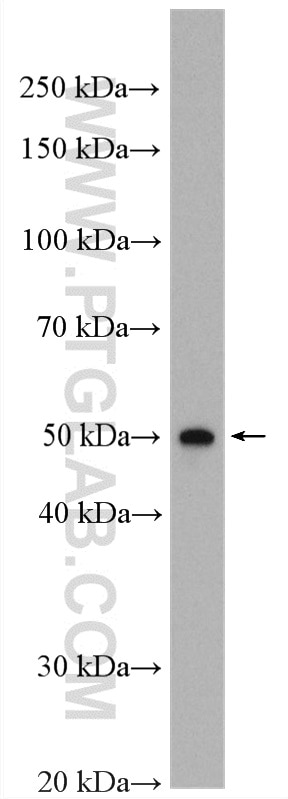
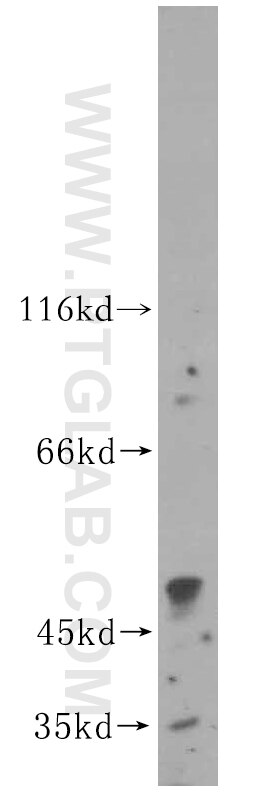
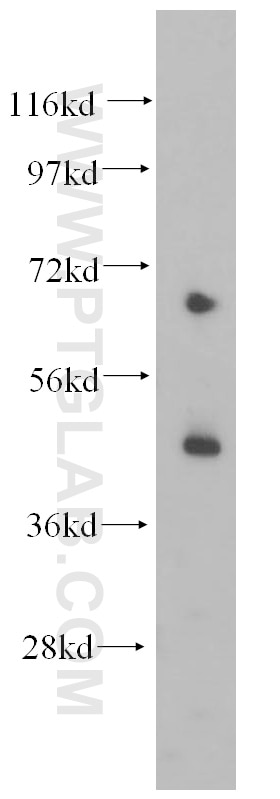
| Positive WB detected in | rat heart tissue, HepG2 cells, human heart tissue, rat skeletal muscle tissue |
Recommended dilution
| Application | Dilution |
|---|---|
| Western Blot (WB) | WB : 1:200-1:1000 |
| It is recommended that this reagent should be titrated in each testing system to obtain optimal results. | |
| Sample-dependent, Check data in validation data gallery. | |
Product Information
16920-1-AP targets Kir6.2 in WB, ELISA applications and shows reactivity with human, mouse, rat samples.
| Tested Reactivity | human, mouse, rat |
| Cited Reactivity | mouse, rat |
| Host / Isotype | Rabbit / IgG |
| Class | Polyclonal |
| Type | Antibody |
| Immunogen |
CatNo: Ag10262 Product name: Recombinant human Kir6.2 protein Source: e coli.-derived, PGEX-4T Tag: GST Domain: 169-390 aa of BC064497 Sequence: MKTAQAHRRAETLIFSKHAVIALRHGRLCFMLRVGDLRKSMIISATIHMQVVRKTTSPEGEVVPLHQVDIPMENGVGGNSIFLVAPLIIYHVIDANSPLYDLAPSDLHHHQDLEIIVILEGVVETTGITTQARTSYLADEILWGQRFVPIVAEEDGRYSVDYSKFGNTIKVPTPLCTARQLDEDHSLLEALTLASARGPLRKRSVPMAKAKPKFSISPDSLS Predict reactive species |
| Full Name | potassium inwardly-rectifying channel, subfamily J, member 11 |
| Calculated Molecular Weight | 390 aa, 44 kDa |
| Observed Molecular Weight | 48 kDa |
| GenBank Accession Number | BC064497 |
| Gene Symbol | Kir6.2 |
| Gene ID (NCBI) | 3767 |
| RRID | AB_2130461 |
| Conjugate | Unconjugated |
| Form | Liquid |
| Purification Method | Antigen affinity purification |
| UNIPROT ID | Q14654 |
| Storage Buffer | PBS with 0.02% sodium azide and 50% glycerol, pH 7.3. |
| Storage Conditions | Store at -20°C. Stable for one year after shipment. Aliquoting is unnecessary for -20oC storage. 20ul sizes contain 0.1% BSA. |
Background Information
Kir6.2 (also known as BIR or IKATP), encoded by the KCNJ11 gene, is the pore-forming unit of the ATP-sensitive K+ channel, an inward-rectifier potassium ion channel. Kir6.2 is controlled by G-proteins and is found associated with the sulfonylurea receptor (SUR) to constitute the ATP-sensitive K+ channel. The KCNJ11 gene is located at 11p15.1 and has no intron. Mutations in KCNJ11 are a cause of familial PHHI, an autosomal recessive disorder characterized by unregulated ins secretion. Defects in KCNJ11 may also contribute to autosomal dominant non-ins-dependent diabetes mellitus type II (NIDDM), transient neonatal diabetes mellitus type 3 (TNDM3), and permanent neonatal diabetes mellitus (PNDM).
Protocols
| Product Specific Protocols | |
|---|---|
| WB protocol for Kir6.2 antibody 16920-1-AP | Download protocol |
| Standard Protocols | |
|---|---|
| Click here to view our Standard Protocols |
Publications
What published studies show
The Kir6.2 Polyclonal antibody (Cat# 16920-1-AP) has 4 citations across four journals: Ecotoxicology and Environmental Safety, Life Sciences, International Immunopharmacology, and Scientific Reports. Research fields include manganese neurotoxicity and autophagy impairment, KATP channel modulation of neurotransmitter release at neuromuscular junctions, Kir6.2 expression in endothelial cells related to neuropathic pain, and glucocorticoid receptor regulation of insulin secretion in pancreatic β-cells. Applications cited include Western blot in mouse and rat models.
| Species | Application | Title |
|---|---|---|
Ecotoxicol Environ Saf Kir6.2-KATP channel: A new target for manganese neurotoxicity induced autophagy impairment and oxidative stress injury. | ||
Life Sci KATP channels as ROS-dependent modulator of neurotransmitter release at the neuromuscular junctions | ||
Int Immunopharmacol Nicorandil restores endothelial cell Kir6.2 expression to alleviate neuropathic pain in mice after chronic constriction injury | ||
Sci Rep Glucocorticoid receptor-NECAB1 axis can negatively regulate insulin secretion in pancreatic β-cells |

