
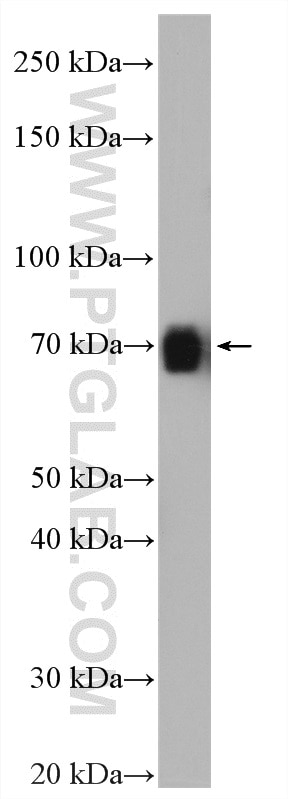

Tested Applications
| Positive WB detected in | mouse brain tissue |
Recommended dilution
| Application | Dilution |
|---|---|
| Western Blot (WB) | WB : 1:1000-1:4000 |
| It is recommended that this reagent should be titrated in each testing system to obtain optimal results. | |
| Sample-dependent, Check data in validation data gallery. | |
Product Information
17929-1-AP targets KCNN1 in WB, ELISA applications and shows reactivity with human, mouse, rat samples.
| Tested Reactivity | human, mouse, rat |
| Cited Reactivity | mouse |
| Host / Isotype | Rabbit / IgG |
| Class | Polyclonal |
| Type | Antibody |
| Immunogen |
CatNo: Ag12357 Product name: Recombinant human KCNN1 protein Source: e coli.-derived, PGEX-4T Tag: GST Domain: 366-543 aa of BC075037 Sequence: ARKLELTKAEKHVHNFMMDTQLTKRVKNAAANVLRETWLIYKHTRLVKKPDQARVRKHQRKFLQAIHQAQKLRSVKIEQGKLNDQANTLTDLAKTQTVMYDLVSELHAQHEELEARLATLESRLDALGASLQALPGLIAQAIRPPPPPLPPRPGPGPQDQAARSSPCRWTPVAPSDCG Predict reactive species |
| Full Name | potassium intermediate/small conductance calcium-activated channel, subfamily N, member 1 |
| Calculated Molecular Weight | 543 aa, 60 kDa |
| Observed Molecular Weight | 70 kDa |
| GenBank Accession Number | BC075037 |
| Gene Symbol | KCNN1 |
| Gene ID (NCBI) | 3780 |
| RRID | AB_2131511 |
| Conjugate | Unconjugated |
| Form | Liquid |
| Purification Method | Antigen affinity purification |
| UNIPROT ID | Q92952 |
| Storage Buffer | PBS with 0.02% sodium azide and 50% glycerol, pH 7.3. |
| Storage Conditions | Store at -20°C. Stable for one year after shipment. Aliquoting is unnecessary for -20oC storage. 20ul sizes contain 0.1% BSA. |
Protocols
| Product Specific Protocols | |
|---|---|
| WB protocol for KCNN1 antibody 17929-1-AP | Download protocol |
| Standard Protocols | |
|---|---|
| Click here to view our Standard Protocols |
Publications
What published studies show
The KCNN1 Polyclonal antibody (catalog number 17929-1-AP) has 2 total citations. One appears in International Journal of Molecular Sciences, studying how Kadsura coccinea roots ameliorate alcohol-induced liver injury by modulating oxidative stress via the Nrf2/MAPK signaling pathway, using WB in mouse. The other is in Proceedings of the National Academy of Sciences (PNAS), investigating how neuronal overexpression of Kcnn1 in A53T α-synuclein mice suppresses phospho-serine 129 α-synuclein formation and extends survival. Research fields span liver injury/oxidative stress and neurodegeneration/Parkinson's disease.
| Species | Application | Title |
|---|---|---|
Int J Mol Sci Kadsura coccinea Roots Ameliorated Alcohol-Induced Liver Injury by Modulating Oxidative Stress Through the Regulation of the Nrf2/MAPK Signaling Pathway. | ||
Proc Natl Acad Sci U S A Neuronal overexpression of Kcnn1 in A53T α-synuclein mice suppresses phospho-serine 129 α-synuclein formation and doubles survival time. |

