
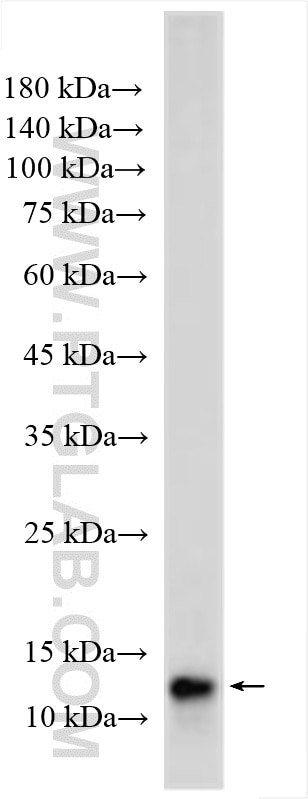



Tested Applications
| Positive WB detected in | human placenta tissue |
| Positive IHC detected in | human placenta tissue, human lung cancer tissue, human liver cancer tissue Note: suggested antigen retrieval with TE buffer pH 9.0; (*) Alternatively, antigen retrieval may be performed with citrate buffer pH 6.0 |
Recommended dilution
| Application | Dilution |
|---|---|
| Western Blot (WB) | WB : 1:2000-1:10000 |
| Immunohistochemistry (IHC) | IHC : 1:50-1:1600 |
| It is recommended that this reagent should be titrated in each testing system to obtain optimal results. | |
| Sample-dependent, Check data in validation data gallery. | |
Product Information
18375-1-AP targets KISS1 in WB, IHC, IF, ELISA applications and shows reactivity with human samples.
| Tested Reactivity | human |
| Cited Reactivity | human, mouse, rat |
| Host / Isotype | Rabbit / IgG |
| Class | Polyclonal |
| Type | Antibody |
| Immunogen |
CatNo: Ag13240 Product name: Recombinant human KISS1 protein Source: e coli.-derived, PGEX-4T Tag: GST Domain: 1-138 aa of BC022819 Sequence: MNSLVSWQLLLFLCATHFGEPLEKVASVGNSRPTGQQLESLGLLAPGEQSLPCTERKPAATARLSRRGTSLSPPPESSGSPQQPGLSAPHSRQIPAPQGAVLVQREKDLPNYNWNSFGLRFGKREAAPGNHGRSAGRG Predict reactive species |
| Full Name | KiSS-1 metastasis-suppressor |
| Calculated Molecular Weight | 15 kDa |
| Observed Molecular Weight | 10-15 kDa |
| GenBank Accession Number | BC022819 |
| Gene Symbol | KISS1 |
| Gene ID (NCBI) | 3814 |
| RRID | AB_11182705 |
| Conjugate | Unconjugated |
| Form | Liquid |
| Purification Method | Antigen affinity purification |
| UNIPROT ID | Q15726 |
| Storage Buffer | PBS with 0.02% sodium azide and 50% glycerol, pH 7.3. |
| Storage Conditions | Store at -20°C. Stable for one year after shipment. Aliquoting is unnecessary for -20oC storage. 20ul sizes contain 0.1% BSA. |
Background Information
KISS1, also known as kisspeptin, is a metastasis suppressor protein that suppresses metastases of human melanomas and breast carcinomas without affecting tumorigenicity. It may regulate events downstream of cell-matrix adhesion, perhaps involving cytoskeletal reorganization. A C-terminally amidated peptide of KISS1, metastin (kisspeptin-54 or kp-54), functions as the endogenous ligand of the G-protein coupled receptor GPR54 (PMID: 11457843; 11385580). KISS1-GPR54 signaling is involved in the regulation of reproduction, playing an important role in initiating secretion of gonadotropin-releasing hormone (GnRH) at puberty (PMID: 18753370).
Protocols
| Product Specific Protocols | |
|---|---|
| IHC protocol for KISS1 antibody 18375-1-AP | Download protocol |
| WB protocol for KISS1 antibody 18375-1-AP | Download protocol |
| Standard Protocols | |
|---|---|
| Click here to view our Standard Protocols |
Publications
What published studies show
The KiSS1 (Kisspeptin) antibody (Cat# 18375-1-AP) has 9 total citations. These appear in journals including Cells, Int J Cancer, Cell Signal, Mol Oncol, Histochem Cell Biol, PLoS One, Vet J, Oncol Lett, and Curr Eye Res. Research fields span hepatic fibrosis, ovarian cancer metastasis, neurodevelopment, colorectal cancer, hepatocellular carcinoma, polycystic ovary syndrome, reproductive function, and ocular cell biology, with applications in WB, IHC, and IF.
| Species | Application | Title |
|---|---|---|
Cells Kisspeptin Alleviates Human Hepatic Fibrogenesis by Inhibiting TGFβ Signaling in Hepatic Stellate Cells | ||
Int J Cancer Long noncoding RNA TC0101441 induces epithelial-mesenchymal transition in epithelial ovarian cancer metastasis by downregulating KiSS1.
| ||
Cell Signal Overexpression of Rap1B alleviate central precocious puberty and neurodevelopmental damage | ||
Mol Oncol Ryanodine receptor 2 promotes colorectal cancer metastasis by the ROS/BACH1 axis | ||
Histochem Cell Biol Functional analysis of miR-767-5p during the progression of hepatocellular carcinoma and the clinical relevance of its dysregulation. | ||
PLoS One Kisspeptin improves local ovarian insulin resistance in PCOS by modulating the PI3K/AKT/GLUT4 signaling pathway. |
Reviews
What customers say
The product received a 5-star rating from a Western Blot application using a 1:500 dilution. The reviewer reported positive results when working with MDA-MB-231 cells, noting an observable increase in modified protein expression. Overall, the feedback indicates the antibody performed well and delivered clear, reliable results in the user's experimental setup.
The reviews below have been submitted by verified Proteintech customers who received an incentive for providing their feedback.
Kristina (Verified Customer) (09-18-2020) | Works great for us- seeing an increase in modified MDA231 cells.
|


