
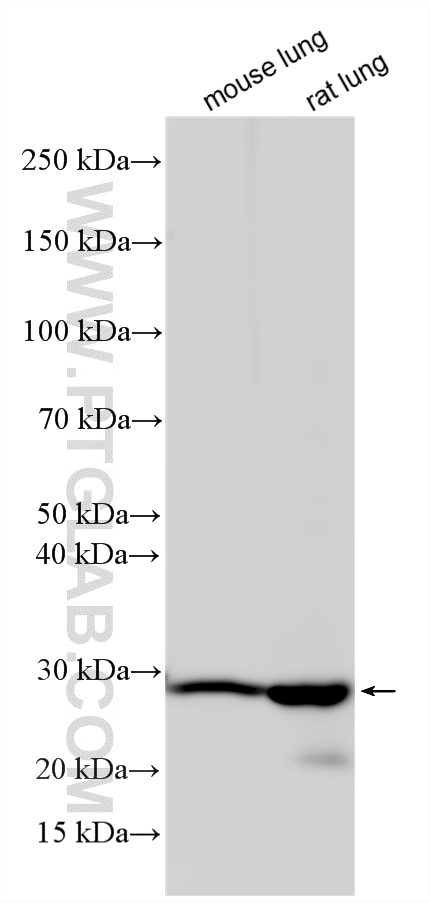
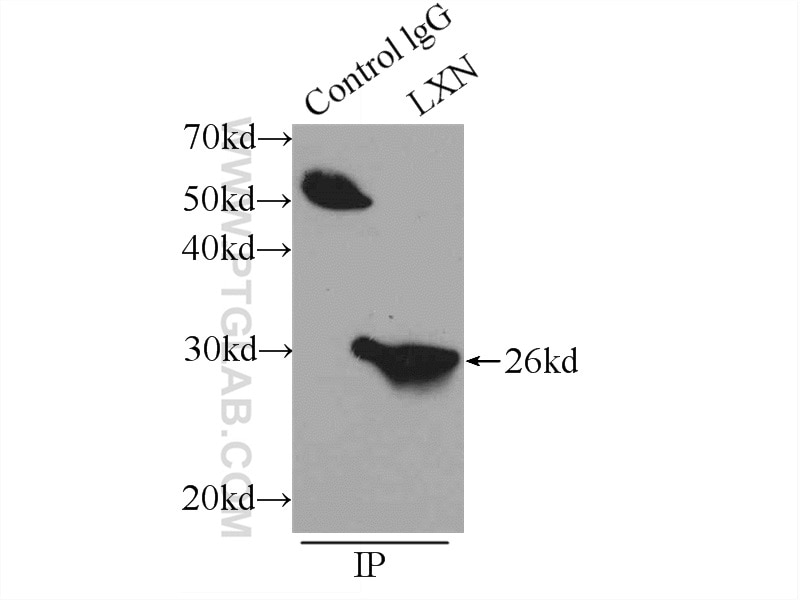
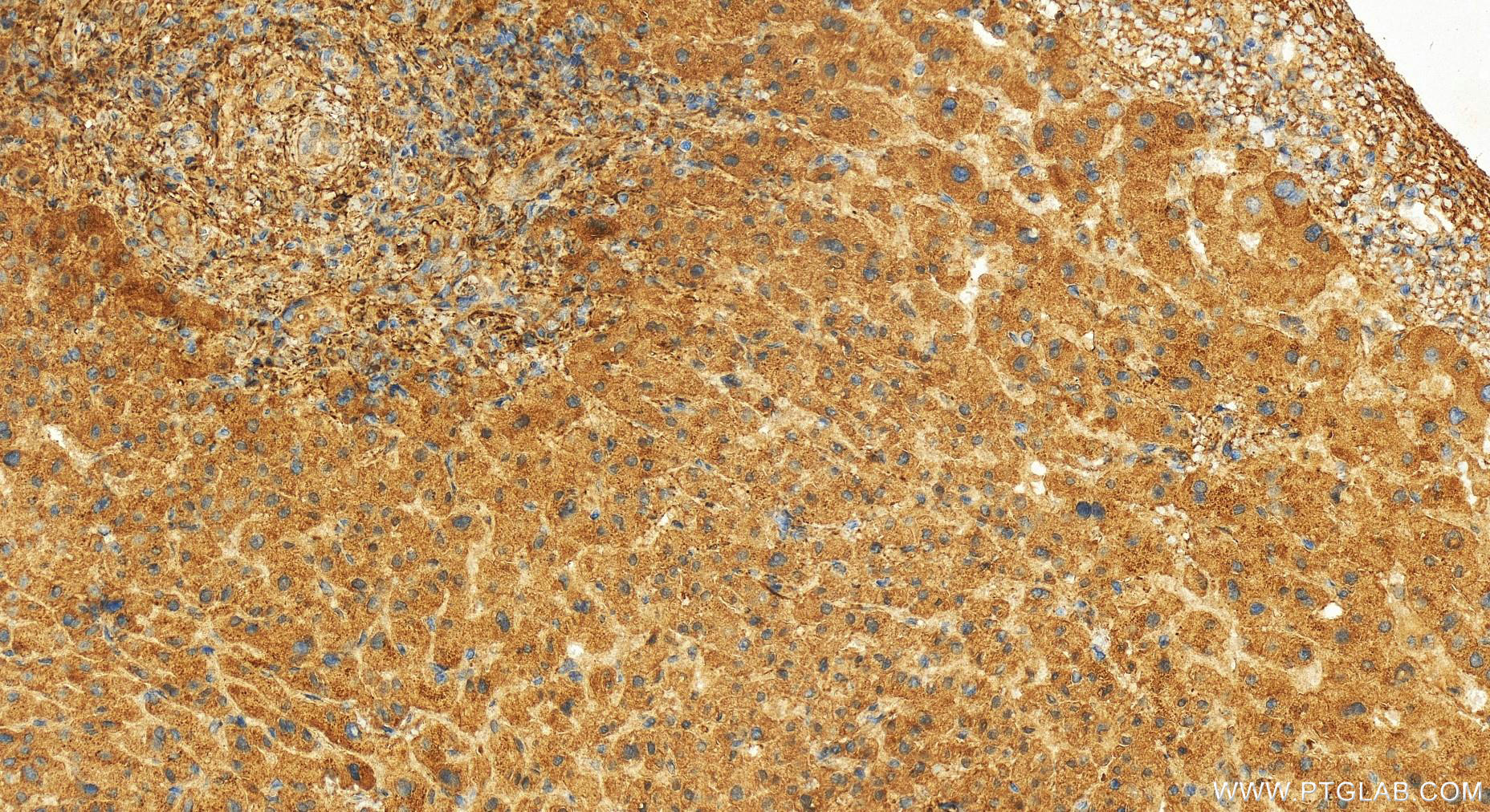

Tested Applications
| Positive WB detected in | mouse lung tissue, rat lung tissue |
| Positive IP detected in | mouse lung tissue |
| Positive IHC detected in | human intrahepatic cholangiocarcinoma tissue Note: suggested antigen retrieval with TE buffer pH 9.0; (*) Alternatively, antigen retrieval may be performed with citrate buffer pH 6.0 |
Recommended dilution
| Application | Dilution |
|---|---|
| Western Blot (WB) | WB : 1:2000-1:12000 |
| Immunoprecipitation (IP) | IP : 0.5-4.0 ug for 1.0-3.0 mg of total protein lysate |
| Immunohistochemistry (IHC) | IHC : 1:50-1:500 |
| It is recommended that this reagent should be titrated in each testing system to obtain optimal results. | |
| Sample-dependent, Check data in validation data gallery. | |
Product Information
13056-1-AP targets LXN in WB, IHC, IF, IP, ELISA applications and shows reactivity with human, mouse, rat samples.
| Tested Reactivity | human, mouse, rat |
| Cited Reactivity | mouse |
| Host / Isotype | Rabbit / IgG |
| Class | Polyclonal |
| Type | Antibody |
| Immunogen |
CatNo: Ag3726 Product name: Recombinant human LXN protein Source: e coli.-derived, PGEX-4T Tag: GST Domain: 1-222 aa of BC005346 Sequence: MEIPPTNYPASRAALVAQNYINYQQGTPHRVFEVQKVKQASMEDIPGRGHKYRLKFAVEEIIQKQVKVNCTAEVLYPSTGQETAPEVNFTFEGETGKNPDEEDNTFYQRLKSMKEPLEAQNIPDNFGNVSPEMTLVLHLAWVACGYIIWQNSTEDTWYKMVKIQTVKQVQRNDDFIELDYTILLHNIASQEIIPWQMQVLWHPQYGTKVKHNSRLPKEVQLE Predict reactive species |
| Full Name | latexin |
| Calculated Molecular Weight | 222 aa, 26 kDa |
| Observed Molecular Weight | 26 kDa |
| GenBank Accession Number | BC005346 |
| Gene Symbol | LXN |
| Gene ID (NCBI) | 56925 |
| RRID | AB_2139511 |
| Conjugate | Unconjugated |
| Form | Liquid |
| Purification Method | Antigen affinity purification |
| UNIPROT ID | Q9BS40 |
| Storage Buffer | PBS with 0.02% sodium azide and 50% glycerol, pH 7.3. |
| Storage Conditions | Store at -20°C. Stable for one year after shipment. Aliquoting is unnecessary for -20oC storage. 20ul sizes contain 0.1% BSA. |
Background Information
Latexin, also named as LTXN, LXN, ECI, MUM and TCI, is hardly reversible, non-competitive, and potent inhibitor of CPA1, CPA2 and CPA4. It may function as a neuroprotective mechanism against tau toxicity.
Protocols
| Product Specific Protocols | |
|---|---|
| IHC protocol for LXN antibody 13056-1-AP | Download protocol |
| IP protocol for LXN antibody 13056-1-AP | Download protocol |
| WB protocol for LXN antibody 13056-1-AP | Download protocol |
| Standard Protocols | |
|---|---|
| Click here to view our Standard Protocols |
Publications
What published studies show
The LXN Polyclonal antibody (Cat# 13056-1-AP) has 4 citations published in Nature Neuroscience, International Journal of Biological Macromolecules, Cell Reports, and Brain Research. The research fields span neuroscience (spinal cord injury, stroke, astrocytic neuroprotection, tau pathology), intestinal biology (organogenesis and injury repair), and hematopoiesis (sex dimorphism regulation). All cited studies used mouse samples with WB and/or IF applications.
| Species | Application | Title |
|---|---|---|
Nat Neurosci Derivation and transcriptional reprogramming of border-forming wound repair astrocytes after spinal cord injury or stroke in mice | ||
Int J Biol Macromol Carboxypeptidase inhibitor Latexin (LXN) regulates intestinal organogenesis and intestinal remodeling involved in intestinal injury repair in mice
| ||
Cell Rep Latexin regulates sex dimorphism in hematopoiesis via gender-specific differential expression of microRNA 98-3p and thrombospondin 1 | ||
Brain Res Astrocytic neuroprotection through induction of cytoprotective molecules; a proteomic analysis of mutant P301S tau-transgenic mouse. |
Reviews
What customers say
Both reviews come from the same user who tested this antibody at a 1:1000 dilution for Western Blot and Immunoprecipitation. One review (5 stars) reports excellent performance in both WB and IP across multiple cell types including HUVECs, RASMCs, and HEK293T cells, as well as aorta tissue. The other review (4 stars) confirms it works well for IP studies in HEK293T cells. Overall, users report reliable and effective results for WB and IP applications.
The reviews below have been submitted by verified Proteintech customers who received an incentive for providing their feedback.
Kyosuke (Verified Customer) (06-12-2019) | It works for IP study.
|
Kyosuke (Verified Customer) (06-05-2019) | It works for WB and IP very well.
|

