
"MBP-Tag Antibodies" Comparison
View side-by-side comparison of MBP-Tag antibodies from other vendors to find the one that best suits your research needs.

Tested Applications
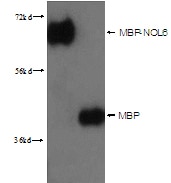
| Positive WB detected in | lane1: MBP-NOL6 64kd; lane2 MBP 42kd, Recombinant protein, transfected HEK-293T cells |
Recommended dilution
| Application | Dilution |
|---|---|
| Western Blot (WB) | WB : 1:1000-1:6000 |
| It is recommended that this reagent should be titrated in each testing system to obtain optimal results. | |
| Sample-dependent, Check data in validation data gallery. | |
Product Information
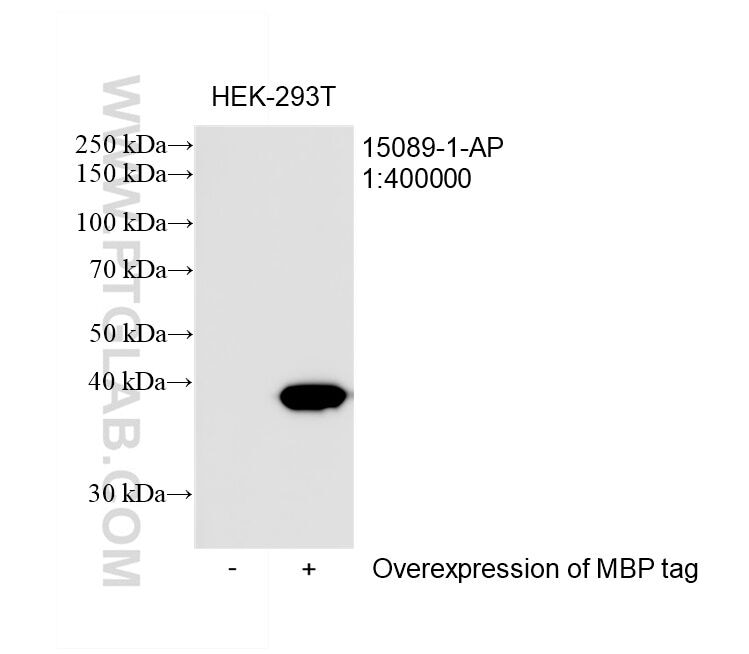
15089-1-AP targets MBP-Tag in WB, IHC, IF, IP, CoIP, ELISA applications and shows reactivity with recombinant protein samples.
| Tested Reactivity | recombinant protein |
| Cited Reactivity | mouse |
| Host / Isotype | Rabbit / IgG |
| Class | Polyclonal |
| Type | Antibody |
| Immunogen |
CatNo: Ag0942 Product name: Recombinant MBP-Tag protein Source: e coli.-derived, Unknow Tag: N/A Sequence: Predict reactive species |
| Full Name | MBP-Tag |
| Calculated Molecular Weight | 40 kDa |
| Gene Symbol | |
| Gene ID (NCBI) | |
| RRID | AB_1607774 |
| Conjugate | Unconjugated |
| Form | Liquid |
| Purification Method | Antigen affinity purification |
| Storage Buffer | PBS with 0.02% sodium azide and 50% glycerol, pH 7.3. |
| Storage Conditions | Store at -20°C. Stable for one year after shipment. Aliquoting is unnecessary for -20oC storage. 20ul sizes contain 0.1% BSA. |
Background Information
Protein tags are protein or peptide sequences located either on the C- or N- terminal of the target protein, which facilitates one or several of the following characteristics: solubility, detection, purification, localization and expression. Maltose binding protein (MBP) is the 370 amino acid product of the E.coli mal E gene. MBP is a useful affinity tag that can increase the expression level and solubility of the resulting tagged protein. The MBP tag also promotes proper folding of the attached protein. Plasmid vectors have been constructed utilizing the MBP domain that allow the synthesis of high levels of MBP-fusion proteins that can be purified in a one step procedure by affinity chromatography cross linked amylose resin. Once bound to amylose, the MBP protein can then be separated from the target protein by cleavage by coagulation Factor Xa at a specific four residue site. Alternatively, the intact fusion protein can be specifically eluted from the resin by the addition of excess free maltose. Subsequent to elution, MBP fusion protein can be visualized either by western blot analysis or immunoprecipitation using antibodies specific for the MBP-tag. This antibody recognizes MBP (Maltose binding protein) TAG in some expression systems.
Publications
What published studies show
The MBP-Tag Polyclonal antibody (catalog number 15089-1-AP) has 40 citations. These appear in journals including Nature, Nature Communications, Cell Research, Blood, Science Advances, New Phytologist, Plant Physiology, EMBO Journal, and Proceedings of the National Academy of Sciences. Research fields span plant biology (signaling, stress responses, development), neuroscience (spinal cord injury, Alzheimer's disease), autophagy, protein modification, immunology, virology, and synthetic biology. Applications include Western blot, immunoprecipitation, immunofluorescence, ELISA, and immunohistochemistry.
| Species | Application | Title |
|---|---|---|
Signal Transduct Target Ther GOLM1 restricts colitis and colon tumorigenesis by ensuring Notch signaling equilibrium in intestinal homeostasis. | ||
Blood γ-Glutamyl carboxylase mutations differentially affect the biological function of vitamin K-dependent proteins. | ||
Bioact Mater Exosomes-loaded electroconductive nerve dressing for nerve regeneration and pain relief against diabetic peripheral nerve injury | ||
Nat Commun Salt stress activates the CDK8-AHL10-SUVH2/9 module to dynamically regulate salt tolerance in Arabidopsis |

