




Tested Applications
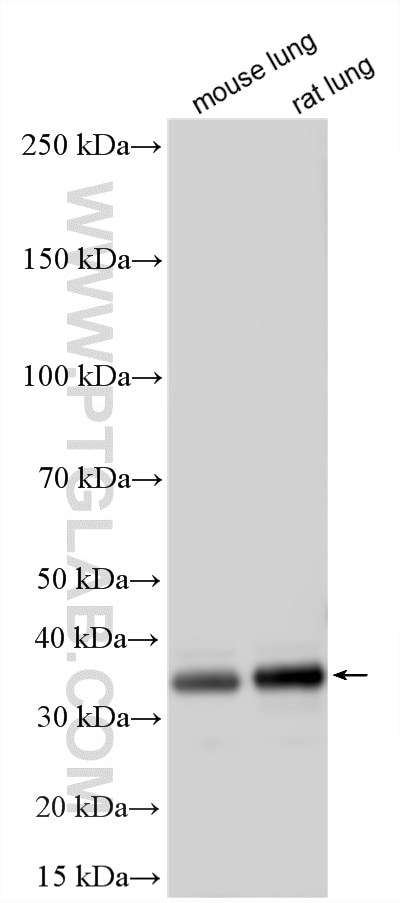
| Positive WB detected in | human kidney tissue, mouse heart tissue, mouse lung tissue, rat lung tissue |
| Positive IHC detected in | human lung tissue, human placenta tissue, human testis tissue, human skin tissue, human spleen tissue Note: suggested antigen retrieval with TE buffer pH 9.0; (*) Alternatively, antigen retrieval may be performed with citrate buffer pH 6.0 |
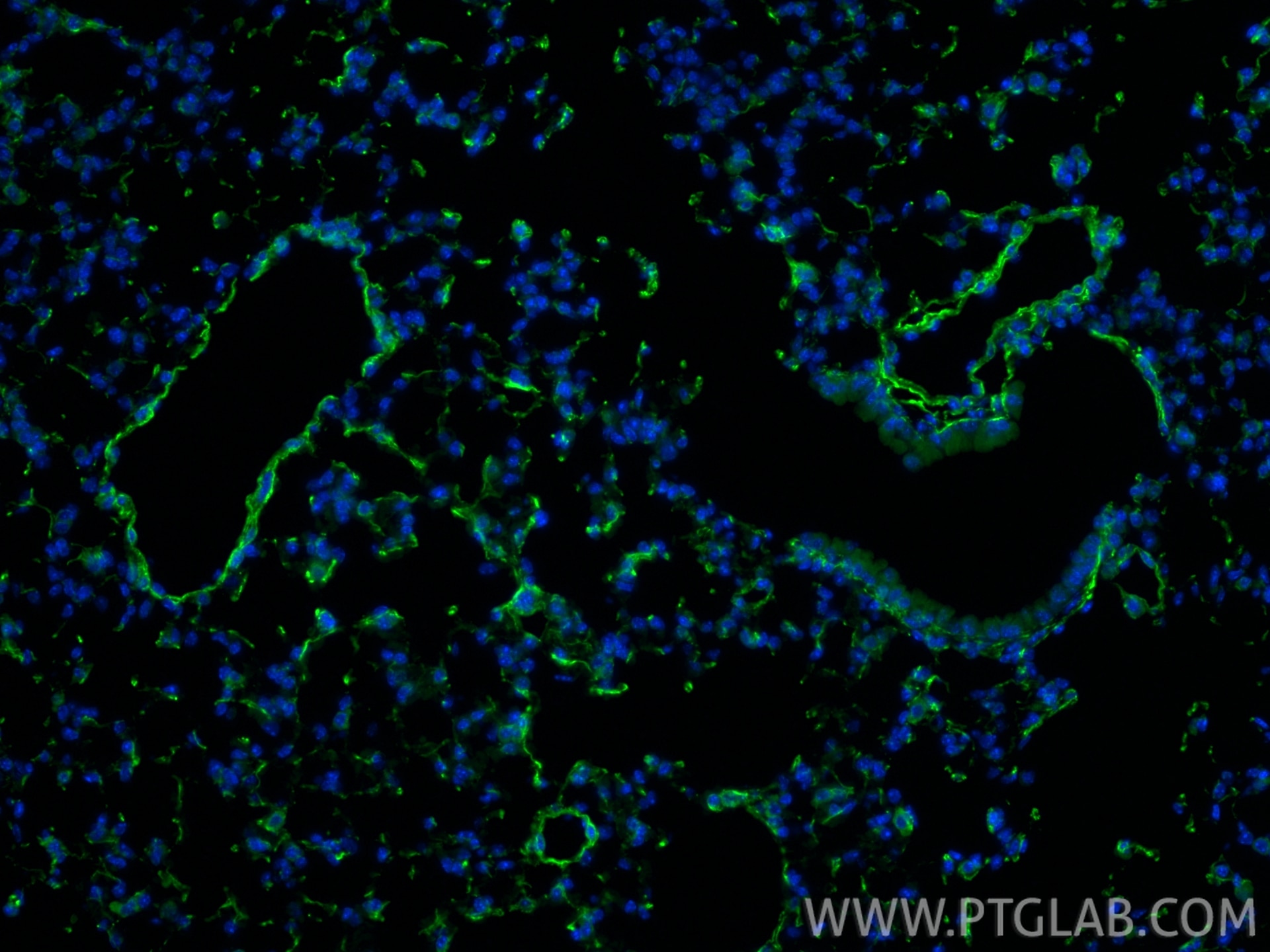
| Positive IF-P detected in | mouse lung tissue |
Recommended dilution
| Application | Dilution |
|---|---|
| Western Blot (WB) | WB : 1:500-1:3000 |
| Immunohistochemistry (IHC) | IHC : 1:250-1:1000 |
| Immunofluorescence (IF)-P | IF-P : 1:200-1:800 |
| It is recommended that this reagent should be titrated in each testing system to obtain optimal results. | |
| Sample-dependent, Check data in validation data gallery. | |
Product Information
17661-1-AP targets MFAP4 in WB, IHC, IF-P, ELISA applications and shows reactivity with human, mouse, rat samples.
| Tested Reactivity | human, mouse, rat |
| Cited Reactivity | human, mouse |
| Host / Isotype | Rabbit / IgG |
| Class | Polyclonal |
| Type | Antibody |
| Immunogen |
CatNo: Ag11920 Product name: Recombinant human MFAP4 protein Source: e coli.-derived, PGEX-4T Tag: GST Domain: 1-255 aa of BC062415 Sequence: MKALLALPLLLLLSTPPCAPQVSGIRGDALERFCLQQPLDCDDIYAQGYQSDGVYLIYPSGPSVPVPVFCDMTTEGGKWTVFQKRFNGSVSFFRGWNDYKLGFGRADGEYWLGLQNMHLLTLKQKYELRVDLEDFENNTAYAKYADFSISPNAVSAEEDGYTLFVAGFEDGGVGDSLSYHSGQKFSTFDRDQDLFVQNCAALSSGAFWFRSCHFANLNGFYLGGSHLSYANGINWAQWKGFYYSLKRTEMKIRRA Predict reactive species |
| Full Name | microfibrillar-associated protein 4 |
| Calculated Molecular Weight | 255 aa, 29 kDa |
| Observed Molecular Weight | 36 kDa |
| GenBank Accession Number | BC062415 |
| Gene Symbol | MFAP4 |
| Gene ID (NCBI) | 4239 |
| RRID | AB_2142355 |
| Conjugate | Unconjugated |
| Form | Liquid |
| Purification Method | Antigen affinity purification |
| UNIPROT ID | P55083 |
| Storage Buffer | PBS with 0.02% sodium azide and 50% glycerol, pH 7.3. |
| Storage Conditions | Store at -20°C. Stable for one year after shipment. Aliquoting is unnecessary for -20oC storage. 20ul sizes contain 0.1% BSA. |
Background Information
Microfibrillar-associated protein 4 (MFAP4) is a extracellular matrix glycoprotein containing a fibrinogen C-terminal domain and a N-terminal located integrin-binding motif. It could be involved in calcium-dependent cell adhesion or intercellular interactions. MFAP4 gene is commonly deleted in Smith-Magenis syndrome patients. (PMID: 7633408; 16867155; 10542261; 18322703)
Protocols
| Product Specific Protocols | |
|---|---|
| IF protocol for MFAP4 antibody 17661-1-AP | Download protocol |
| IHC protocol for MFAP4 antibody 17661-1-AP | Download protocol |
| WB protocol for MFAP4 antibody 17661-1-AP | Download protocol |
| Standard Protocols | |
|---|---|
| Click here to view our Standard Protocols |
Publications
What published studies show
The MFAP4 Polyclonal antibody (Cat# 17661-1-AP) has 18 citations. These appear in journals including Nature Communications, Phytomedicine, Thorax, Cell Mol Gastroenterol Hepatol, Frontiers in Pharmacology, BMC Biology, Journal of Integrative Medicine, Scientific Reports, Translational Oncology, Molecular and Cellular Biochemistry, FASEB Journal, Journal of Proteome Research, Experimental Dermatology, Journal of Proteomics, Discover Oncology, and Frontiers in Pediatrics. Research fields span fibrosis, atherosclerosis, cancer (glioma, lung, ovarian, bladder, breast), cardiomyopathy, photoaging, nerve regeneration, and wound repair.
| Species | Application | Title |
|---|---|---|
Nat Commun Clec3b⁺ fibroblasts are the primary effectors of portal fibrosis following activation via a KLF4/periostin axis | ||
Phytomedicine Gualou Huoxue Jiedu Decoction inhibits VSMC phenotypic switching to alleviate atherosclerosis via promoting Mfap4 DNA methylation. | ||
Thorax A large lung gene expression study identifying fibulin-5 as a novel player in tissue repair in COPD. | ||
Cell Mol Gastroenterol Hepatol MFAP4 Deficiency Attenuates Liver Fibrosis by Regulating Hepatic Stellate Cell Fate Through Inhibition of the FAK/PI3K/NFκB Signaling Pathway | ||
BMC Biol The m6A writer KIAA1429 regulates photoaging progression via MFAP4-dependent collagen synthesis | ||
Front Pharmacol MFAP4 is a novel prognostic biomarker in glioma correlating with immunotherapy resistance and ferroptosis |


