

Tested Applications
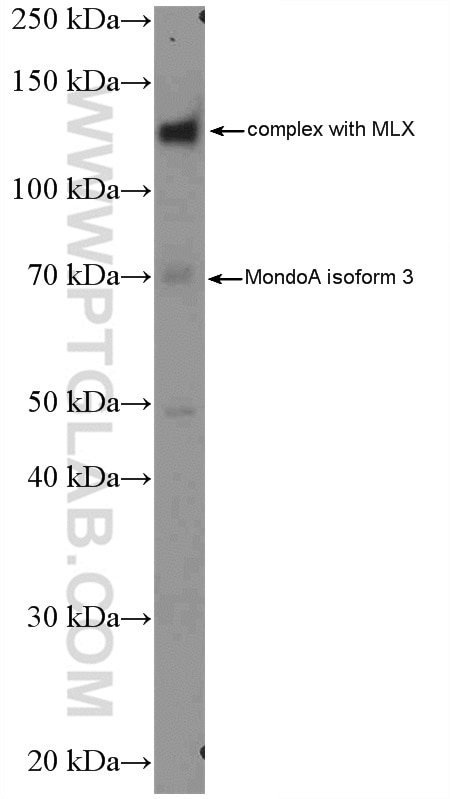
| Positive WB detected in | K-562 cells |
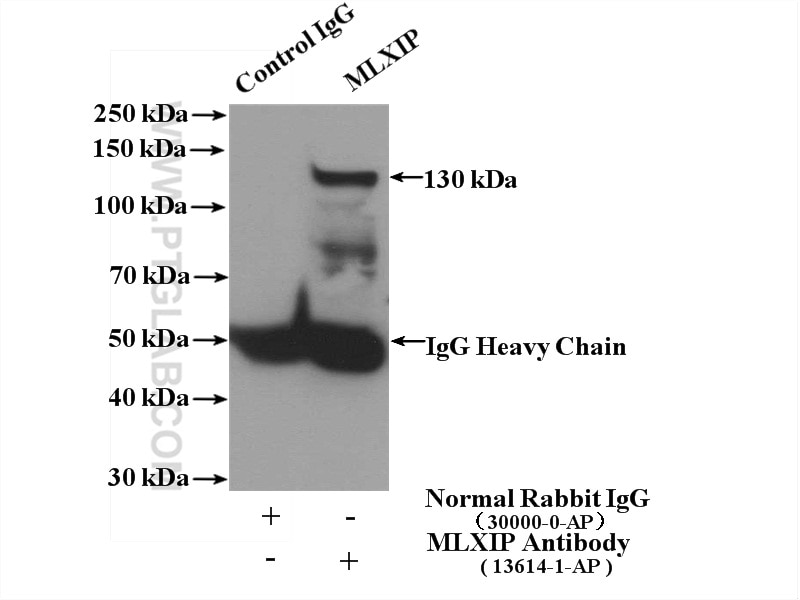
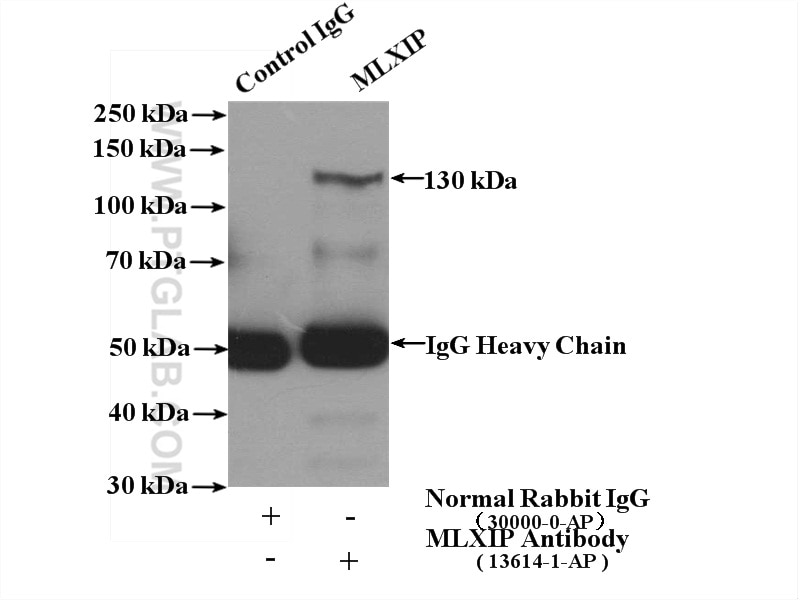
| Positive IP detected in | K-562 cells |
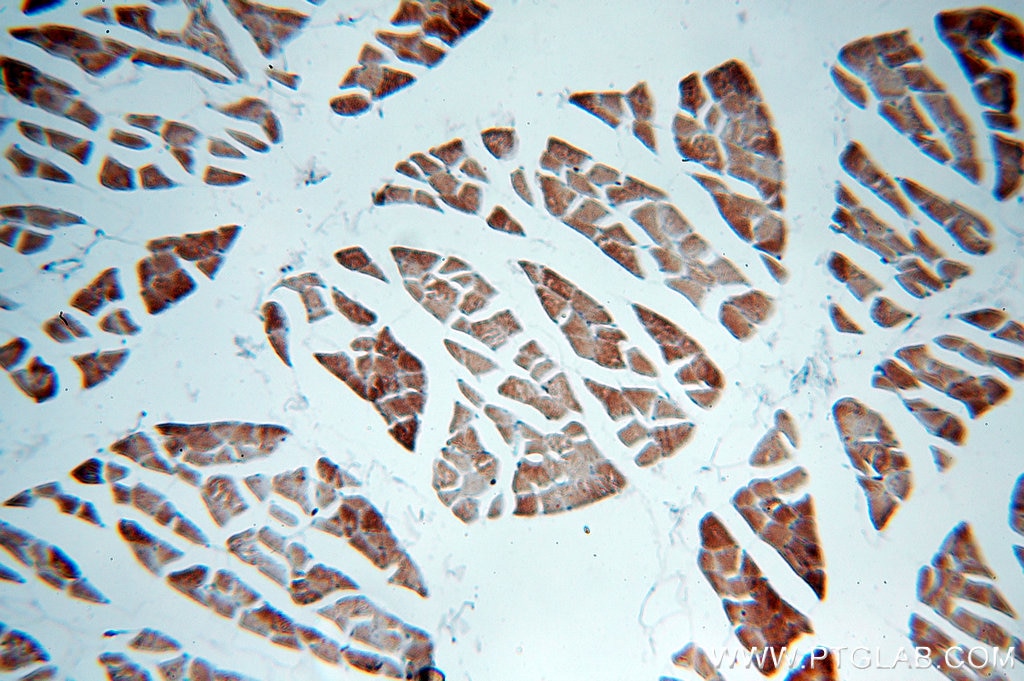
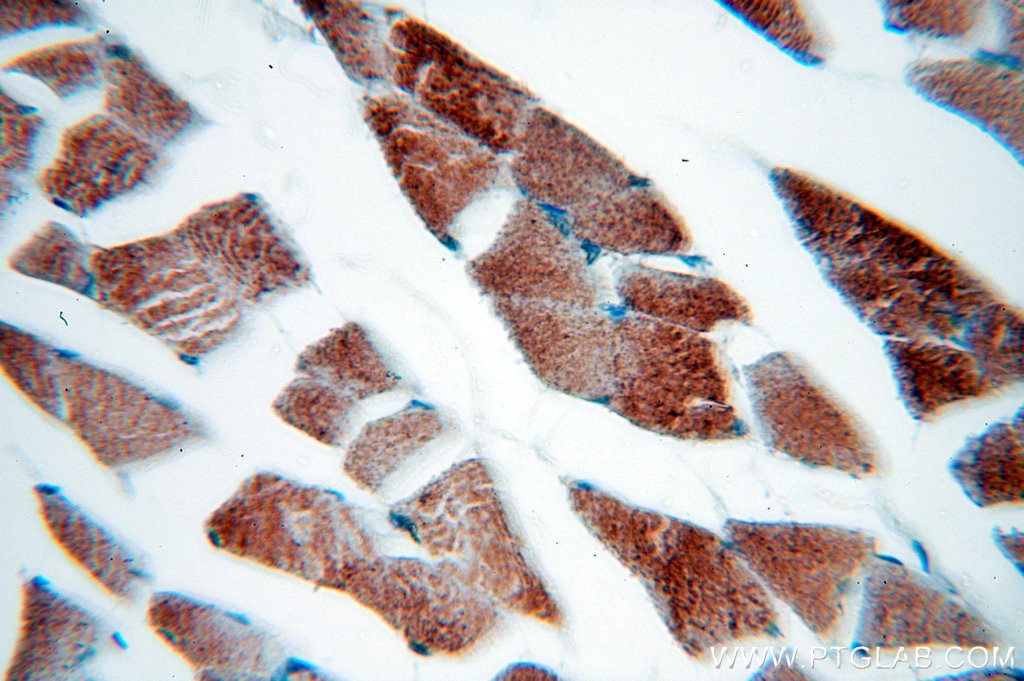
| Positive IHC detected in | human skeletal muscle tissue Note: suggested antigen retrieval with TE buffer pH 9.0; (*) Alternatively, antigen retrieval may be performed with citrate buffer pH 6.0 |
Recommended dilution
| Application | Dilution |
|---|---|
| Western Blot (WB) | WB : 1:200-1:1000 |
| Immunoprecipitation (IP) | IP : 0.5-4.0 ug for 1.0-3.0 mg of total protein lysate |
| Immunohistochemistry (IHC) | IHC : 1:20-1:200 |
| It is recommended that this reagent should be titrated in each testing system to obtain optimal results. | |
| Sample-dependent, Check data in validation data gallery. | |
Product Information
13614-1-AP targets MLXIP in WB, IHC, IF, IP, ChIP, ELISA applications and shows reactivity with human samples.
| Tested Reactivity | human |
| Cited Reactivity | human, mouse, rat |
| Host / Isotype | Rabbit / IgG |
| Class | Polyclonal |
| Type | Antibody |
| Immunogen |
CatNo: Ag4519 Product name: Recombinant human MLXIP protein Source: e coli.-derived, PGEX-4T Tag: GST Domain: 1-217 aa of BC039704 Sequence: MDGQGCEHTSRTEDPFIQPTDFGPSEPPLSVPPPISPVLPLVPPPATALNPPAPPTFHQPQKFAGVNKAPSVITHTASATLTHDAPATTFSQSQGLVITTHHPAPSAAPCGLALSPVTRPPQPRLTFVHPKPVSLTGGRPKQPHKIVPAPKPEPVSLVLKNARIAPGEPGGETQCGAPPDPEGCFPIPKAFKLVTTTTTLVCTCMRTHIHLNETKVS Predict reactive species |
| Full Name | MLX interacting protein |
| Calculated Molecular Weight | 919 aa, 100 kDa |
| Observed Molecular Weight | 130 kDa, 69 kDa |
| GenBank Accession Number | BC039704 |
| Gene Symbol | MLXIP |
| Gene ID (NCBI) | 22877 |
| RRID | AB_2282153 |
| Conjugate | Unconjugated |
| Form | Liquid |
| Purification Method | Antigen affinity purification |
| UNIPROT ID | Q9HAP2 |
| Storage Buffer | PBS with 0.02% sodium azide and 50% glycerol, pH 7.3. |
| Storage Conditions | Store at -20°C. Stable for one year after shipment. Aliquoting is unnecessary for -20oC storage. 20ul sizes contain 0.1% BSA. |
Background Information
Mlx-interacting protein(MLXIP), after forming heterodimers with MLX, can bind to and then activate transcription from CACGTG E boxes. The N terminus of MLXIP acts as a CRM1-dependent nuclear export signal and contribute to the cytoplasmic localization of the complex, and as a binding site for 13 protein. the C terminus contains a cytoplasmic localization signal and mediates protein-protein interaction of MONDOA and MLX. The complex play a role in transcriptional activation of glycolytic target genes and glucose-responsive gene regulation. This antibody could recognize isoform1(~110kd) and isoform3(~69kd) of MLXIP. A prominent and specific MLXIP of approximately 130 kDa was detected. It demonstrates that MLXIP associated specifically with Mlx in the cytoplasm (PMID: 11073985).
Protocols
| Product Specific Protocols | |
|---|---|
| IHC protocol for MLXIP antibody 13614-1-AP | Download protocol |
| IP protocol for MLXIP antibody 13614-1-AP | Download protocol |
| WB protocol for MLXIP antibody 13614-1-AP | Download protocol |
| Standard Protocols | |
|---|---|
| Click here to view our Standard Protocols |
Publications
What published studies show
The MLXIP (TXNIP) polyclonal antibody (Cat# 13614-1-AP) has accumulated 23 citations published in 22 journals, including Nature Metabolism, Nature Neuroscience, Cancer Cell, Gastroenterology, Science Advances, PNAS, EMBO Molecular Medicine, Oncogene, and Diabetes. The research fields span cancer metabolism, glucose-sensing transcription, neurodegeneration, immunology, muscle biology, endocrinology, and virology. Cited applications include WB, IHC, IF, IP, and ChIP across human, mouse, and rat species.
| Species | Application | Title |
|---|---|---|
Cancer Cell Deregulated Myc requires MondoA/Mlx for metabolic reprogramming and tumorigenesis. | ||
Gastroenterology MondoA-Thioredoxin-Interacting Protein Axis Maintains Regulatory T-Cell Identity and Function in Colorectal Cancer Microenvironment. | ||
Mil Med Res D-mannose alleviates intervertebral disc degeneration through glutamine metabolism | ||
Nat Metab Targeting MondoA-TXNIP restores antitumour immunity in lactic-acid-induced immunosuppressive microenvironment | ||
Acta Pharm Sin B Class I histone deacetylase inhibition is synthetic lethal with BRCA1 deficiency in breast cancer cells |

