
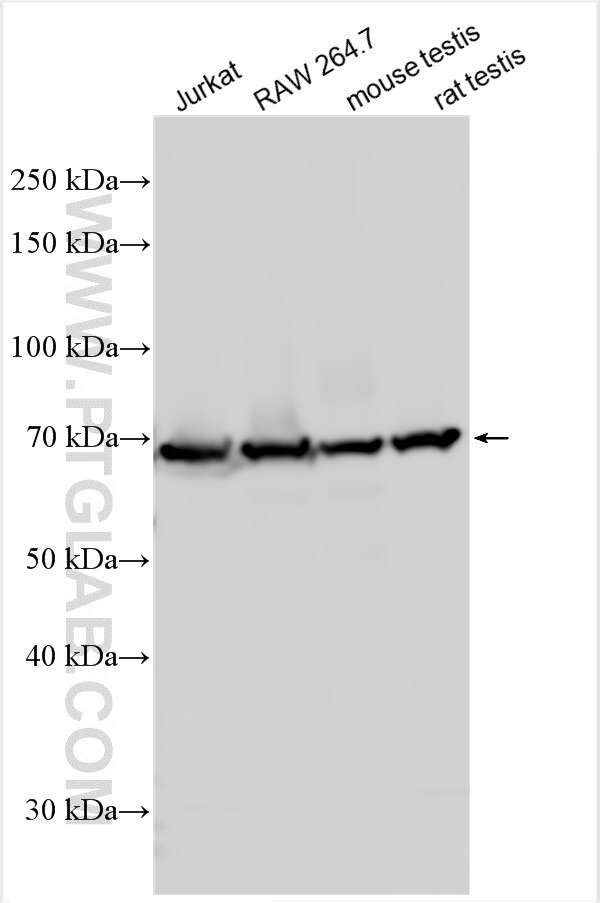
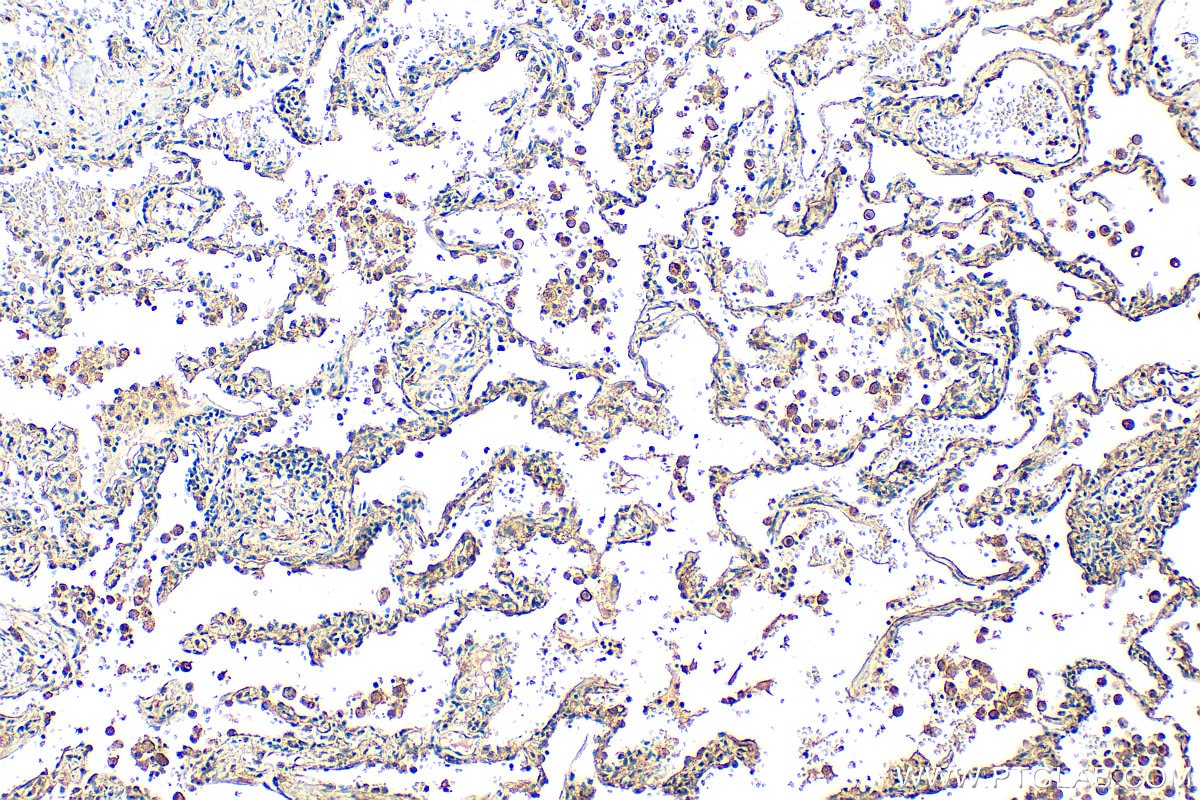
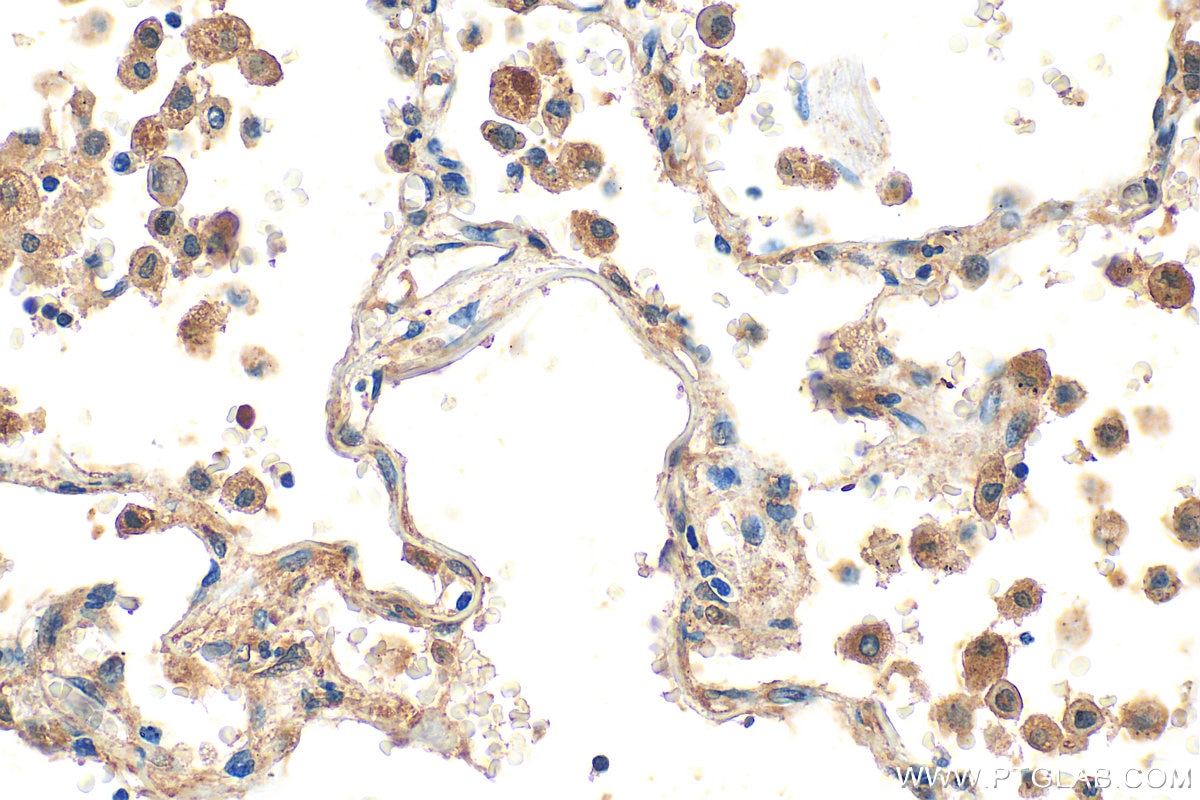
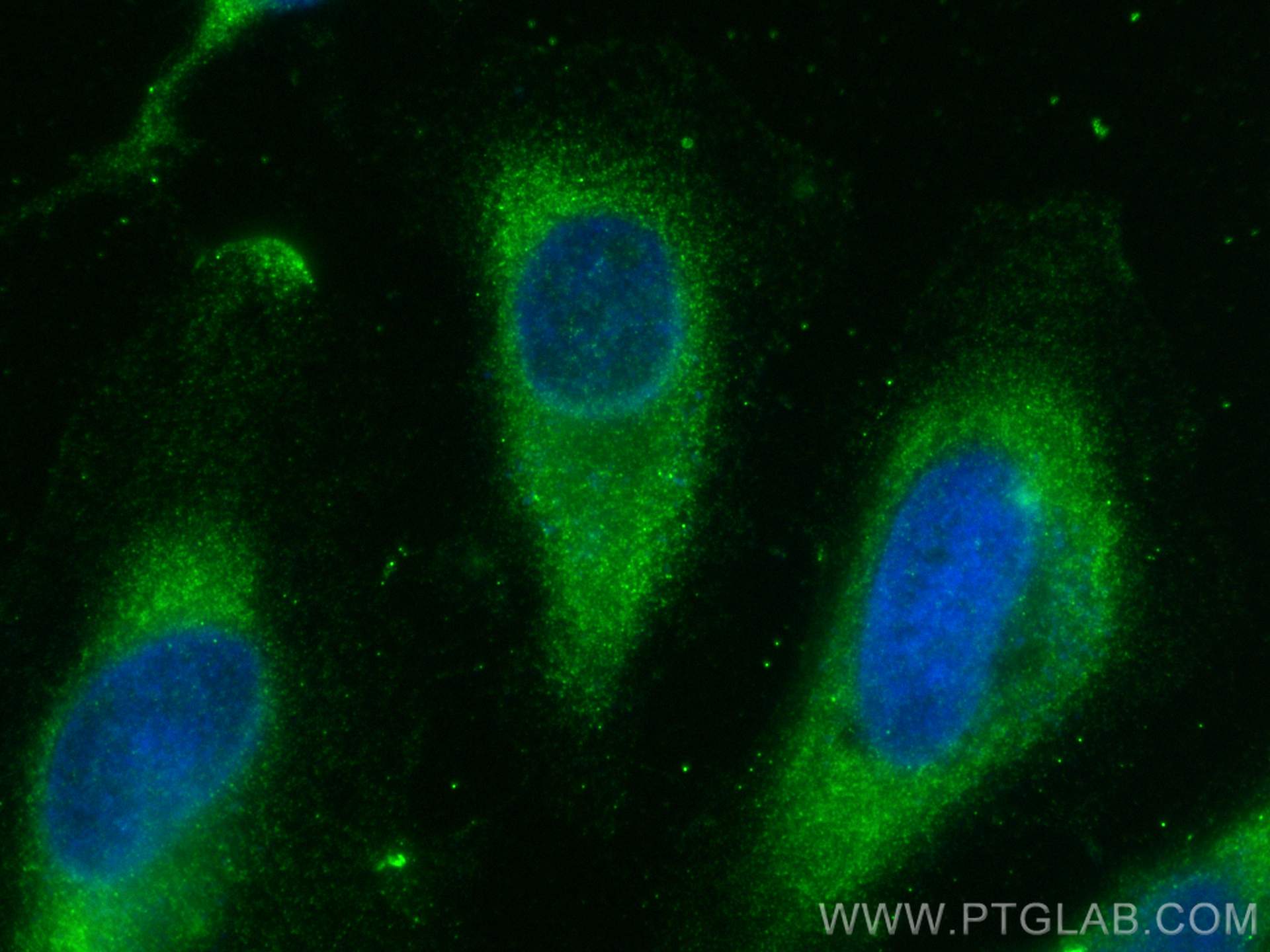

Tested Applications
| Positive WB detected in | Jurkat cells, RAW 264.7 cells, mouse testis tissue, rat testis tissue |
| Positive IHC detected in | human lung tissue Note: suggested antigen retrieval with TE buffer pH 9.0; (*) Alternatively, antigen retrieval may be performed with citrate buffer pH 6.0 |
| Positive IF/ICC detected in | HeLa cells |
Recommended dilution
| Application | Dilution |
|---|---|
| Western Blot (WB) | WB : 1:1000-1:4000 |
| Immunohistochemistry (IHC) | IHC : 1:200-1:800 |
| Immunofluorescence (IF)/ICC | IF/ICC : 1:50-1:500 |
| It is recommended that this reagent should be titrated in each testing system to obtain optimal results. | |
| Sample-dependent, Check data in validation data gallery. | |
Product Information
14973-1-AP targets MTMR14 in WB, IHC, IF/ICC, ELISA applications and shows reactivity with human, mouse, rat samples.
| Tested Reactivity | human, mouse, rat |
| Cited Reactivity | human, mouse |
| Host / Isotype | Rabbit / IgG |
| Class | Polyclonal |
| Type | Antibody |
| Immunogen |
CatNo: Ag6883 Product name: Recombinant human MTMR14 protein Source: e coli.-derived, PET28a Tag: 6*His Domain: 245-598 aa of BC050626 Sequence: LSIPYPGCEFFKEYKDRDYMAEGLIFNWKQDYVDAPLSIPDFLTHSLNIDWSQYQCWDLVQQTQNYLKLLLSLVNSDDDSGLLVHCISGWDRTPLFISLLRLSLWADGLIHTSLKPTEILYLTVAYDWFLFGHMLVDRLSKGEEIFFFCFNFLKHITSEEFSALKTQRRKSLPARDGGFTLEDICMLRRKDRGSTTSLGSDFSLVMESSPGATGSFTYEAVELVPAGAPTQAAWRKSHSSSPQSVLWNRPQPSEDRLPSQQGLAEARSSSSSSSNHSDNFFRMGSSPLEVPKPRLAALSDRETRLQEVRSAFLAAYSSTVGLRAVAPSPSGAIGGLLEQFARGVGLRSISSNAL Predict reactive species |
| Full Name | myotubularin related protein 14 |
| Calculated Molecular Weight | 72 kDa |
| Observed Molecular Weight | 60-72 kDa |
| GenBank Accession Number | BC050626 |
| Gene Symbol | MTMR14 |
| Gene ID (NCBI) | 64419 |
| RRID | AB_2147828 |
| Conjugate | Unconjugated |
| Form | Liquid |
| Purification Method | Antigen affinity purification |
| UNIPROT ID | Q8NCE2 |
| Storage Buffer | PBS with 0.02% sodium azide and 50% glycerol, pH 7.3. |
| Storage Conditions | Store at -20°C. Stable for one year after shipment. Aliquoting is unnecessary for -20oC storage. 20ul sizes contain 0.1% BSA. |
Background Information
MTMR14, also known as Jumpy, belongs to the MTM1/MTMRs family which has 15 members that divided into two subgroup: catalytically inactive and active. MTMR14 is a catalytically active member possessing an active phosphatase domain, that specifically dephosphorylates PI3P and phosphatidylinositol (3,5)-bisphosphate (PI3,5P2) at position 3 on inositol ring. A remarkable feature of the MTM1/MTMRs family is the association between a catalytically inactive member and a catalytically active member, which plays an important regulatory role. MTMR14 has 3 isoforms with molecular weight of 60-72 kDa.
Protocols
| Product Specific Protocols | |
|---|---|
| IF protocol for MTMR14 antibody 14973-1-AP | Download protocol |
| IHC protocol for MTMR14 antibody 14973-1-AP | Download protocol |
| WB protocol for MTMR14 antibody 14973-1-AP | Download protocol |
| Standard Protocols | |
|---|---|
| Click here to view our Standard Protocols |
Publications
What published studies show
I'll retrieve the citation information for 14973-1-AP.MTMR14 Polyclonal antibody (14973-1-AP) has 3 citations total. They appear in Nature Communications, Respiratory Research, and Gene. The research fields covered include neuroscience and autophagy (mitochondrial damage regulation of neuronal autophagy), respiratory/pulmonary immunology (macrophage polarization in COPD and emphysema), and oncology (cell apoptosis and migration in liver cancer cells). Applications used across these studies include Western blot (WB) and immunofluorescence (IF) in human and mouse samples.
| Species | Application | Title |
|---|---|---|
Nat Commun Mitochondrial damage triggers the concerted degradation of negative regulators of neuronal autophagy. | ||
Respir Res MTMR14 depletion aggravates intrapulmonary inflammation and emphysema in experimental COPD through activating macrophage M1 polarization | ||
Gene Knockdown MTMR14 promotes cell apoptosis and inhibits migration in liver cancer cells.
|

