
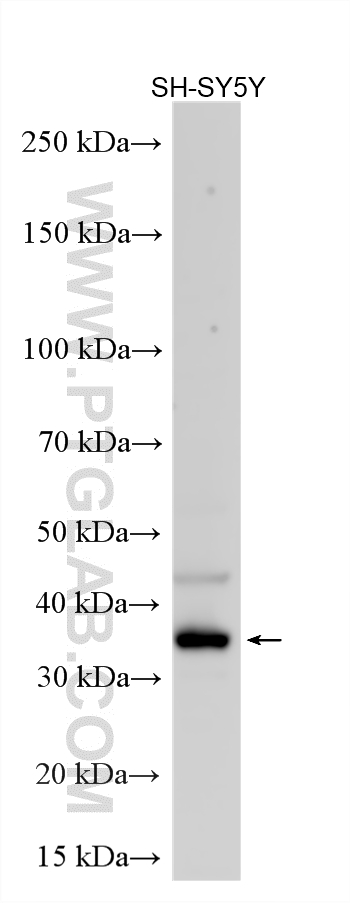



Tested Applications
| Positive WB detected in | SH-SY5Y cells |
| Positive IHC detected in | human kidney tissue Note: suggested antigen retrieval with TE buffer pH 9.0; (*) Alternatively, antigen retrieval may be performed with citrate buffer pH 6.0 |
Recommended dilution
| Application | Dilution |
|---|---|
| Western Blot (WB) | WB : 1:500-1:1000 |
| Immunohistochemistry (IHC) | IHC : 1:50-1:500 |
| It is recommended that this reagent should be titrated in each testing system to obtain optimal results. | |
| Sample-dependent, Check data in validation data gallery. | |
Product Information
16133-1-AP targets MUL1 in WB, IHC, IP, CoIP, ELISA applications and shows reactivity with human, mouse, rat samples.
| Tested Reactivity | human, mouse, rat |
| Cited Reactivity | human, mouse, rat |
| Host / Isotype | Rabbit / IgG |
| Class | Polyclonal |
| Type | Antibody |
| Immunogen |
CatNo: Ag9119 Product name: Recombinant human MUL1 protein Source: e coli.-derived, PGEX-4T Tag: GST Domain: 27-239 aa of BC010101 Sequence: SVYRQKARVSQELKGAKKVHLGEDLKSILSEAPGKCVPYAVIEGAVRSVKETLNSQFVENCKGVIQRLTLQEHKMVWNRTTHLWNDCSKIIHQRTNTVPFDLVPHEDGVDVAVRVLKPLDSVDLGLETVYEKFHPSIQSFTDVIGHYISGERPKGIQETEEMLKVGATLTGVGELVLDNNSVRLQPPKQGMQYYLSSQDFDSLLQRQESSVRL Predict reactive species |
| Full Name | mitochondrial E3 ubiquitin ligase 1 |
| Calculated Molecular Weight | 352 aa, 40 kDa |
| Observed Molecular Weight | 35 kDa |
| GenBank Accession Number | BC010101 |
| Gene Symbol | MUL1 |
| Gene ID (NCBI) | 79594 |
| RRID | AB_2147111 |
| Conjugate | Unconjugated |
| Form | Liquid |
| Purification Method | Antigen affinity purification |
| UNIPROT ID | Q969V5 |
| Storage Buffer | PBS with 0.02% sodium azide and 50% glycerol, pH 7.3. |
| Storage Conditions | Store at -20°C. Stable for one year after shipment. Aliquoting is unnecessary for -20oC storage. 20ul sizes contain 0.1% BSA. |
Background Information
Mitochondrial ubiquitin ligase 1 (MUL1),MAPL, MULAN, or gGIDE, was identified as an E3 protein ligase by three independent groups. Work in mammalian systems shows that MUL1 has small ubiquitin-like modifier (SUMO) ligase activity, stabilizing Drp1, or ubiquitin ligase activity, degrading Mfn. MUL1 expression in mammalian cells results in smaller and more fragmented mitochondria.
Protocols
| Product Specific Protocols | |
|---|---|
| IHC protocol for MUL1 antibody 16133-1-AP | Download protocol |
| WB protocol for MUL1 antibody 16133-1-AP | Download protocol |
| Standard Protocols | |
|---|---|
| Click here to view our Standard Protocols |
Publications
What published studies show
The MUL1 Polyclonal antibody (Cat# 16133-1-AP) has 16 citations across journals including Nature Communications, Cell Death & Disease, Journal of Experimental & Clinical Cancer Research, International Journal of Biological Sciences, Phytomedicine, European Journal of Pharmacology, and Bone Research. Research fields span mitochondrial dynamics and quality control, cancer (gastric, lung, colorectal, bladder, ovarian), ischemia/reperfusion injury, obesity, diabetic neuropathy, skeletal muscle atrophy, and Leigh syndrome. Applications include WB, IP, IHC, and CoIP in human, mouse, and rat models.
| Species | Application | Title |
|---|---|---|
Bone Res The mitochondrial E3 ligase MAPL SUMOylates Drp1 to facilitate mitochondrial fission in intervertebral disc degeneration.
| ||
Nat Commun A mitochondria-driven quality control mechanism for peroxisomal membrane proteins. | ||
J Exp Clin Cancer Res PHB2 promotes SHIP2 ubiquitination via the E3 ligase NEDD4 to regulate AKT signaling in gastric cancer | ||
Cell Death Dis SLC44A2 negatively regulates mitochondrial fatty acid oxidation to suppress colorectal progression by blocking the MUL1-CPT2 interaction. | ||
Cell Death Dis CRTAC1 enhances the chemosensitivity of non-small cell lung cancer to cisplatin by eliciting RyR-mediated calcium release and inhibiting Akt1 expression | ||
Int J Biol Sci SUMO E3 ligase MUL1 inhibits lymph node metastasis of bladder cancer by mediating mitochondrial HSPA9 translocation |


