
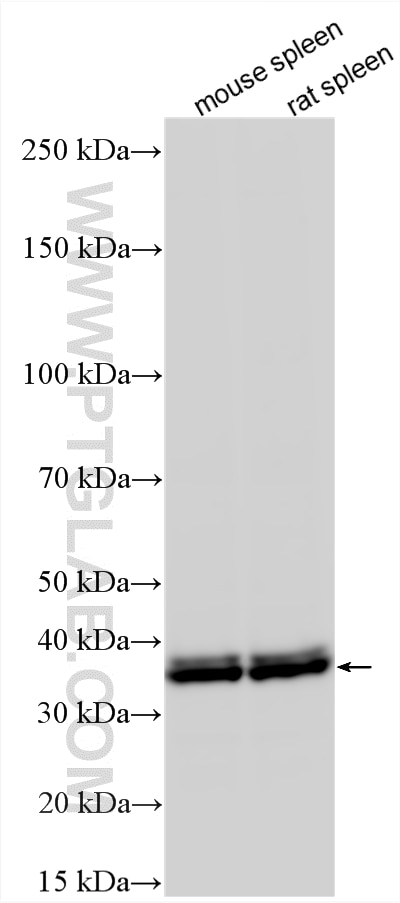



Tested Applications
| Positive WB detected in | mouse spleen tissue, rat spleen tissue |
| Positive IHC detected in | human liver tissue Note: suggested antigen retrieval with TE buffer pH 9.0; (*) Alternatively, antigen retrieval may be performed with citrate buffer pH 6.0 |
Recommended dilution
| Application | Dilution |
|---|---|
| Western Blot (WB) | WB : 1:500-1:1000 |
| Immunohistochemistry (IHC) | IHC : 1:50-1:500 |
| It is recommended that this reagent should be titrated in each testing system to obtain optimal results. | |
| Sample-dependent, Check data in validation data gallery. | |
Product Information
26469-1-AP targets Mitoferrin 1 in WB, IHC, IF, ELISA applications and shows reactivity with human, mouse, rat samples.
| Tested Reactivity | human, mouse, rat |
| Cited Reactivity | human, mouse, rat |
| Host / Isotype | Rabbit / IgG |
| Class | Polyclonal |
| Type | Antibody |
| Immunogen |
CatNo: Ag24876 Product name: Recombinant human SLC25A37 protein Source: e coli.-derived, PGEX-4T Tag: GST Domain: 1-44 aa of BC132799 Sequence: MELRSGSVGSQAVARRMDGDSRDGGGGKDATGSEDYENLPTSAS Predict reactive species |
| Full Name | solute carrier family 25, member 37 |
| Observed Molecular Weight | 37 kDa |
| GenBank Accession Number | BC132799 |
| Gene Symbol | Mitoferrin 1 |
| Gene ID (NCBI) | 51312 |
| RRID | AB_2880527 |
| Conjugate | Unconjugated |
| Form | Liquid |
| Purification Method | Antigen affinity purification |
| UNIPROT ID | Q9NYZ2 |
| Storage Buffer | PBS with 0.02% sodium azide and 50% glycerol, pH 7.3. |
| Storage Conditions | Store at -20°C. Stable for one year after shipment. Aliquoting is unnecessary for -20oC storage. 20ul sizes contain 0.1% BSA. |
Background Information
Mitoferrin-1 (MFRN1; SLC25A37), a 338-residue member of the mitochondrial carrier family, is an inner-membrane importer that delivers iron to the mitochondrial matrix for heme and iron-sulfur cluster synthesis. Its paralog MFRN2 (SLC25A28) is ubiquitously expressed, whereas MFRN1 functions predominantly in erythropoiesis (PMID: 38692382). Global Mfrn1 deletion is embryonic lethal in mice; hematopoietic-specific deletion causes severe anemia through a deficit in erythroblast formation; and hepatocyte-specific deletion produces protoporphyria only when porphyrin synthesis is increased (PMID: 21310927). In zebrafish, mfrn1 loss arrests terminally differentiating erythroid cells at G2/M, and iron supplementation rescues the defect (PMID: 40601908). MFRN1 is stabilized by the inner-membrane transporter ABCB10, which promotes MFRN1-dependent iron import (PMID: 19805291), and MFRN1 knockdown has been reported to decrease hepatocyte ferroptosis in experimental models (PMID: 37741044).
Protocols
| Product Specific Protocols | |
|---|---|
| IHC protocol for Mitoferrin 1 antibody 26469-1-AP | Download protocol |
| WB protocol for Mitoferrin 1 antibody 26469-1-AP | Download protocol |
| Standard Protocols | |
|---|---|
| Click here to view our Standard Protocols |
Publications
What published studies show
Mitoferrin 1 Polyclonal antibody (Cat# 26469-1-AP) has 22 citations spanning journals including Nature Cancer, Nature Metabolism, Nature Cell Biology, Redox Biology, Molecular Cell, Nature Chemical Biology, Cell Death & Disease, Genome Medicine, Cell Death Discovery, Haematologica, and others. Research fields encompass ferroptosis, mitochondrial iron homeostasis, cancer biology, neurodegeneration, cerebral ischemia, diabetes, HIV-related mitochondrial dysfunction, and heme biosynthesis, with applications primarily in Western blot and IHC across human, mouse, and rat models.
| Species | Application | Title |
|---|---|---|
Nat Cancer ENO1 suppresses cancer cell ferroptosis by degrading the mRNA of iron regulatory protein 1. | ||
Nat Metab BDH2-driven lysosome-to-mitochondria iron transfer shapes ferroptosis vulnerability of the melanoma cell states
| ||
Autophagy PINK1-deficiency facilitates mitochondrial iron accumulation and colon tumorigenesis | ||
Redox Biol FoxO1 regulates adipose transdifferentiation and iron influx by mediating Tgfβ1 signaling pathway | ||
Redox Biol Mitochondrial ferritin alleviates apoptosis by enhancing mitochondrial bioenergetics and stimulating glucose metabolism in cerebral ischemia reperfusion |
Reviews
What customers say
Able is busy answering your previous question. Please try again later.
The reviews below have been submitted by verified Proteintech customers who received an incentive for providing their feedback.
Rahul (Verified Customer) (07-23-2025) | Works well to detect Mitoferrin1 even with a couple thousand cells (pretty sensitive).
 |


