

Tested Applications
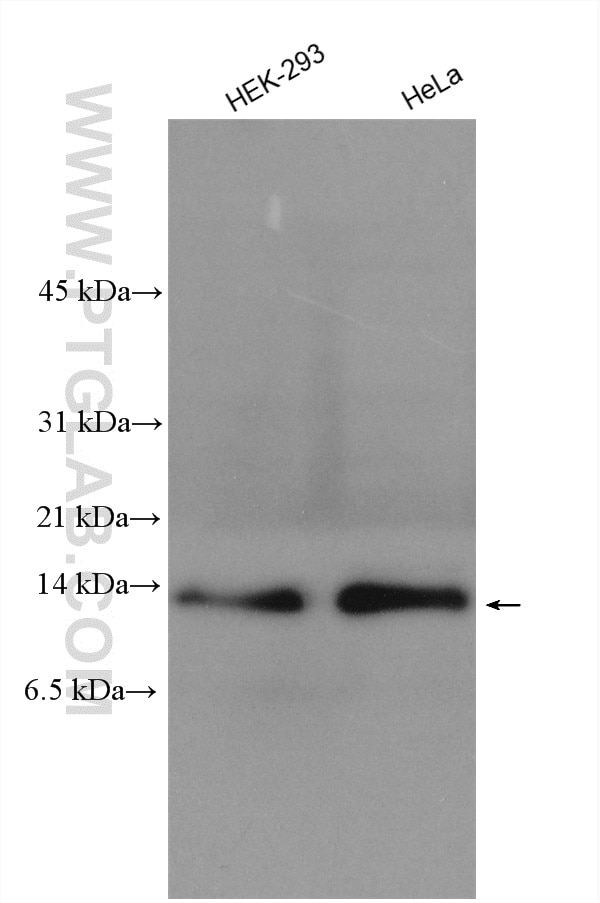
| Positive WB detected in | HEK-293 cells, HeLa cells |
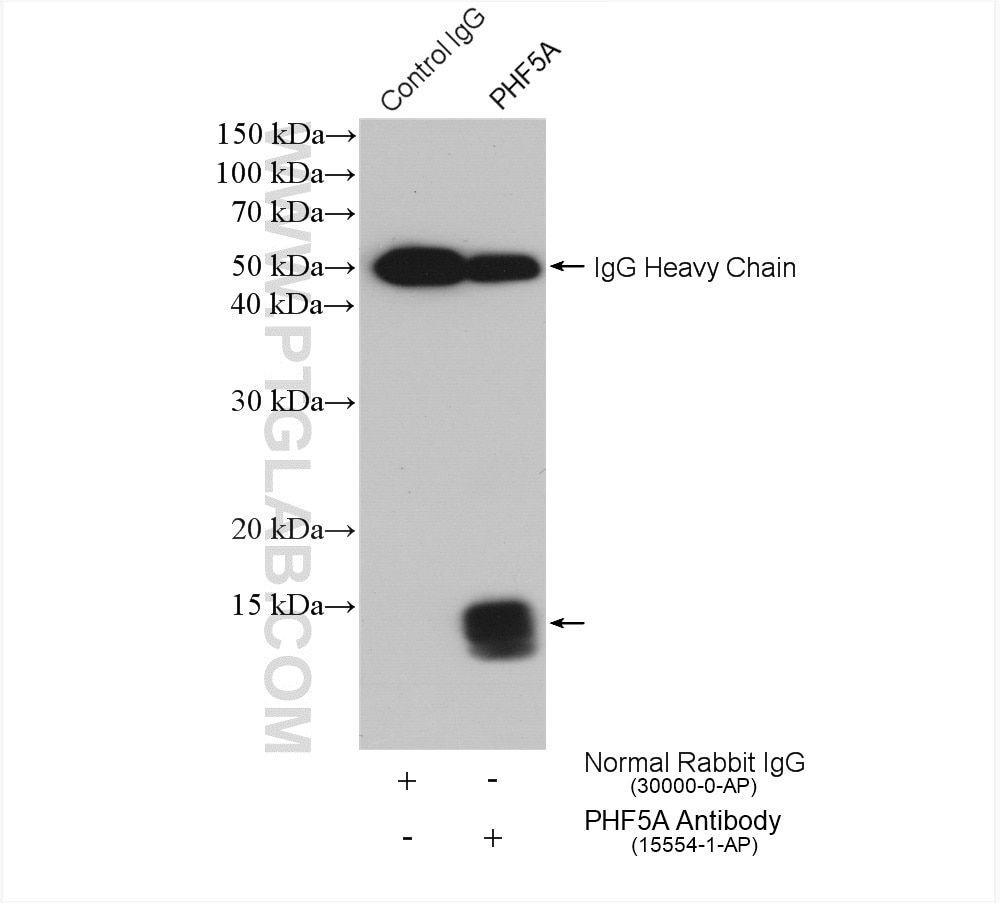
| Positive IP detected in | HeLa cells |
Recommended dilution
| Application | Dilution |
|---|---|
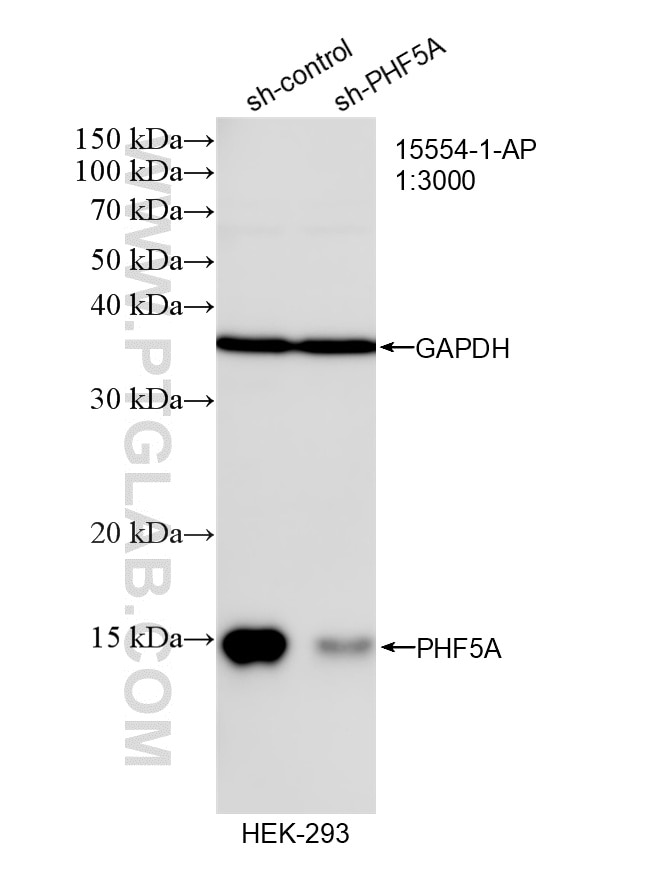
| Western Blot (WB) | WB : 1:1000-1:6000 |
| Immunoprecipitation (IP) | IP : 0.5-4.0 ug for 1.0-3.0 mg of total protein lysate |
| It is recommended that this reagent should be titrated in each testing system to obtain optimal results. | |
| Sample-dependent, Check data in validation data gallery. | |
Product Information
15554-1-AP targets PHF5A in WB, IHC, IF, IP, CoIP, ChIP, ELISA applications and shows reactivity with human, mouse samples.
| Tested Reactivity | human, mouse |
| Cited Reactivity | human, mouse, chicken |
| Host / Isotype | Rabbit / IgG |
| Class | Polyclonal |
| Type | Antibody |
| Immunogen |
CatNo: Ag7918 Product name: Recombinant human INI-1 protein Source: e coli.-derived, PGEX-4T Tag: GST Domain: 1-110 aa of BC007321 Sequence: MAKHHPDLIFCRKQAGVAIGRLCEKCDGKCVICDSYVRPCTLVRICDECNYGSYQGRCVICGGPGVSDAYYCKECTIQEKDRDGCPKIVNLGSSKTDLFYERKKYGFKKR Predict reactive species |
| Full Name | PHD finger protein 5A |
| Calculated Molecular Weight | 12 kDa |
| Observed Molecular Weight | 12-14 kDa |
| GenBank Accession Number | BC007321 |
| Gene Symbol | PHF5A |
| Gene ID (NCBI) | 84844 |
| RRID | AB_2165365 |
| Conjugate | Unconjugated |
| Form | Liquid |
| Purification Method | Antigen affinity purification |
| UNIPROT ID | Q7RTV0 |
| Storage Buffer | PBS with 0.02% sodium azide and 50% glycerol, pH 7.3. |
| Storage Conditions | Store at -20°C. Stable for one year after shipment. Aliquoting is unnecessary for -20oC storage. 20ul sizes contain 0.1% BSA. |
Background Information
The PHD finger-like domain protein 5a (PHF5A) is ubiquitously expressed and is located in the nucleus. The gene Phf5a and its human counterpart PHF5A (former name Ini) are located on rat chromosome 7 (RNO7q34) and human chromosome 22 (HSA2213q2), respectively. The rat gene consists of four exons, while the human gene have five exons. Both genes encode a highly conserved protein of 110 amino acids that contains a PHD finger domain.(PMID: 23675859) It acts as a transcriptional regulator by binding to the GJA1/Cx43 promoter and enhancing its up-regulation by ESR1/ER-alpha and is involved in pre-mRNA splicing.
Protocols
| Product Specific Protocols | |
|---|---|
| IP protocol for PHF5A antibody 15554-1-AP | Download protocol |
| WB protocol for PHF5A antibody 15554-1-AP | Download protocol |
| Standard Protocols | |
|---|---|
| Click here to view our Standard Protocols |
Publications
What published studies show
The PHF5A Polyclonal antibody (Cat# 15554-1-AP) has 22 citations. These appear in journals including Gastroenterology, Nature Cell Biology, Cancer Research, Nature Communications, Molecular Cell, Journal of Experimental & Clinical Cancer Research, Cell Death & Disease, Genome Medicine, Cell Reports, Blood Advances, Cell Proliferation, Genes & Development, Molecular Therapy Nucleic Acids, Genetics in Medicine, Frontiers in Cell and Developmental Biology, BMC Cancer, Development, PLoS Genetics, and Research Square. Research fields span alternative splicing, spliceosome biology, epigenetics, and cancer (pancreatic, breast, lung, colorectal, melanoma, liver), plus development, aging, and genetic disorders.
| Species | Application | Title |
|---|---|---|
Gastroenterology Enterotoxigenic Bacteroides fragilis promotes intestinal inflammation and malignancy by inhibiting exosomes-packaged miR-149-3p. | ||
Gastroenterology RNA Polymerase II-Associated Factor 1 Regulates Stem Cell Features of Pancreatic Cancer Cells, Independently of the PAF1 Complex, via Interactions With PHF5A and DDX3. | ||
Nat Cell Biol Regulation of transcriptional elongation in pluripotency and cell differentiation by the PHD-finger protein Phf5a.
| ||
Cancer Res PHF5A Epigenetically Inhibits Apoptosis to Promote Breast Cancer Progression.
| ||
Nat Commun Determination of trunk neural crest cell fate and susceptibility to splicing perturbation by the DLC1-SF3B1-PHF5A splicing complex | ||
Nat Commun KMT2A associates with PHF5A-PHF14-HMG20A-RAI1 subcomplex in pancreatic cancer stem cells and epigenetically regulates their characteristics |

