
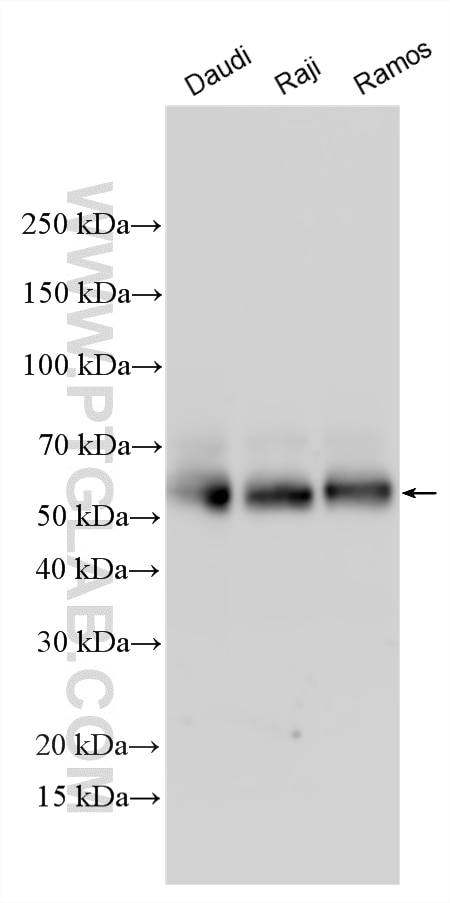



Tested Applications
| Positive WB detected in | Daudi cells, human brain tissue, human spleen tissue, Raji cells, Ramos cells |
| Positive IHC detected in | human spleen tissue Note: suggested antigen retrieval with TE buffer pH 9.0; (*) Alternatively, antigen retrieval may be performed with citrate buffer pH 6.0 |
Recommended dilution
| Application | Dilution |
|---|---|
| Western Blot (WB) | WB : 1:500-1:2000 |
| Immunohistochemistry (IHC) | IHC : 1:20-1:200 |
| It is recommended that this reagent should be titrated in each testing system to obtain optimal results. | |
| Sample-dependent, Check data in validation data gallery. | |
Product Information
18996-1-AP targets OCT2/POU2F2-Specific in WB, IHC, ELISA applications and shows reactivity with human samples.
| Tested Reactivity | human |
| Cited Reactivity | human |
| Host / Isotype | Rabbit / IgG |
| Class | Polyclonal |
| Type | Antibody |
| Immunogen |
Peptide Predict reactive species |
| Full Name | POU class 2 homeobox 2 |
| Calculated Molecular Weight | 62 kDa |
| Observed Molecular Weight | 52-66 kDa |
| GenBank Accession Number | NM_002698 |
| Gene Symbol | POU2F2 |
| Gene ID (NCBI) | 5452 |
| RRID | AB_10596624 |
| Conjugate | Unconjugated |
| Form | Liquid |
| Purification Method | Antigen affinity purification |
| UNIPROT ID | P09086 |
| Storage Buffer | PBS with 0.02% sodium azide and 50% glycerol, pH 7.3. |
| Storage Conditions | Store at -20°C. Stable for one year after shipment. Aliquoting is unnecessary for -20oC storage. 20ul sizes contain 0.1% BSA. |
Background Information
OCT2, also named as POU2F2 and OTF2, belongs to the POU transcription factor family and Class-2 subfamily. OCT2 is a transcription factor that specifically binds to the octamer motif (5'-ATTTGCAT-3'). OCT2 regulates transcription in a number of tissues in addition to activating immunoglobulin gene expression. It modulates transcription transactivation by NR3C1, AR and PGR. Isoform 5 activates the U2 small nuclear RNA (snRNA) promoter. The antibody is specific to OCT2. OCT2 can be detected 52-66 kDa (PMID: 15377492, PMID: 34010659).
Protocols
| Product Specific Protocols | |
|---|---|
| IHC protocol for OCT2/POU2F2-Specific antibody 18996-1-AP | Download protocol |
| WB protocol for OCT2/POU2F2-Specific antibody 18996-1-AP | Download protocol |
| Standard Protocols | |
|---|---|
| Click here to view our Standard Protocols |
Publications
What published studies show
The OCT2/POU2F2-Specific Polyclonal antibody (Cat# 18996-1-AP) has 6 citations. These appear in Cancer Cell, Molecular Therapy, International Journal of Oncology, Toxicology in Vitro, Biochemical and Biophysical Research Communications, and Age. The research fields span cancer immunotherapy, bladder cancer, cervical cancer, immune regulation, and kidney nephrotoxicity, with applications primarily in Western blot and IHC.
| Species | Application | Title |
|---|---|---|
Cancer Cell Targeting the immune privilege of tumor-initiating cells to enhance cancer immunotherapy | ||
Mol Ther miR-3687 Overexpression Promotes Bladder Cancer Cell Growth by Inhibiting the Negative Effect of FOXP1 on Cyclin E2 Transcription. | ||
Int J Oncol Receptor for activated C kinase 1 promotes cervical cancer lymph node metastasis via the glycolysis‑dependent AKT/mTOR signaling. | ||
Toxicol In Vitro Comparisons of segment-specific toxicity of platinum-based agents and cadmium using S1, S2, and S3 cells derived from mouse kidney proximal tubules. | ||
Biochem Biophys Res Commun CBX7 represses the POU2F2 to inhibit the PD-L1 expression and regulate the immune response in bladder cancer.
| ||


