

Tested Applications
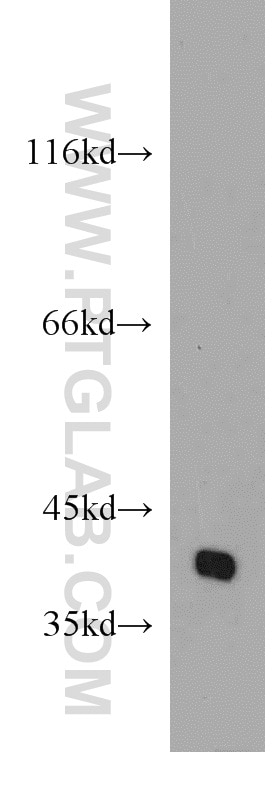
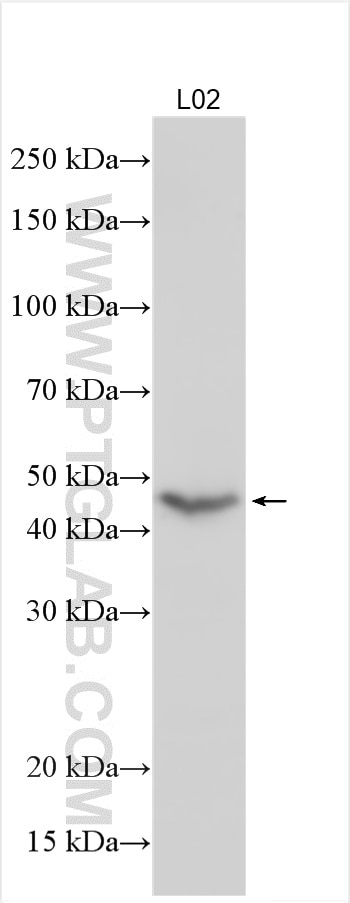
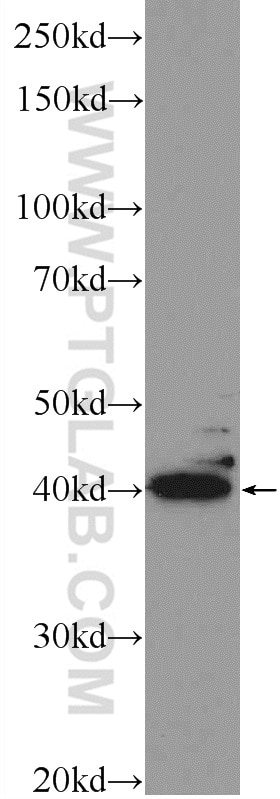
| Positive WB detected in | L02 cells, mouse eye tissue, mouse brain tissue |
Recommended dilution
| Application | Dilution |
|---|---|
| Western Blot (WB) | WB : 1:500-1:1000 |
| It is recommended that this reagent should be titrated in each testing system to obtain optimal results. | |
| Sample-dependent, Check data in validation data gallery. | |
Product Information
55042-1-AP targets POU4F2 in WB, IF, ELISA applications and shows reactivity with human, mouse samples.
| Tested Reactivity | human, mouse |
| Cited Reactivity | human, mouse |
| Host / Isotype | Rabbit / IgG |
| Class | Polyclonal |
| Type | Antibody |
| Immunogen |
Peptide Predict reactive species |
| Full Name | POU class 4 homeobox 2 |
| Calculated Molecular Weight | 43 kDa |
| Observed Molecular Weight | 40-44 kDa |
| GenBank Accession Number | NM_004575 |
| Gene Symbol | POU4F2 |
| Gene ID (NCBI) | 5458 |
| RRID | AB_10888633 |
| Conjugate | Unconjugated |
| Form | Liquid |
| Purification Method | Antigen affinity purification |
| UNIPROT ID | Q12837 |
| Storage Buffer | PBS with 0.02% sodium azide and 50% glycerol, pH 7.3. |
| Storage Conditions | Store at -20°C. Stable for one year after shipment. Aliquoting is unnecessary for -20oC storage. 20ul sizes contain 0.1% BSA. |
Background Information
POU4F2,also named as BRN3.2, BRN3B and Brn-3b, belongs to the POU transcription factor family and Class-4 subfamily. It is a transcription factor. POU4F2 may play a role in determining or maintaining the identities of a small subset of visual system neurons. The antibody is specific to POU4F2.
Protocols
| Product Specific Protocols | |
|---|---|
| WB protocol for POU4F2 antibody 55042-1-AP | Download protocol |
| Standard Protocols | |
|---|---|
| Click here to view our Standard Protocols |
Publications
What published studies show
The POU4F2 Polyclonal antibody (Cat# 55042-1-AP) has 4 citations published in Stem Cell Research & Therapy, Life Sciences, Neurochemistry International, and Scientific Reports. The cited research spans retinal degenerative disease and glaucoma (OPTN mutant signaling in retinal ganglion cells), stem cell biology (iPS-derived retinal pigmented epithelial cells), and colon cancer epithelial-mesenchymal transition involving the SOX21/POU4F2/Hedgehog signaling axis. Applications used include WB and IF in human and mouse samples.
| Species | Application | Title |
|---|---|---|
Stem Cell Res Ther Protective effects of human iPS-derived retinal pigmented epithelial cells on retinal degenerative disease. | ||
Life Sci Intervention of epithelial mesenchymal transition against colon cancer cell growth and metastasis based on SOX21/POU4F2/Hedgehog signaling axis | ||
Neurochem Int Human primary retinal cells as an in-vitro model for investigating defective signalling caused by OPTN mutants associated with glaucoma. | ||
Sci Rep 661W is a retinal ganglion precursor-like cell line in which glaucoma-associated optineurin mutants induce cell death selectively. |
Reviews
What customers say
One user rated this antibody 4 out of 5 stars for immunofluorescence on retinal organoids at a 1:300 dilution. They described it as a good antibody for detecting retinal ganglion cells. Overall, the limited feedback suggests satisfactory performance for its intended application.
The reviews below have been submitted by verified Proteintech customers who received an incentive for providing their feedback.
Alessandro (Verified Customer) (12-09-2023) | good Ab for retinal ganglio cells
|

