
Filter:

Able AI
What's the best dilution for PRKACG in ?
Tested Applications
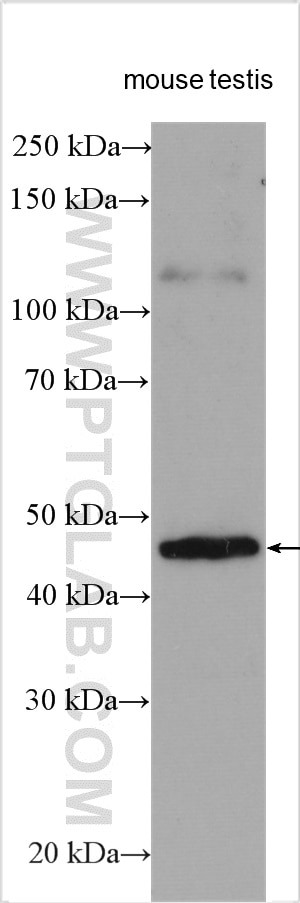
| Positive WB detected in | mouse testis tissue |
Recommended dilution
| Application | Dilution |
|---|---|
| Western Blot (WB) | WB : 1:500-1:1000 |
| It is recommended that this reagent should be titrated in each testing system to obtain optimal results. | |
| Sample-dependent, Check data in validation data gallery. | |
Product Information
55346-1-AP targets PRKACG in WB, ELISA applications and shows reactivity with human, mouse samples.
| Tested Reactivity | human, mouse |
| Cited Reactivity | human, mouse |
| Host / Isotype | Rabbit / IgG |
| Class | Polyclonal |
| Type | Antibody |
| Immunogen |
Peptide Predict reactive species |
| Full Name | protein kinase, cAMP-dependent, catalytic, gamma |
| Calculated Molecular Weight | 40 kDa |
| Observed Molecular Weight | 40 kDa |
| GenBank Accession Number | NM_002732 |
| Gene Symbol | PRKACG |
| Gene ID (NCBI) | 5568 |
| RRID | AB_2881314 |
| Conjugate | Unconjugated |
| Form | Liquid |
| Purification Method | Antigen affinity purification |
| UNIPROT ID | P22612 |
| Storage Buffer | PBS with 0.02% sodium azide and 50% glycerol, pH 7.3. |
| Storage Conditions | Store at -20°C. Aliquoting is unnecessary for -20oC storage. 20ul sizes contain 0.1% BSA. |
Protocols
| Product Specific Protocols | |
|---|---|
| WB protocol for PRKACG antibody 55346-1-AP | Download protocol |
| Standard Protocols | |
|---|---|
| Click here to view our Standard Protocols |
Publications
What published studies show
The PRKACG Polyclonal antibody (Catalog No. 55346-1-AP) has received 3 citations in peer-reviewed journals:
- Environment International (2026) – mouse, WB – toxicology, specifically DBDPE-induced spermatogenic disorder (reproductive toxicology)
- Journal of Ethnopharmacology (2025) – mouse, WB – pharmacology/obesity research (brown fat thermogenesis)
- Human Cell (2024) – human/mouse, WB – liver fibrosis research (miR-3074/BMP7 axis in hepatic stellate cells)
The citations span research fields including reproductive toxicology, metabolic/pharmacology, and liver fibrosis.
| Species | Application | Title |
|---|---|---|
Environ Int Molecular mechanisms of DBDPE-induced spermatogenic disorder: A network toxicology, machine learning, and in vivo experimental validation. | ||
J Ethnopharmacol Flavonoid-rich extracts of Nelumbo nucifera leaves alleviate obesity in HFD-fed mice via microbiota-dependent modulation of brown fat thermogenesis | ||
Hum Cell The miR-3074/BMP7 axis regulates TGF-β-caused activation of hepatic stellate cells in vitro and CCl4-caused murine liver fibrosis in vivo |

