
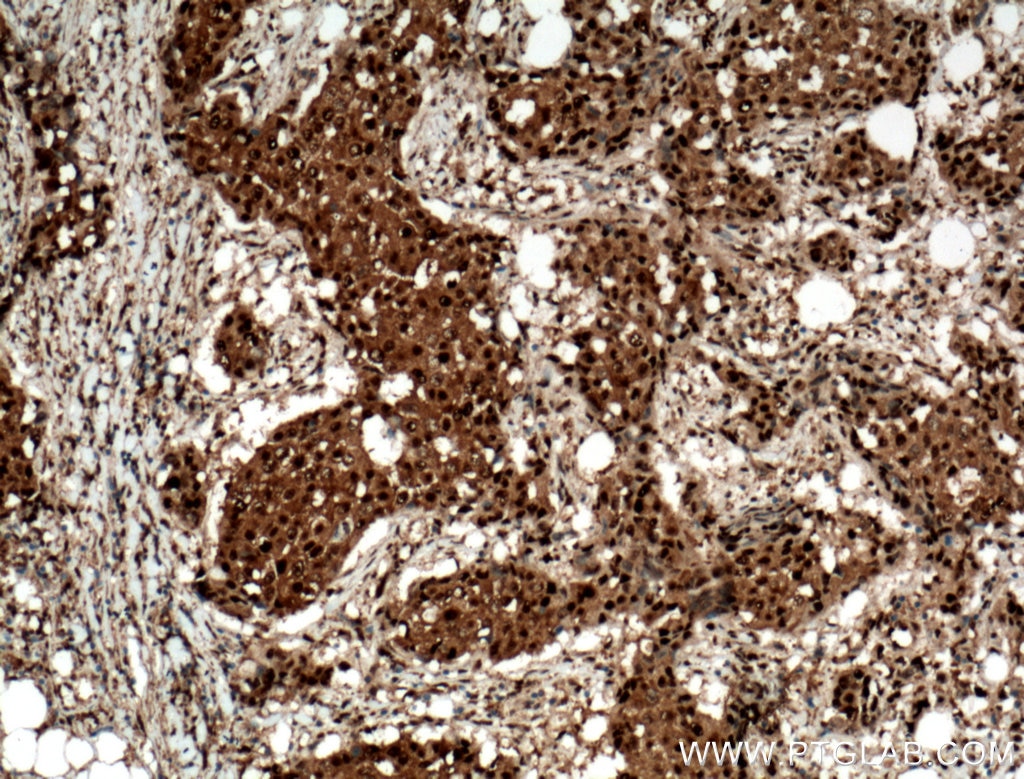
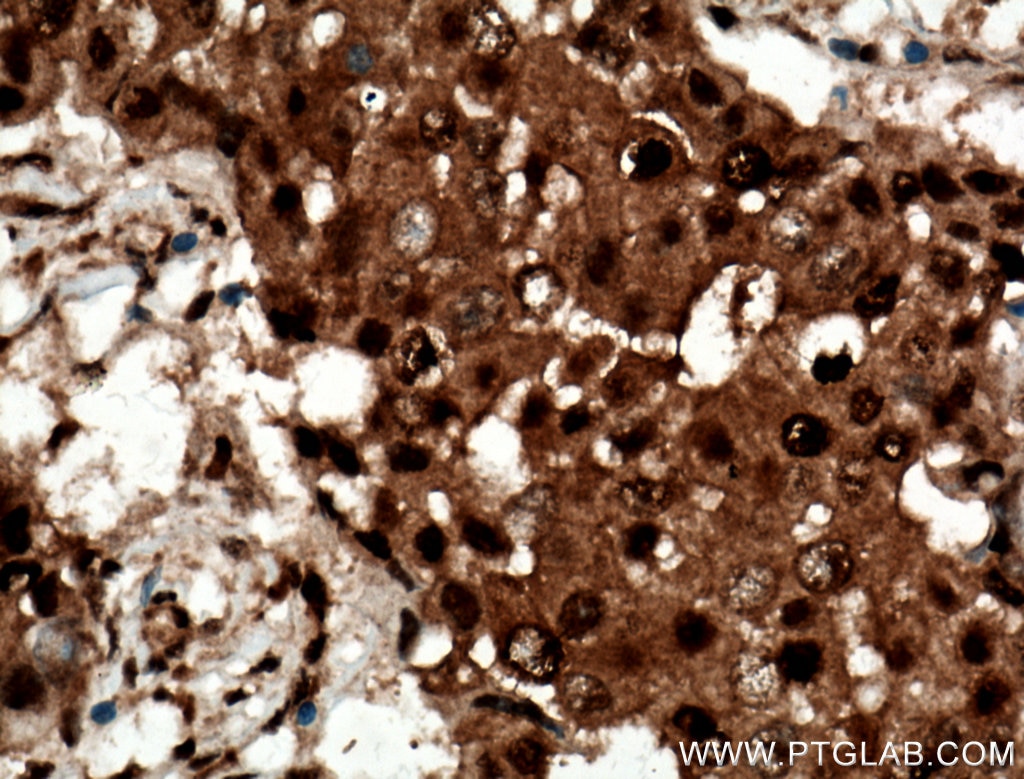

Tested Applications
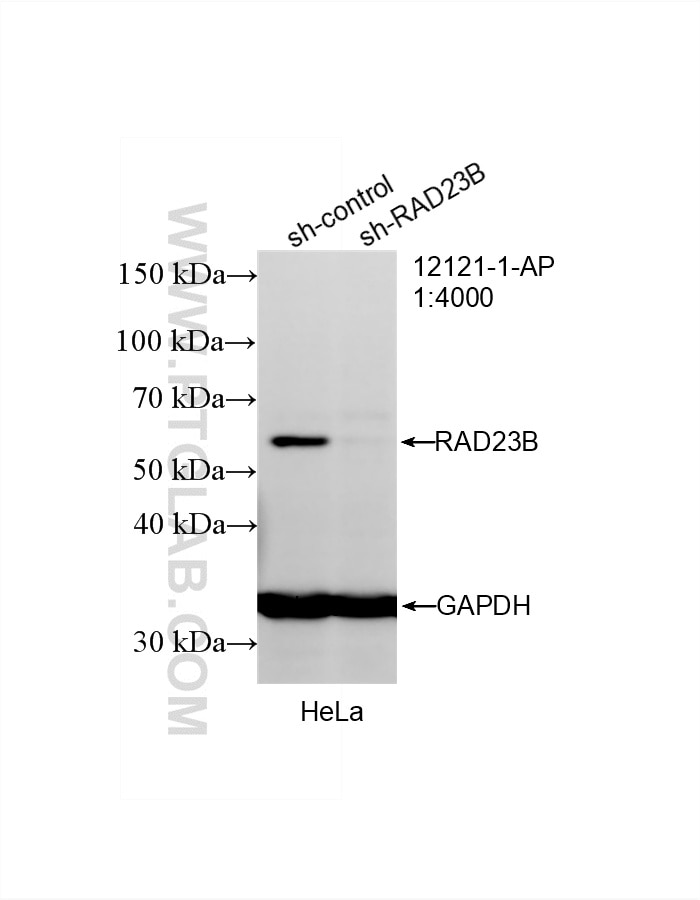
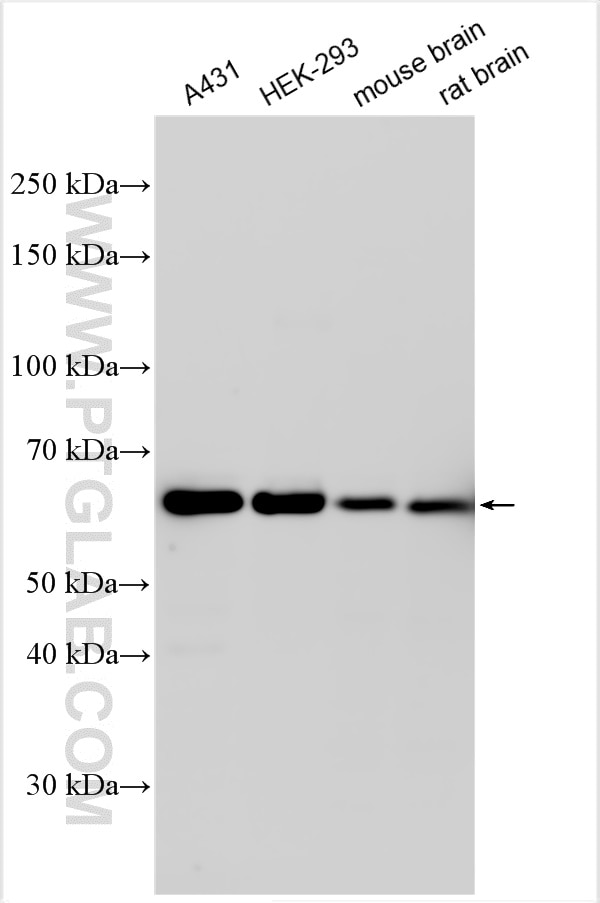
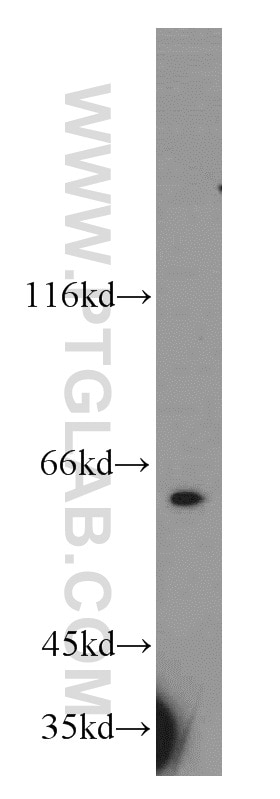
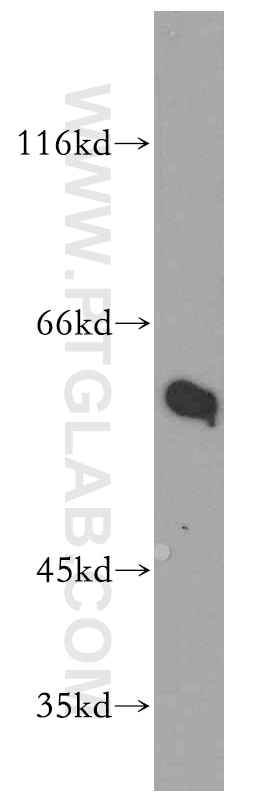
| Positive WB detected in | A431 cells, HEK-293 cells, HeLa cells, mouse brain tissue, rat brain tissue |
| Positive IHC detected in | human breast cancer tissue Note: suggested antigen retrieval with TE buffer pH 9.0; (*) Alternatively, antigen retrieval may be performed with citrate buffer pH 6.0 |
Recommended dilution
| Application | Dilution |
|---|---|
| Western Blot (WB) | WB : 1:500-1:3000 |
| Immunohistochemistry (IHC) | IHC : 1:50-1:500 |
| It is recommended that this reagent should be titrated in each testing system to obtain optimal results. | |
| Sample-dependent, Check data in validation data gallery. | |
Product Information
12121-1-AP targets RAD23B in WB, IHC, IF, CoIP, ELISA applications and shows reactivity with human, mouse, rat samples.
| Tested Reactivity | human, mouse, rat |
| Cited Reactivity | human, mouse, rat, pig |
| Host / Isotype | Rabbit / IgG |
| Class | Polyclonal |
| Type | Antibody |
| Immunogen |
CatNo: Ag2763 Product name: Recombinant human RAD23B protein Source: e coli.-derived, PGEX-4T Tag: GST Domain: 1-409 aa of BC020973 Sequence: MQVTLKTLQQQTFKIDIDPEETVKALKEKIESEKGKDAFPVAGQKLIYAGKILNDDTALKEYKIDEKNFVVVMVTKPKAVSTPAPATTQQSAPASTTAVTSSTTTTVAQAPTPVPALAPTSTPASITPASATASSEPAPASAAKQEKPAEKPAETPVATSPTATDSTSGDSSRSNLFEDATSALVTGQSYENMVTEIMSMGYEREQVIAALRASFNNPDRAVEYLLMGIPGDRESQAVVDPPQAASTGVPQSSAVAAAAATTTATTTTTSSGGHPLEFLRNQPQFQQMRQIIQQNPSLLPALLQQIGRENPQLLQQISQHQEHFIQMLNEPVQEAGGQGGGGGGGSGGIAEAGSGHMNYIQVTPQEKEAIERLKALGFPEGLVIQAYFACEKNENLAANFLLQQNFDED Predict reactive species |
| Full Name | RAD23 homolog B (S. cerevisiae) |
| Calculated Molecular Weight | 409 aa, 43 kDa |
| Observed Molecular Weight | 58 kDa |
| GenBank Accession Number | BC020973 |
| Gene Symbol | RAD23B |
| Gene ID (NCBI) | 5887 |
| RRID | AB_10641048 |
| Conjugate | Unconjugated |
| Form | Liquid |
| Purification Method | Antigen affinity purification |
| UNIPROT ID | P54727 |
| Storage Buffer | PBS with 0.02% sodium azide and 50% glycerol, pH 7.3. |
| Storage Conditions | Store at -20°C. Stable for one year after shipment. Aliquoting is unnecessary for -20oC storage. 20ul sizes contain 0.1% BSA. |
Background Information
RAD23B, also named as p58, hHR23B and HR23B, belongs to the RAD23 family. It plays a central role both in proteosomal degradation of misfolded proteins and DNA repair. RAD23B is a central component of a complex required to couple deglycosylation and proteasome-mediated degradation of misfolded proteins in the endoplasmic reticulun that are retrotranslocated in the cytosol. Involved in DNA excision repair by stabilizing XPC protein. It may play a part in DNA damage recognition and/or in altering chromatin structure to allow access by damage-processing enzymes. RAD23B displays aberrant mobility in SDS-polyacrylamide gels, as it is typically detected as a 58- to 60-kDa protein despite a predicted size of 42 kDa (PMID: 8692695, 12052895).
Protocols
| Product Specific Protocols | |
|---|---|
| IHC protocol for RAD23B antibody 12121-1-AP | Download protocol |
| WB protocol for RAD23B antibody 12121-1-AP | Download protocol |
| Standard Protocols | |
|---|---|
| Click here to view our Standard Protocols |
Publications
What published studies show
The RAD23B Polyclonal antibody (Cat# 12121-1-AP) has 11 citations published in journals including Molecular Cell, International Journal of Biological Sciences, Neurotherapeutics, Frontiers in Immunology, Molecular & Cellular Proteomics, Clinical Proteomics, Frontiers in Oncology, Journal of Cancer, Neuroscience Research, PLoS ONE, and Journal of Biomedical Science. Research fields span cancer (gastric, lung, NSCLC), neurodegeneration (Huntington's disease, spinocerebellar ataxia, stroke), immunology, proteomics, cartilage biology, and evolutionary biology.
| Species | Application | Title |
|---|---|---|
Mol Cell RAD23B acquires a copper metalloadaptor function in amphibian-to-reptile evolution to increase metabolism and regulate genomic integrity | ||
Int J Biol Sci Deubiquitinase PSMD7 promotes the proliferation, invasion, and cisplatin resistance of gastric cancer cells by stabilizing RAD23B. | ||
Neurotherapeutics Rad23b exacerbates pathological aggregates through disrupting proteasome functions in Spinocerebellar ataxia type 3.
| ||
Front Immunol PDLIM7 Synergizes With PDLIM2 and p62/Sqstm1 to Inhibit Inflammatory Signaling by Promoting Degradation of the p65 Subunit of NF-κB. | ||
Mol Cell Proteomics The mechano-ubiquitinome of articular cartilage: Differential ubiquitination and activation of a group of ER-associated DUBs and ER stress regulators | ||
Clin Proteomics Investigation on the mechanisms of human sperm DNA damage based on the proteomics analysis by SWATH-MS |

