

Tested Applications
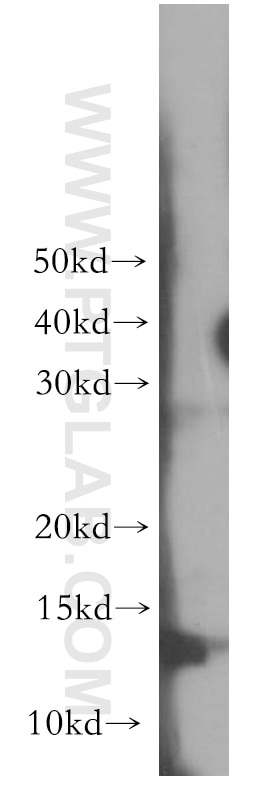
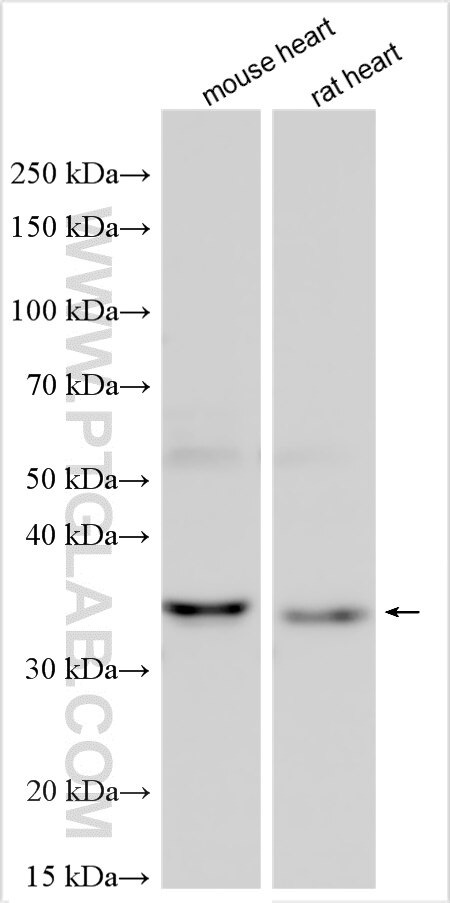
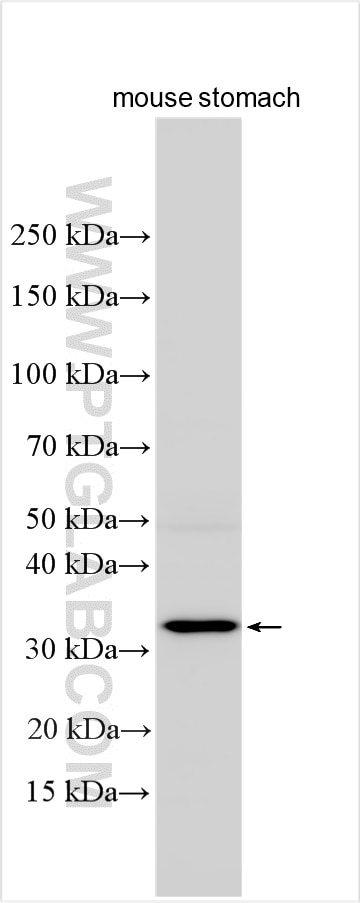
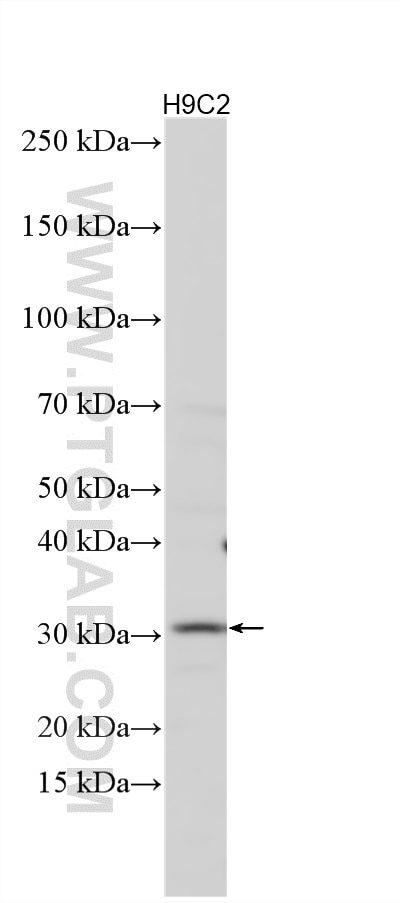
| Positive WB detected in | mouse heart tissue, H9C2 cells, human heart tissue, mouse stomach tissue, rat heart tissue |
Recommended dilution
| Application | Dilution |
|---|---|
| Western Blot (WB) | WB : 1:500-1:3000 |
| It is recommended that this reagent should be titrated in each testing system to obtain optimal results. | |
| Sample-dependent, Check data in validation data gallery. | |
Product Information
10327-1-AP targets RAMP1 in WB, IHC, IF, ELISA applications and shows reactivity with human, mouse, rat samples.
| Tested Reactivity | human, mouse, rat |
| Cited Reactivity | human, mouse, rat |
| Host / Isotype | Rabbit / IgG |
| Class | Polyclonal |
| Type | Antibody |
| Immunogen |
CatNo: Ag0402 Product name: Recombinant human RAMP1 protein Source: e coli.-derived, PGEX-4T Tag: GST Domain: 1-148 aa of BC000548 Sequence: MARALCRLPRRGLWLLLAHHLFMTTACQEANYGALLRELCLTQFQVDMEAVGETLWCDWGRTIRSYRELADCTWHMAEKLGCFWPNAEVDRFFLAVHGRYFRSCPISGRAVRDPPGSILYPFIVVPITVTLLVTALVVWQSKRTEGIV Predict reactive species |
| Full Name | receptor (G protein-coupled) activity modifying protein 1 |
| Calculated Molecular Weight | 17 kDa |
| Observed Molecular Weight | 14 kDa, 33-35 kDa |
| GenBank Accession Number | BC000548 |
| Gene Symbol | RAMP1 |
| Gene ID (NCBI) | 10267 |
| RRID | AB_2269270 |
| Conjugate | Unconjugated |
| Form | Liquid |
| Purification Method | Antigen affinity purification |
| UNIPROT ID | O60894 |
| Storage Buffer | PBS with 0.02% sodium azide and 50% glycerol, pH 7.3. |
| Storage Conditions | Store at -20°C. Stable for one year after shipment. Aliquoting is unnecessary for -20oC storage. 20ul sizes contain 0.1% BSA. |
Background Information
RAMP1 (receptor-activity-modifying protein) is a member of the RAMP family of single-transmembrane-domain proteins which consist of an N-terminal extracellular domain, a transmembrane region, and a short intracellular C-terminal tail. RAMPs are required to transport calcitonin-receptor-like receptor (CRLR) to the plasma membrane. CRLR, a G protein-coupled receptor, can function as either a calcitonin gene-related peptide (CGRP) receptor or an adrenomedullin receptor, depending on which members of the RAMP family are expressed. RAMP1 transports the CRLR to the plasma membrane and then remains associated with it to function as a terminally glycosylated CGRP receptor, while RAMP2 and RAMP3 transfer the CRLR to the cell surface to generate receptors that are preferentially selective for adrenomedullin. RAMP1 can form a homodimer, which migrates at 30-37 kDa on SDS-PAGE. (PMID: 9620797; 16188935; 12051717;PMID: 18384073)
Protocols
| Product Specific Protocols | |
|---|---|
| WB protocol for RAMP1 antibody 10327-1-AP | Download protocol |
| Standard Protocols | |
|---|---|
| Click here to view our Standard Protocols |
Publications
What published studies show
The anti-CGRP antibody (Cat# 10327-1-AP) has 15 total citations spanning journals including Cell, Advances in Science, Journal of Headache and Pain, Clinical Science, Diabetes, Obesity and Metabolism, International Journal of Molecular Sciences, Investigative Ophthalmology & Visual Science, Frontiers in Pharmacology, iScience, Journal of Virology, Journal of Biological Chemistry, PLoS ONE, Neuroscience Letters, and Chinese Medicine. Research fields cover neurology/migraine, oncology/tumor microenvironment, wound healing, inflammation, metabolic disease, ophthalmology, and infectious disease.
| Species | Application | Title |
|---|---|---|
Cell Sensory neurons drive immune exclusion by stimulating a dense extracellular matrix in the breast cancer tumor microenvironment. | ||
Adv Sci (Weinh) Ultrasound Controlled-Release Hydrogel Promotes Diabetic Wound Healing via Neuroimmune Modulation and Synergistic ROS Scavenging. | ||
J Headache Pain Calcitonin gene-related peptide receptor antagonist BIBN4096BS regulates synaptic transmission in the vestibular nucleus and improves vestibular function via PKC/ERK/CREB pathway in an experimental chronic migraine rat model. | ||
J Headache Pain Migraine-induced cochlear injury triggers ZBP1-mediated PANoptosis via CGRP signaling. | ||
Chin Med Acupuncture accelerates wound healing via CGRP-RAMP1-TSP1-mediated macrophage M2 polarization. | ||
Clin Sci (Lond) CGRP alleviates lipopolysaccharide-induced ARDS inflammation via the HIF-1α signaling pathway |
Reviews
What customers say
One reviewer rated this antibody 5 stars after testing it by immunofluorescence at 1:200 dilution in two different cancer cell lines (MG63/LNCaP). The antibody performed perfectly in one cell type but failed to detect RAMP1 in the other, despite both being expected to express the protein. Overall, the user was satisfied with the result but noted inconsistent performance across cell lines.
The reviews below have been submitted by verified Proteintech customers who received an incentive for providing their feedback.
Beatriz (Verified Customer) (06-25-2026) | The antibody was tested in 2 different cancer cell lines. Both should express RAMP1 protein, the antibody worked perfectly in one cell type but not in the other.
|

