
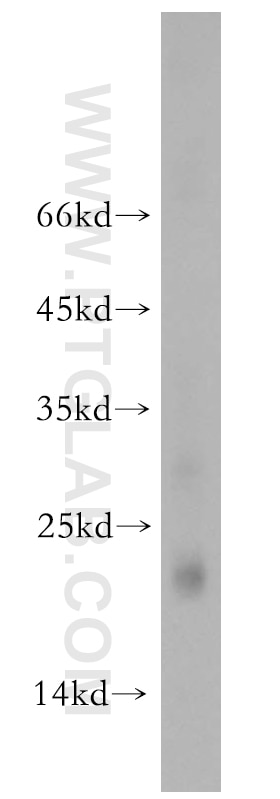
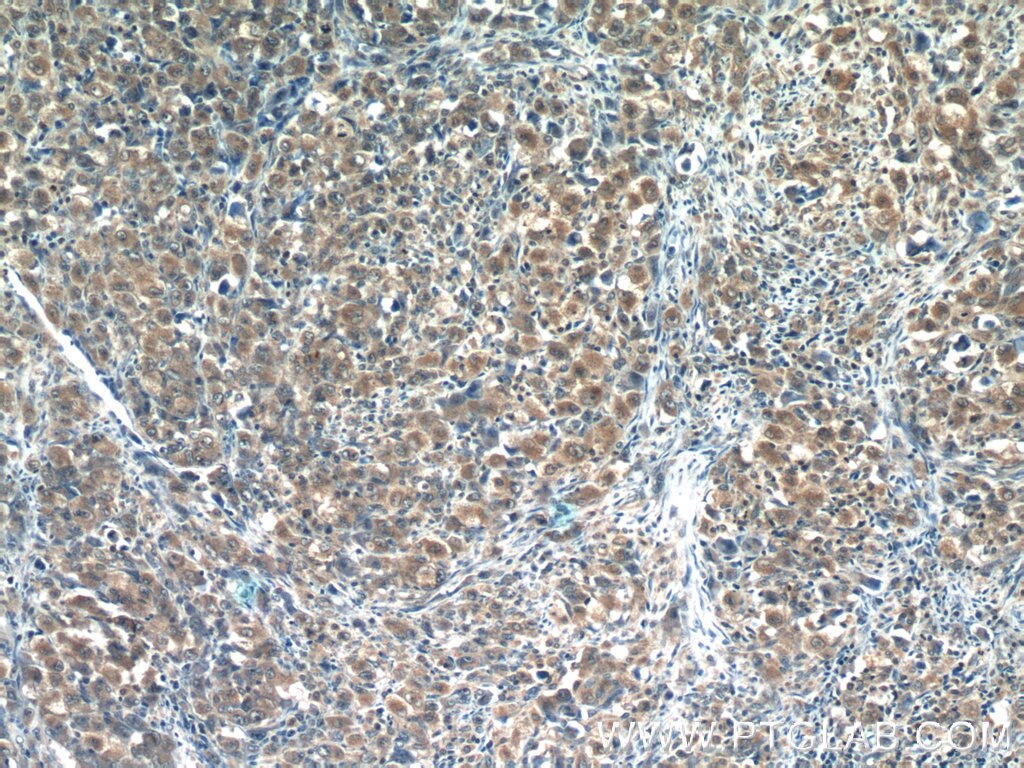
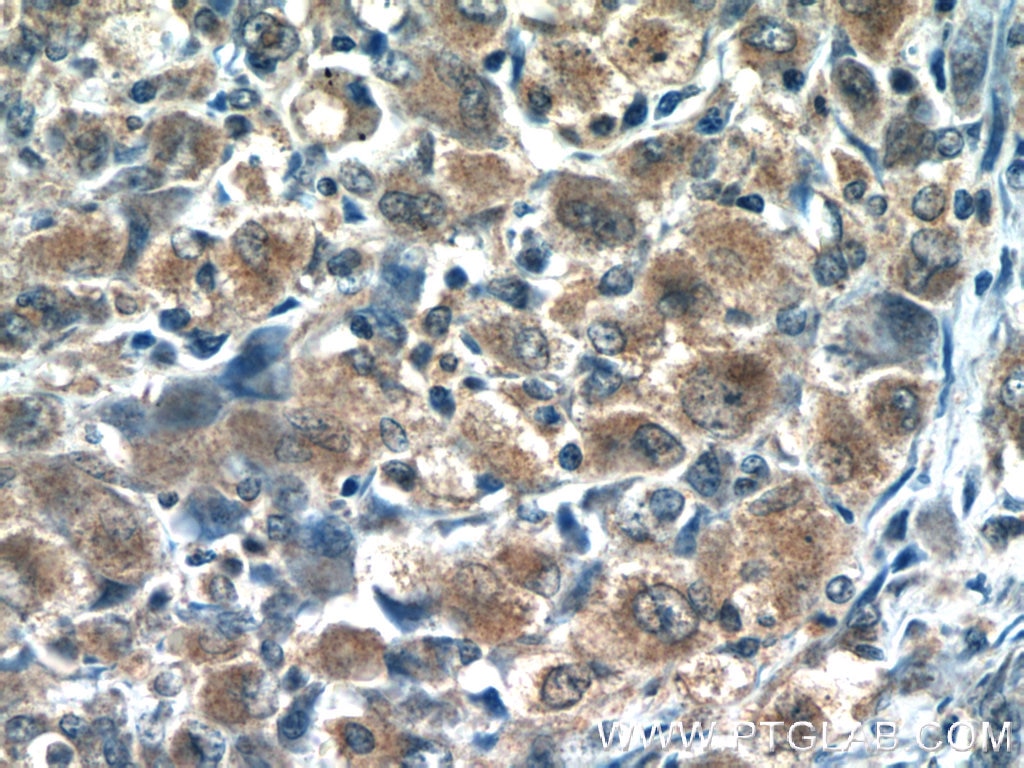

Tested Applications
| Positive WB detected in | A2780 cells |
| Positive IHC detected in | human lymphoma tissue Note: suggested antigen retrieval with TE buffer pH 9.0; (*) Alternatively, antigen retrieval may be performed with citrate buffer pH 6.0 |
RNF125 expresses at a very low level in most cells and tissues.
Recommended dilution
| Application | Dilution |
|---|---|
| Western Blot (WB) | WB : 1:500-1:1000 |
| Immunohistochemistry (IHC) | IHC : 1:20-1:200 |
| It is recommended that this reagent should be titrated in each testing system to obtain optimal results. | |
| Sample-dependent, Check data in validation data gallery. | |
Product Information
13290-1-AP targets RNF125 in WB, IHC, IP, ELISA applications and shows reactivity with human samples.
| Tested Reactivity | human |
| Cited Reactivity | human |
| Host / Isotype | Rabbit / IgG |
| Class | Polyclonal |
| Type | Antibody |
| Immunogen |
CatNo: Ag3908 Product name: Recombinant human RNF125 protein Source: e coli.-derived, PGEX-4T Tag: GST Domain: 1-232 aa of BC012021 Sequence: MGSVLSTDSGKSAPASATARALERRRDPELPVTSFDCAVCLEVLHQPVRTRCGHVFCRSCIATSLKNNKWTCPYCRAYLPSEGVPATDVAKRMKSEYKNCAECDIVLYLSEMRAHIRTCQKYIDKYGPLQELEETAARCVCPFCQRELYEDSLLDHCITHHRSERRPVFCPLCRLIPDENPSSFSGSLIRHLQVSHTLFYDDFIDFNIIEEALIRRVLDRSLLEYVNHSNTA Predict reactive species |
| Full Name | ring finger protein 125 |
| Calculated Molecular Weight | 232 aa, 26 kDa |
| Observed Molecular Weight | 22-26 kDa |
| GenBank Accession Number | BC012021 |
| Gene Symbol | RNF125 |
| Gene ID (NCBI) | 54941 |
| RRID | AB_10597852 |
| Conjugate | Unconjugated |
| Form | Liquid |
| Purification Method | Antigen affinity purification |
| UNIPROT ID | Q96EQ8 |
| Storage Buffer | PBS with 0.02% sodium azide and 50% glycerol, pH 7.3. |
| Storage Conditions | Store at -20°C. Stable for one year after shipment. Aliquoting is unnecessary for -20oC storage. 20ul sizes contain 0.1% BSA. |
Protocols
| Product Specific Protocols | |
|---|---|
| IHC protocol for RNF125 antibody 13290-1-AP | Download protocol |
| WB protocol for RNF125 antibody 13290-1-AP | Download protocol |
| Standard Protocols | |
|---|---|
| Click here to view our Standard Protocols |
Publications
What published studies show
The anti-RNF125 antibody (Cat# 13290-1-AP) has 7 total citations across journals including Oncogene, Cell Reports, Journal of Virology, Molecular and Cellular Biochemistry, Oncology Reports, Oncology Letters, and Current Medicinal Chemistry. Research fields span hepatocellular carcinoma progression, antiviral innate immunity, CD8 T cell-mediated anticancer immunity in cervical cancer, lung adenocarcinoma tumor suppressor regulation, viral RLR signaling pathway inhibition, liver cancer cell proliferation, and ubiquitination-based classification in sarcoma.
| Species | Application | Title |
|---|---|---|
Oncogene RNF125 attenuates hepatocellular carcinoma progression by downregulating SRSF1-ERK pathway
| ||
Cell Rep Type I interferon/STAT1 signaling regulates UBE2M-mediated antiviral innate immunity in a negative feedback manner | ||
Oncol Rep RNA‑binding protein MBNL1 regulates tumor growth, chemosensitivity and antitumor immunity in lung adenocarcinoma by controlling the expression of tumor suppressor RNF125 | ||
Mol Cell Biochem RNF125 promotes CD8 T cell-mediated anticancer immunity and suppresses the malignant phenotype of cervical cancer. | ||
Oncol Lett RNF125‑mediated ubiquitination of MCM6 regulates the proliferation of human liver hepatocellular carcinoma cells |
Reviews
What customers say
One reviewer (Jessica Lenoir, Jan 2019) rated this antibody 3/5 for Western Blot at 1:1000 dilution. She reported it works well for detecting overexpressed RNF125 in HEK293T cells, but could barely detect endogenous RNF125 in HCT116 cells after 10 hours of SeV exposure, suggesting limited sensitivity for low-abundance targets.
The reviews below have been submitted by verified Proteintech customers who received an incentive for providing their feedback.
Jessica (Verified Customer) (01-31-2019) | Works well to detect overexpression of RNF125 in HEK293TCan barely detect RNF125 in HCT116 cells after exposure to 10h SeV.
|

