

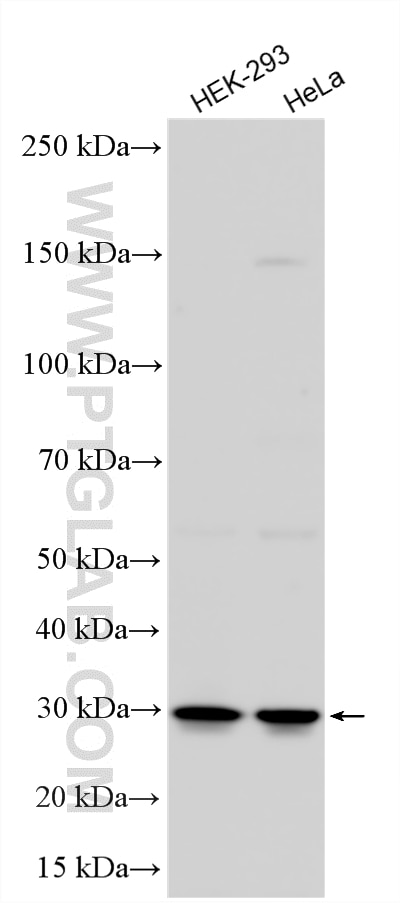
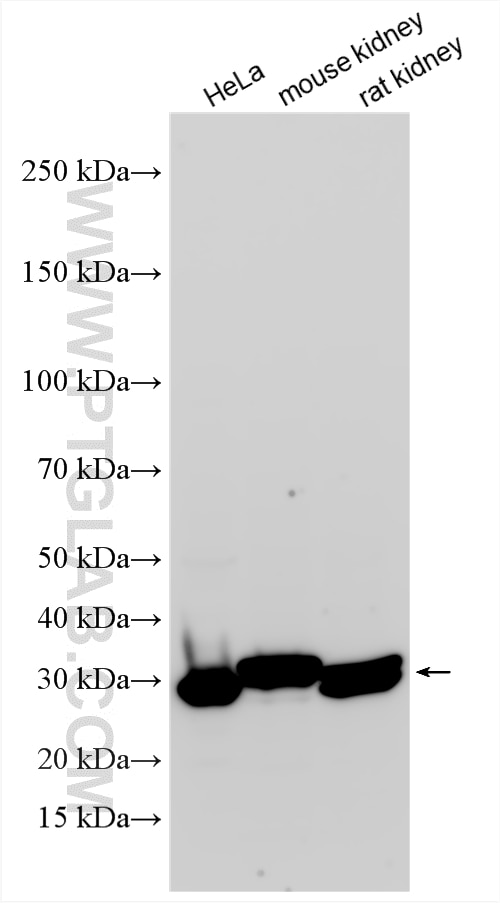

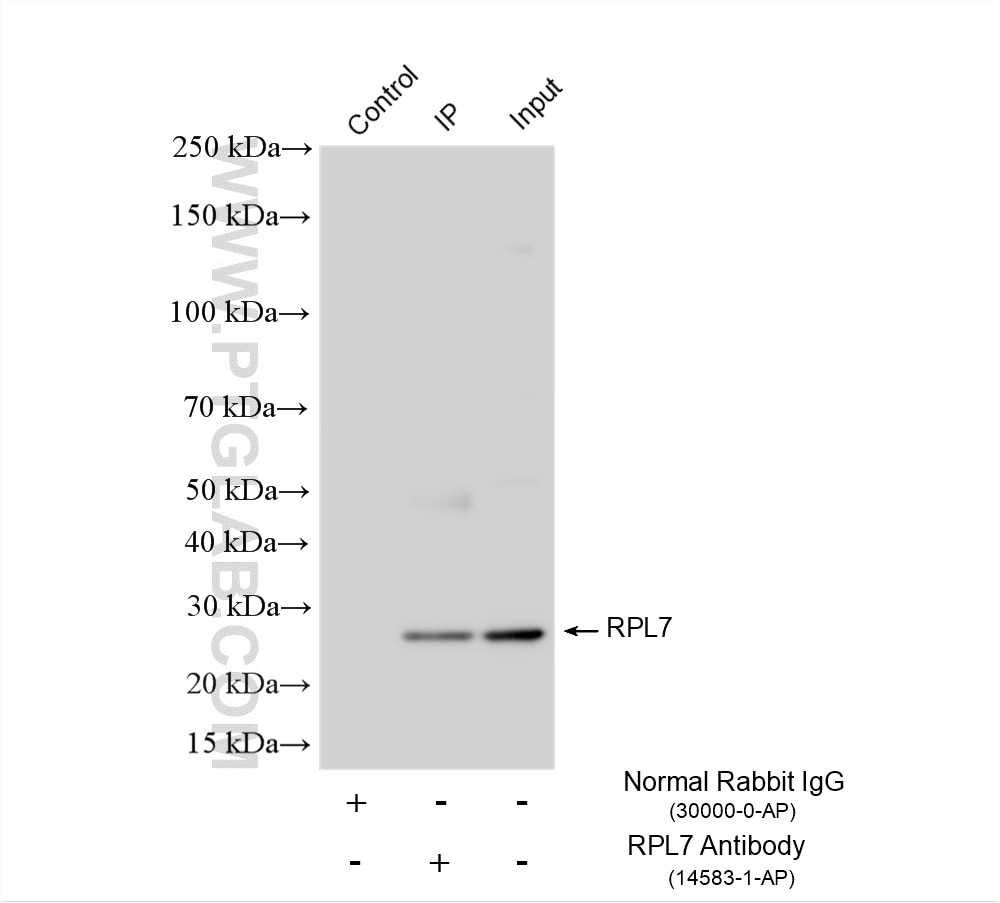



Tested Applications
| Positive WB detected in | HEK-293 cells, HeLa cells, mouse kidney tissue, rat kidney tissue |
| Positive IP detected in | HeLa cells |
| Positive IHC detected in | human skin cancer tissue Note: suggested antigen retrieval with TE buffer pH 9.0; (*) Alternatively, antigen retrieval may be performed with citrate buffer pH 6.0 |
| Positive IF/ICC detected in | HepG2 cells, A431 cells |
Recommended dilution
| Application | Dilution |
|---|---|
| Western Blot (WB) | WB : 1:1000-1:4000 |
| Immunoprecipitation (IP) | IP : 0.5-4.0 ug for 1.0-3.0 mg of total protein lysate |
| Immunohistochemistry (IHC) | IHC : 1:20-1:200 |
| Immunofluorescence (IF)/ICC | IF/ICC : 1:200-1:800 |
| It is recommended that this reagent should be titrated in each testing system to obtain optimal results. | |
| Sample-dependent, Check data in validation data gallery. | |
Product Information
14583-1-AP targets RPL7 in WB, IHC, IF/ICC, IP, CoIP, RIP, ELISA applications and shows reactivity with human, mouse, rat samples.
| Tested Reactivity | human, mouse, rat |
| Cited Reactivity | human, mouse, rat |
| Host / Isotype | Rabbit / IgG |
| Class | Polyclonal |
| Type | Antibody |
| Immunogen |
CatNo: Ag6104 Product name: Recombinant human RPL7 protein Source: e coli.-derived, PET28a Tag: 6*His Domain: 1-248 aa of BC006095 Sequence: MEGVEEKKKEVPAVPETLKKKRRNFAELKIKRLRKKFAQKMLRKARRKLIYEKAKHYHKEYRQMYRTEIRMARMARKAGNFYVPAEPKLAFVIRIRGINGVSPKVRKVLQLLRLRQIFNGTFVKLNKASINMLRIVEPYIAWGYPNLKSVNELIYKRGYGKINKKRIALTDNALIARSLGKYGIICMEDLIHEIYTVGKRFKEANNFLWPFKLSSPRGGMKKKTTHFVEGGDAGNREDQINRLIRRMN Predict reactive species |
| Full Name | ribosomal protein L7 |
| Calculated Molecular Weight | 29 kDa |
| Observed Molecular Weight | 29-30 kDa |
| GenBank Accession Number | BC006095 |
| Gene Symbol | RPL7 |
| Gene ID (NCBI) | 6129 |
| RRID | AB_2254049 |
| Conjugate | Unconjugated |
| Form | Liquid |
| Purification Method | Antigen affinity purification |
| UNIPROT ID | P18124 |
| Storage Buffer | PBS with 0.02% sodium azide and 50% glycerol, pH 7.3. |
| Storage Conditions | Store at -20°C. Stable for one year after shipment. Aliquoting is unnecessary for -20oC storage. 20ul sizes contain 0.1% BSA. |
Background Information
The mammalian ribosome comprises 79 ribosomal proteins and four rRNAs, which combine in equimolar ratios to form the small (40S) and large (60S) subunits. Ribosome proteins are a direct and critical target of the PI3K pathway in promoting growth.[PMID:15289434]. RPL7 binds to G-rich structures in 28S rRNA, and plays a regulatory role in the translation apparatus, inhibits cell-free translation of mRNAs. In addition, RPL7 is suggested to have a role as an integral part of natural freeze tolerance[PMID: 18706984]. Besides, RPL7 is responsible for its normal ribosome functions including the nuclear targeting, ribosome assembly and translation[PMID:17258209].
Protocols
| Product Specific Protocols | |
|---|---|
| IF protocol for RPL7 antibody 14583-1-AP | Download protocol |
| IHC protocol for RPL7 antibody 14583-1-AP | Download protocol |
| IP protocol for RPL7 antibody 14583-1-AP | Download protocol |
| WB protocol for RPL7 antibody 14583-1-AP | Download protocol |
| Standard Protocols | |
|---|---|
| Click here to view our Standard Protocols |
Publications
What published studies show
RPL7 Polyclonal Antibody (Catalog No. 14583-1-AP) has been cited 19 times. Citations appear in journals including J Hematol Oncol, Science, Cell, J Hepatol, Cell Metab, Nat Cell Biol, Nat Commun, Nucleic Acids Res, PNAS, Dev Cell, Cell Rep, Front Endocrinol, iScience, J Cell Sci, BBRC, and Biophys Rep. Research fields cover ribosome biogenesis and translation, mRNA metabolism, stress granules, ribophagy, mitochondrial/ER function, and cancer biology (liver, cholangiocarcinoma, breast, and small-cell lung carcinoma), used primarily in WB, with IHC, IF, IP, RIP, and CoIP applications.
| Species | Application | Title |
|---|---|---|
J Hematol Oncol METTL16 promotes liver cancer stem cell self-renewal via controlling ribosome biogenesis and mRNA translation | ||
Science Endosomal lipid signaling reshapes the endoplasmic reticulum to control mitochondrial function | ||
Cell QKI shuttles internal m7G-modified transcripts into stress granules and modulates mRNA metabolism | ||
J Hepatol Nucleolin lactylation contributes to intrahepatic cholangiocarcinoma pathogenesis via RNA splicing regulation of MADD | ||
Cell Metab Adipocyte-derived glutathione promotes obesity-related breast cancer by regulating the SCARB2-ARF1-mTORC1 complex | ||
Nat Cell Biol METTL16 exerts an m6A-independent function to facilitate translation and tumorigenesis. |


