
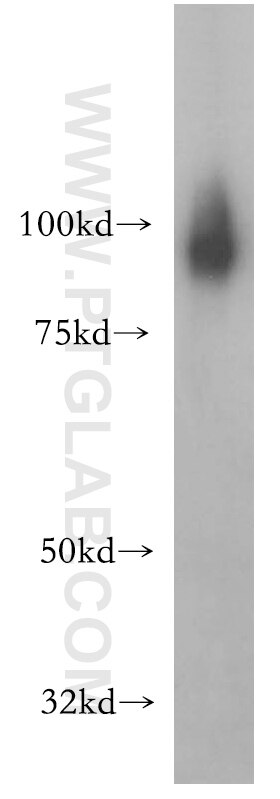
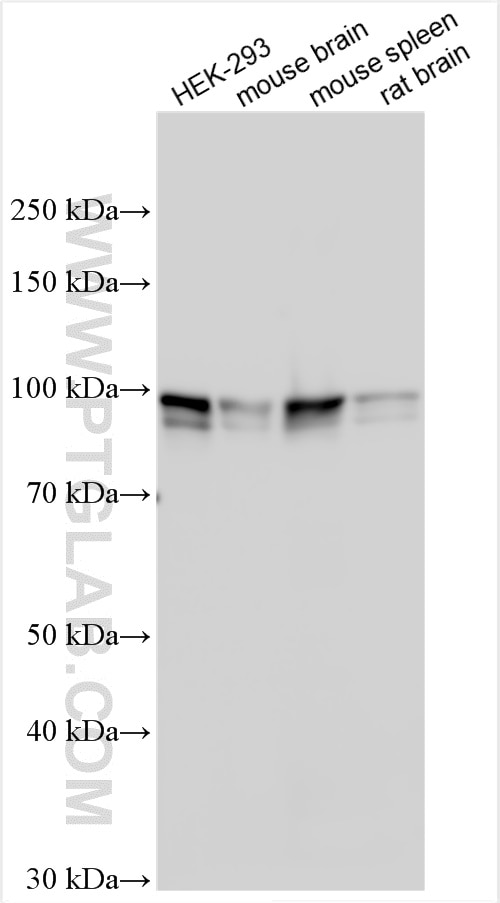
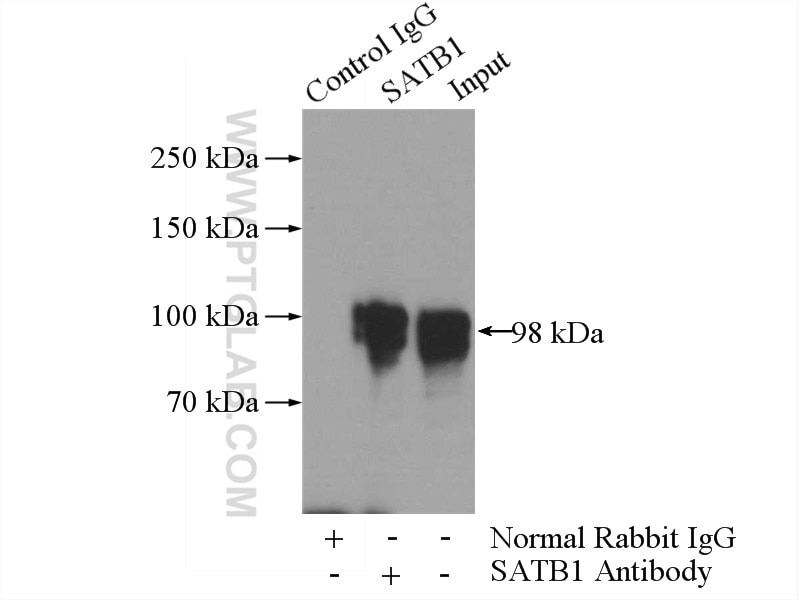



Tested Applications
| Positive WB detected in | human brain tissue, HEK-293 cells, mouse brain tissue, mouse spleen tissue, rat brain tissue |
| Positive IP detected in | HEK-293 cells |
| Positive IHC detected in | human oesophagus cancer tissue, human urothelial carcinoma tissue, mouse spleen tissue, mouse thymus tissue, rat brain tissue, rat spleen tissue, rat thymus tissue Note: suggested antigen retrieval with TE buffer pH 9.0; (*) Alternatively, antigen retrieval may be performed with citrate buffer pH 6.0 |
Recommended dilution
| Application | Dilution |
|---|---|
| Western Blot (WB) | WB : 1:1000-1:8000 |
| Immunoprecipitation (IP) | IP : 0.5-4.0 ug for 1.0-3.0 mg of total protein lysate |
| Immunohistochemistry (IHC) | IHC : 1:1000-1:4000 |
| It is recommended that this reagent should be titrated in each testing system to obtain optimal results. | |
| Sample-dependent, Check data in validation data gallery. | |
Product Information
15400-1-AP targets SATB1 in WB, IHC, IP, CoIP, ChIP, ELISA applications and shows reactivity with human, mouse, rat samples.
| Tested Reactivity | human, mouse, rat |
| Cited Reactivity | human, mouse, rat |
| Host / Isotype | Rabbit / IgG |
| Class | Polyclonal |
| Type | Antibody |
| Immunogen |
CatNo: Ag7615 Product name: Recombinant human SATB1 protein Source: e coli.-derived, PGEX-4T Tag: GST Domain: 415-763 aa of BC001744 Sequence: PKTASQSLLVNLRAMQNFLQLPEAERDRIYQDERERSLNAASAMGPAPLISTPPSRPPQVKTATIATERNGKPENNTMNINASIYDEIQQEMKRAKVSQALFAKVAATKSQGWLCELLRWKEDPSPENRTLWENLSMIRRFLSLPQPERDAIYEQESNAVHHHGDRPPHIIHVPAEQIQQQQQQQQQQQQQQQAPPPPQPQQQPQTGPRLPPRQPTVASPAESDEENRQKTRPRTKISVEALGILQSFIQDVGLYPDEEAIQTLSAQLDLPKYTIIKFFQNQRYYLKHHGKLKDNSGLEVDVAEYKEEELLKDLEESVQDKNTNTLFSVKLEEELSVEGNTDINTDLKD Predict reactive species |
| Full Name | SATB homeobox 1 |
| Calculated Molecular Weight | 86 kDa |
| Observed Molecular Weight | 86-100 kDa |
| GenBank Accession Number | BC001744 |
| Gene Symbol | SATB1 |
| Gene ID (NCBI) | 6304 |
| RRID | AB_2184321 |
| Conjugate | Unconjugated |
| Form | Liquid |
| Purification Method | Antigen affinity purification |
| UNIPROT ID | Q01826 |
| Storage Buffer | PBS with 0.02% sodium azide and 50% glycerol, pH 7.3. |
| Storage Conditions | Store at -20°C. Stable for one year after shipment. Aliquoting is unnecessary for -20oC storage. 20ul sizes contain 0.1% BSA. |
Background Information
Epigenetic modifications and dynamic changes in chromatin organization by organizer proteins have recently been shown to play an instrumental role in regulating cancer-promoting genes. Special AT-rich binding protein (SATB1) is a unique type of global regulator that integrates higher-order chromatin organization -withregulation of gene expression. [PMID:23076250,22998183,23121661] SATB1 is a T cell-enriched transcription factor and a chromatin organizer essential for controlling genes that participate in T-cell development and activation. It regulates gene expression by periodically anchoring matrix attachment regions to the nuclear matrix and directly recruiting chromatin-modifying factors. Depending on its posttranslational modifications, SATB1 activates or represses multiple genes.Its expression is regulated by interleukin-4 (IL4) during T helper-2(Th2) cell differentiation[PMID: 20522714]. The calculated molecular weight of SATB1 is 86 kDa, but modified SATB1 is about 100 kDa (PMID: 22879953).
Protocols
| Product Specific Protocols | |
|---|---|
| IHC protocol for SATB1 antibody 15400-1-AP | Download protocol |
| IP protocol for SATB1 antibody 15400-1-AP | Download protocol |
| WB protocol for SATB1 antibody 15400-1-AP | Download protocol |
| Standard Protocols | |
|---|---|
| Click here to view our Standard Protocols |
Publications
What published studies show
The SATB1 Polyclonal antibody (catalog number 15400-1-AP) has 10 total citations. These appear in journals including Pharmacological Research, Development Cell, Cell Reports, International Immunopharmacology, Molecular Neurobiology, International Journal of Medical Sciences, IUBMB Life, European Review of Medical and Pharmacological Sciences, International Journal of Clinical and Experimental Pathology, and Stem Cell Research & Therapy. Research fields span neurology (stroke, Parkinson's disease), oncology (nasopharyngeal carcinoma), immunology (autoimmune hepatitis, T cells), epigenetics, and stem cell biology.
| Species | Application | Title |
|---|---|---|
Pharmacol Res Cyclo-(Phe-Tyr) as a novel cyclic dipeptide compound alleviates ischemic/reperfusion brain injury via JUNB/JNK/NF-κB and SOX5/PI3K/AKT pathways. | ||
Cell Rep SATB1 regulates 3D genome architecture in T cells by constraining chromatin interactions surrounding CTCF-binding sites
| ||
Int Immunopharmacol Unveiling the interplay between hepatocyte SATB1 and innate immunity in autoimmune hepatitis | ||
Mol Neurobiol SATB1/SLC7A11/HO-1 Axis Ameliorates Ferroptosis in Neuron Cells After Ischemic Stroke by Danhong Injection | ||
Int J Med Sci SATB1 Knockdown Inhibits Proliferation and Invasion and Decreases Chemoradiation Resistance in Nasopharyngeal Carcinoma Cells by Reversing EMT and Suppressing MMP-9.
|


