
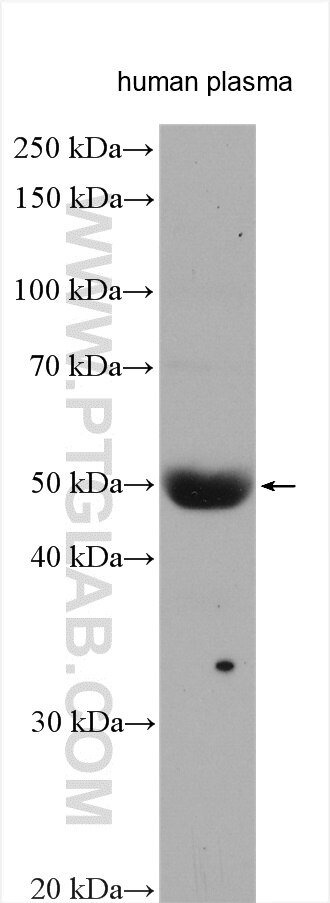
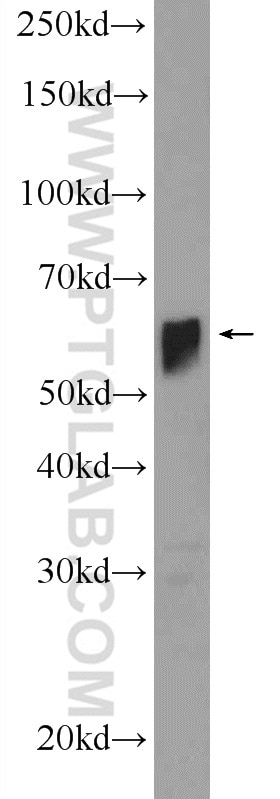
Tested Applications
| Positive WB detected in | human plasma tissue |
Recommended dilution
| Application | Dilution |
|---|---|
| Western Blot (WB) | WB : 1:500-1:2000 |
| It is recommended that this reagent should be titrated in each testing system to obtain optimal results. | |
| Sample-dependent, Check data in validation data gallery. | |
Product Information
12741-1-AP targets SERPIND1 in WB, ELISA applications and shows reactivity with human, mouse, rat samples.
| Tested Reactivity | human, mouse, rat |
| Cited Reactivity | human |
| Host / Isotype | Rabbit / IgG |
| Class | Polyclonal |
| Type | Antibody |
| Immunogen |
CatNo: Ag3637 Product name: Recombinant human SERPIND1 protein Source: e coli.-derived, T-HIS Tag: 6*His Domain: 149-499 aa of BC035028 Sequence: DNIFIAPVGISTAMGMISLGLKGETHEQVHSILHFKDFVNASSKYEITTIHNLFRKLTHRLFRRNFGYTLRSVNDLYIQKQFPILLDFKTKVREYYFAEAQIADFSDPAFISKTNNHIMKLTKGLIKDALENIDPATQMMILNCIYFKGSWVNKFPVEMTHNHNFRLNEREVVKVSMMQTKGNFLAANDQELDCDILQLEYVGGISMLIVVPHKMSGMKTLEAQLTPGVVERWQKSMTNRTREVLLPKFKLEKNYNLVESLKLMGIRMLFDKNGNMAGISDQRIAIDLFKHQGTITVNEEGTQATTVTTVGFMPLSTQVRFTVDRPFLFLIYEHRTSCLLFMGRVANPSRS Predict reactive species |
| Full Name | serpin peptidase inhibitor, clade D (heparin cofactor), member 1 |
| Calculated Molecular Weight | 499 aa, 57 kDa |
| Observed Molecular Weight | 57-60 kDa |
| GenBank Accession Number | BC035028 |
| Gene Symbol | SERPIND1 |
| Gene ID (NCBI) | 3053 |
| RRID | AB_2877878 |
| Conjugate | Unconjugated |
| Form | Liquid |
| Purification Method | Antigen affinity purification |
| UNIPROT ID | P05546 |
| Storage Buffer | PBS with 0.02% sodium azide and 50% glycerol, pH 7.3. |
| Storage Conditions | Store at -20°C. Stable for one year after shipment. Aliquoting is unnecessary for -20oC storage. 20ul sizes contain 0.1% BSA. |
Background Information
Serpin family D member 1 (SERPIND1, Serpin D1) is also named heparin cofactor 2 (HC-II) and protease inhibitor leuserpin-2 (HLS2). It belongs to the serpin family. SERPIND1 can inhibit thrombin activity through interaction with heparin; hence, it is also known as heparin cofactor II (PMID: 15315969). SERPIND1 can also promote the release of leukocyte chemotactic factors and induce angiogenesis (PMID: 2713501, PMID: 22904320). SERPIND1 promoted the proliferation, migration, invasion, G1-to-S phase transition, and epithelial-mesenchymal transition of ovarian cancer cells and inhibited their apoptosis by promoting phosphorylation in the phosphoinositide 3-kinase/protein kinase B (PI3K/AKT) pathway (PMID: 31637210). It is a thrombin inhibitor activated by the glycosaminoglycans, heparin or dermatan sulfate. In the presence of the latter, HC-II becomes the predominant thrombin inhibitor in place of antithrombin III (AT-III). It also inhibits chymotrypsin, but in a glycosaminoglycan-independent manner (PMID: 1939083, PMID: 32827448).
Protocols
| Product Specific Protocols | |
|---|---|
| WB protocol for SERPIND1 antibody 12741-1-AP | Download protocol |
| Standard Protocols | |
|---|---|
| Click here to view our Standard Protocols |
Publications
What published studies show
| Species | Application | Title |
|---|---|---|
Sci Rep Association of urinary ketamine and APOA1 levels with bladder dysfunction in ketamine abusers revealed via proteomics and targeted metabolite analyses. | ||
Oncol Rep Analysis of the gene expression profile in response to human epididymis protein 4 in epithelial ovarian cancer cells. | ||
Gene Ther RNAi targeting heparin cofactor II promotes hemostasis in a canine model of acquired hemophilia A
|

