
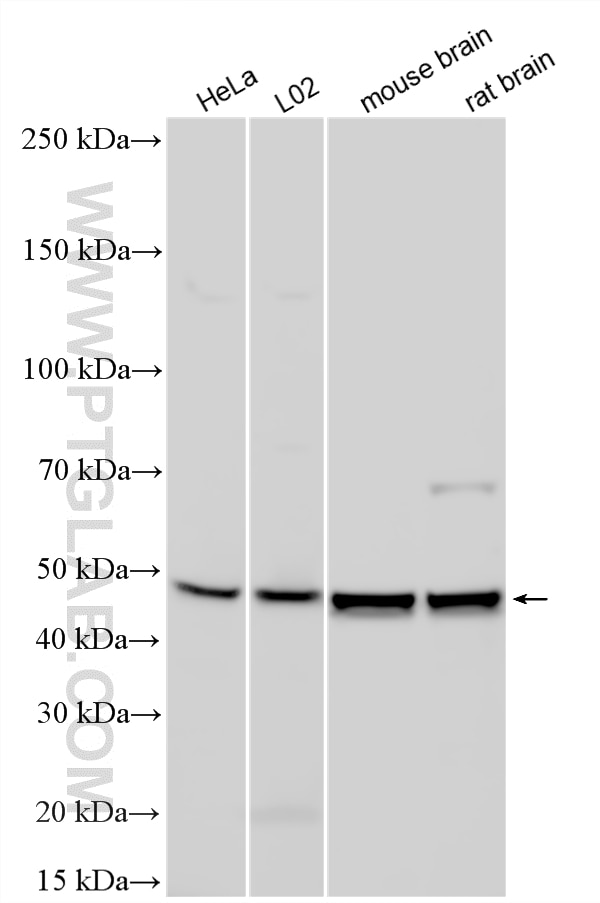



Tested Applications
| Positive WB detected in | HeLa cells, C6 cells, mouse brain tissue, mouse kidney tissue, L02 cells, rat brain tissue, NIH/3T3 cells |
| Positive IF/ICC detected in | HeLa cells |
Recommended dilution
| Application | Dilution |
|---|---|
| Western Blot (WB) | WB : 1:1000-1:6000 |
| Immunofluorescence (IF)/ICC | IF/ICC : 1:20-1:200 |
| It is recommended that this reagent should be titrated in each testing system to obtain optimal results. | |
| Sample-dependent, Check data in validation data gallery. | |
Product Information
24840-1-AP targets SETD7 in WB, IHC, IF/ICC, CoIP, ELISA applications and shows reactivity with human, mouse, rat samples.
| Tested Reactivity | human, mouse, rat |
| Cited Reactivity | human, mouse, rat |
| Host / Isotype | Rabbit / IgG |
| Class | Polyclonal |
| Type | Antibody |
| Immunogen |
CatNo: Ag18219 Product name: Recombinant human SETD7 protein Source: e coli.-derived, PGEX-4T Tag: GST Domain: 1-366 aa of BC121055 Sequence: MDSDDEMVEEAVEGHLDDDGLPHGFCTVTYSSTDRFEGNFVHGEKNGRGKFFFFDGSTLEGYYVDDALQGQGVYTYEDGGVLQGTYVDGELNGPAQEYDTDGRLIFKGQYKDNIRHGVCWIYYPDGGSLVGEVNEDGEMTGEKIAYVYPDERTALYGKFIDGEMIEGKLATLMSTEEGRPHFELMPGNSVYHFDKSTSSCISTNALLPDPYESERVYVAESLISSAGEGLFSKVAVGPNTVMSFYNGVRITHQEVDSRDWALNGNTLSLDEETVIDVPEPYNHVSKYCASLGHKANHSFTPNCIYDMFVHPRFGPIKCIRTLRAVEADEELTVAYGYDHSPPGKSGPEAPEWYQVELKAFQATQQK Predict reactive species |
| Full Name | SET domain containing (lysine methyltransferase) 7 |
| Calculated Molecular Weight | 366 aa, 41 kDa |
| Observed Molecular Weight | 48-50 kDa |
| GenBank Accession Number | BC121055 |
| Gene Symbol | SETD7 |
| Gene ID (NCBI) | 80854 |
| RRID | AB_2737406 |
| Conjugate | Unconjugated |
| Form | Liquid |
| Purification Method | Antigen affinity purification |
| UNIPROT ID | Q8WTS6 |
| Storage Buffer | PBS with 0.02% sodium azide and 50% glycerol, pH 7.3. |
| Storage Conditions | Store at -20°C. Stable for one year after shipment. Aliquoting is unnecessary for -20oC storage. 20ul sizes contain 0.1% BSA. |
Background Information
SET domain containing lysine methyltransferase 7 (SETD7, also called SET7/9) was the first lysine methyltransferase (KMT) discovered to specifically monomethylate lysine-4 of histone 3 (H3K4me1) (PMID: 26435321). SETD7 has been shown to have a very broad target specificity in vitro, including transcriptional regulators such as TAF10, p53, ER, p65, STAT3, Rb, Mypt, Tat, and Foxo3 (PMID: 25136132, 30013796).
Protocols
| Product Specific Protocols | |
|---|---|
| IF protocol for SETD7 antibody 24840-1-AP | Download protocol |
| WB protocol for SETD7 antibody 24840-1-AP | Download protocol |
| Standard Protocols | |
|---|---|
| Click here to view our Standard Protocols |
Publications
What published studies show
The SETD7 Polyclonal antibody (Cat# 24840-1-AP) has 14 citations published in 13 journals, including Bioact Mater, Cell Death Dis, Mol Ther, EBioMedicine, Acta Pharmacol Sin, FASEB J, J Biol Chem, Oncotarget, and Biochem Biophys Res Commun. Associated research fields encompass epigenetic regulation, multiple cancer types (gastric, colorectal, breast, ovarian, pancreatic, osteosarcoma), cardiovascular disease, acute liver failure, osteoarthritis, preeclampsia, stem cell differentiation, and immune signaling.
| Species | Application | Title |
|---|---|---|
Bioact Mater Dynamic hydrogels orchestrate the differentiation fate of mesenchymal stem cells through epigenetic regulation of SETD7 to accelerate bone defect repair. | ||
Cell Death Dis ACAT2 suppresses the ubiquitination of YAP1 to enhance the proliferation and metastasis ability of gastric cancer via the upregulation of SETD7
| ||
Mol Ther Integrated stress response promotes acute liver failure by activating SETD7 and enhancing NLRP3 methylation. | ||
EBioMedicine Histone-lysine N-methyltransferase SETD7 is a potential serum biomarker for colorectal cancer patients. | ||
Acta Pharmacol Sin Inhibition of Setd7 protects against cardiomyocyte hypertrophy via inhibiting lipid oxidation.
| ||
Biol Direct SETD7-mediated epigenetic regulation of LncRNA XIST promotes trophoblast pyroptosis: a study in preeclampsia mouse and cell models. |


