
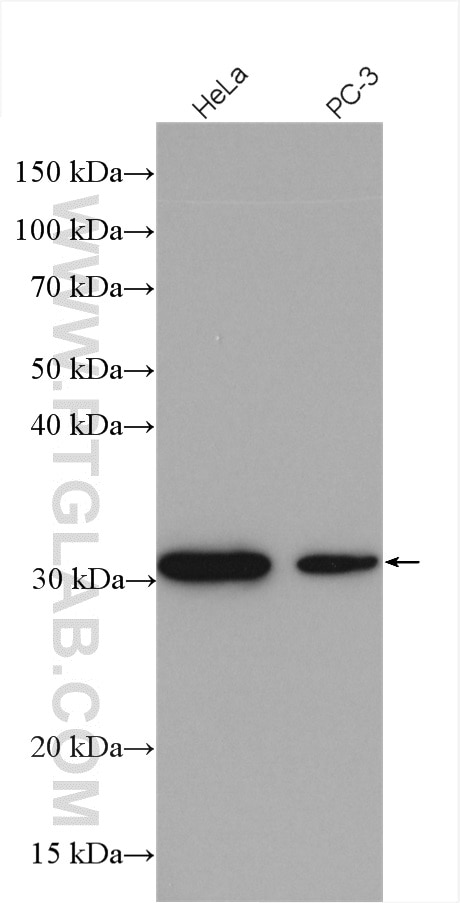
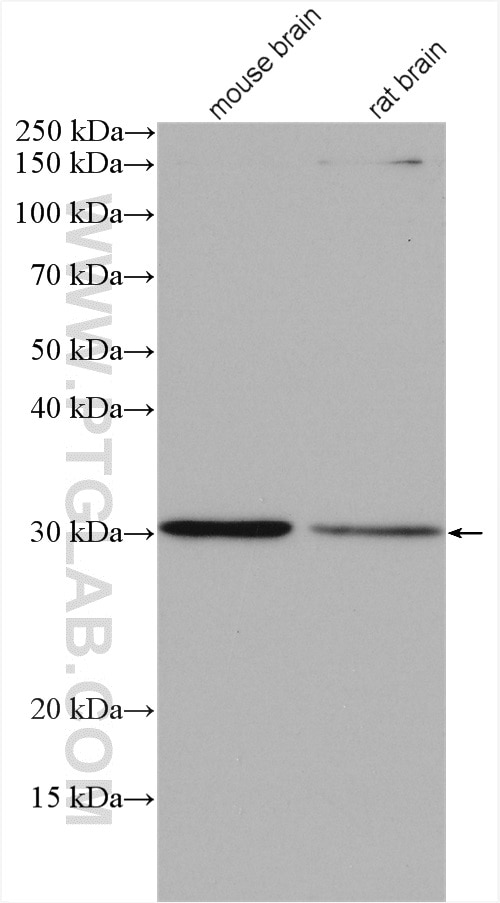
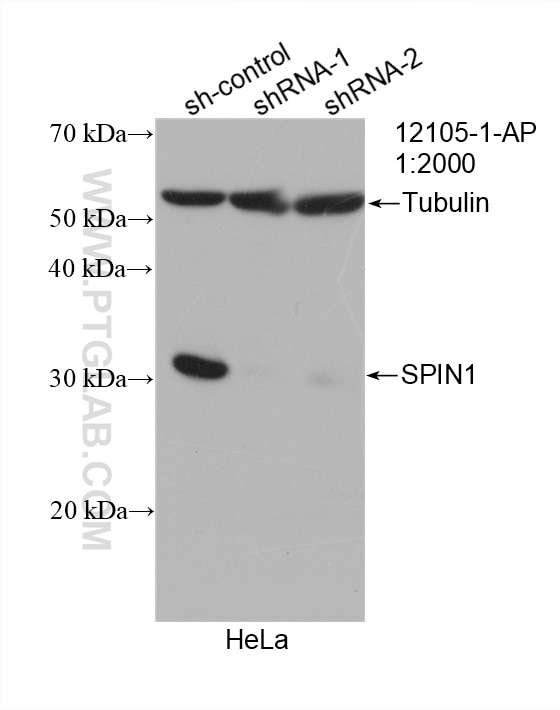
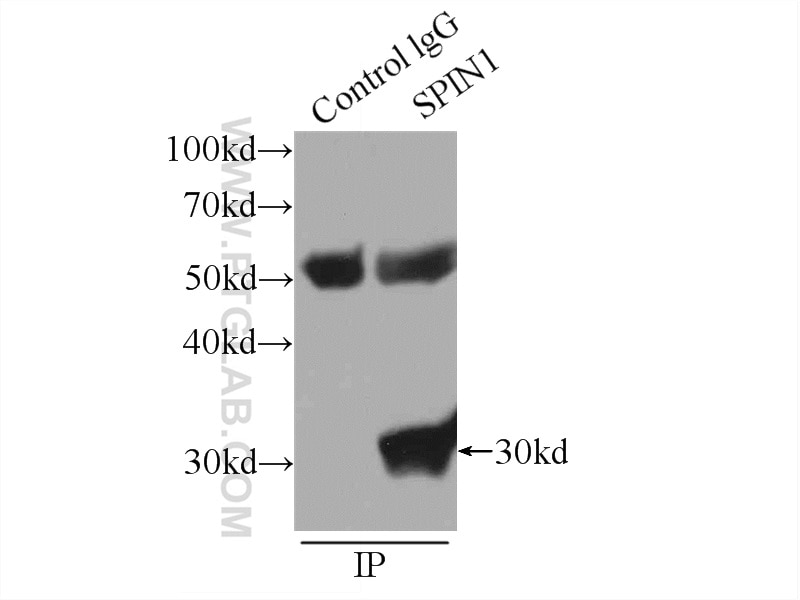

Tested Applications
| Positive WB detected in | HeLa cells, PC-3 cells |
| Positive IP detected in | HeLa cells |
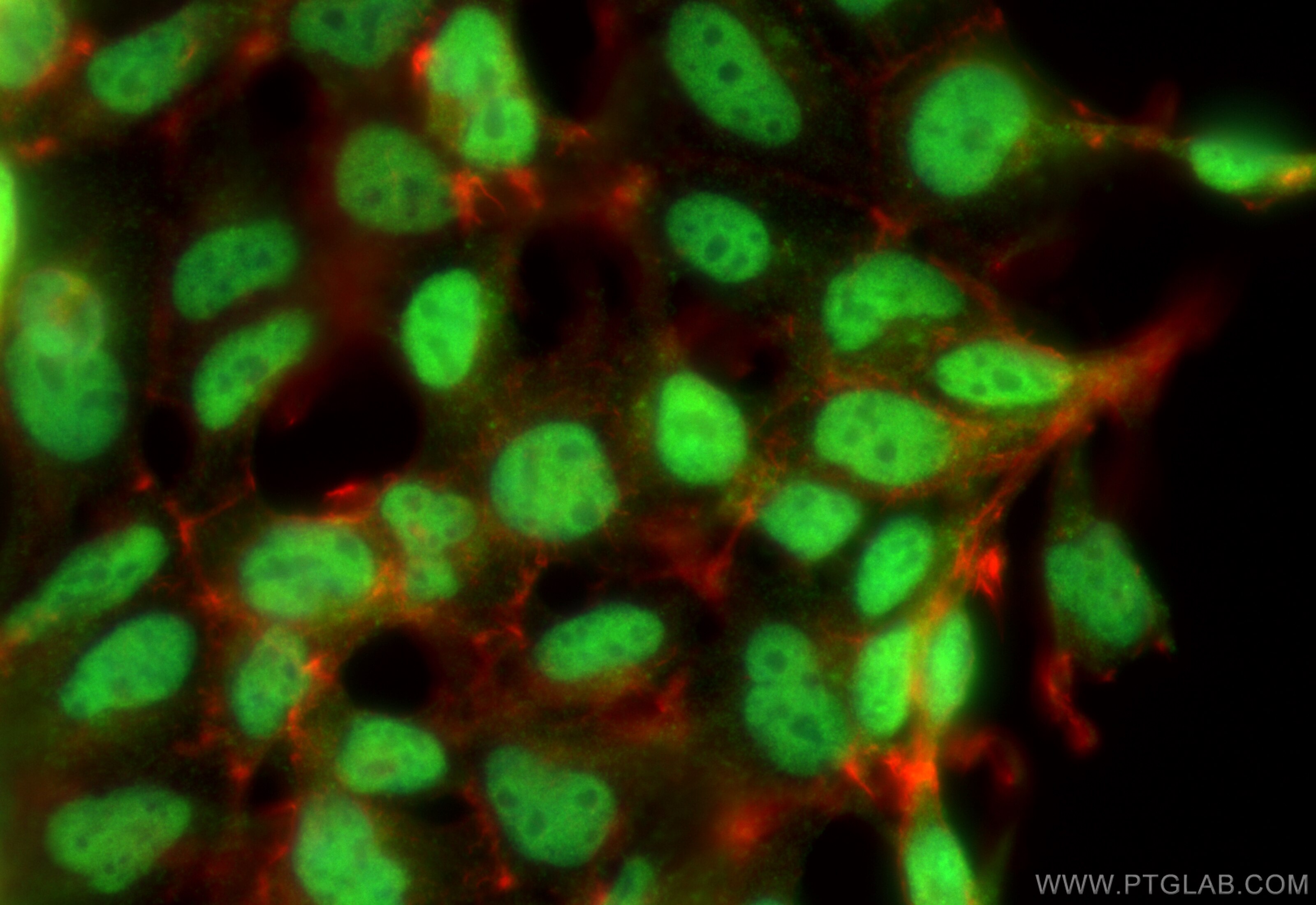
| Positive IF/ICC detected in | HEK-293 cells |
Recommended dilution
| Application | Dilution |
|---|---|
| Western Blot (WB) | WB : 1:1000-1:6000 |
| Immunoprecipitation (IP) | IP : 0.5-4.0 ug for 1.0-3.0 mg of total protein lysate |
| Immunofluorescence (IF)/ICC | IF/ICC : 1:200-1:800 |
| It is recommended that this reagent should be titrated in each testing system to obtain optimal results. | |
| Sample-dependent, Check data in validation data gallery. | |
Product Information
12105-1-AP targets SPIN1 in WB, IHC, IF/ICC, IP, ChIP, ELISA applications and shows reactivity with human, mouse, rat samples.
| Tested Reactivity | human, mouse, rat |
| Cited Reactivity | human, mouse |
| Host / Isotype | Rabbit / IgG |
| Class | Polyclonal |
| Type | Antibody |
| Immunogen |
CatNo: Ag2750 Product name: Recombinant human SPIN1 protein Source: e coli.-derived, PGEX-4T Tag: GST Domain: 1-262 aa of BC013571 Sequence: MKTPFGKTPGQRSRADAGHAGVSANMMKKRTSHKKHRSSVGPSKPVSQPRRNIVGCRIQHGWKEGNGPVTQWKGTVLDQVPVNPSLYLIKYDGFDCVYGLELNKDERVSALEVLPDRVATSRISDAHLADTMIGKAVEHMFETEDGSKDEWRGMVLARAPVMNTWFYITYEKDPVLYMYQLLDDYKEGDLRIMPDSNDSPPAEREPGEVVDSLVGKQVEYAKEDGSKRTGMVIHQVEAKPSVYFIKFDDDFHIYVYDLVKTS Predict reactive species |
| Full Name | spindlin 1 |
| Calculated Molecular Weight | 262 aa, 30 kDa |
| Observed Molecular Weight | 30 kDa |
| GenBank Accession Number | BC013571 |
| Gene Symbol | SPIN1 |
| Gene ID (NCBI) | 10927 |
| RRID | AB_2196111 |
| Conjugate | Unconjugated |
| Form | Liquid |
| Purification Method | Antigen affinity purification |
| UNIPROT ID | Q9Y657 |
| Storage Buffer | PBS with 0.02% sodium azide and 50% glycerol, pH 7.3. |
| Storage Conditions | Store at -20°C. Stable for one year after shipment. Aliquoting is unnecessary for -20oC storage. 20ul sizes contain 0.1% BSA. |
Background Information
SPIN1 (Spindlin 1) is a histone methylation reader, which recognizes trimethylated histone H3 lysine 4 through the protein-protein interaction. SPIN1 was initially found in ovarian cancer via searching ovarian cancer-related genes . It is overexpressed in ovarian cancer tissue, which exhibits a high homology to mouse Spin (Spindlin) gene. Signaling pathways responsible for SPIN1 functions include PI3K/Akt, Wnt and RET that are highly relevant to tumorigenesis.(PMID: 34492335, PMID: 31790762)
Protocols
| Product Specific Protocols | |
|---|---|
| IF protocol for SPIN1 antibody 12105-1-AP | Download protocol |
| IP protocol for SPIN1 antibody 12105-1-AP | Download protocol |
| WB protocol for SPIN1 antibody 12105-1-AP | Download protocol |
| Standard Protocols | |
|---|---|
| Click here to view our Standard Protocols |
Publications
What published studies show
The SPIN1 Polyclonal antibody (Cat# 12105-1-AP) has 16 citations spanning journals including Nature Communications, Cell Death & Disease, Nature Structural & Molecular Biology, EMBO Reports, PLoS Pathogens, eLife, and Molecular Oncology. Research fields cover rRNA transcription regulation, histone methylation recognition, tumorigenesis (NSCLC, gastric, colorectal, osteosarcoma), antiviral defense, epigenetic control of cell cycle, oocyte biology, phase separation, and protein degradation.
| Species | Application | Title |
|---|---|---|
Nat Commun Structural mechanism of bivalent histone H3K4me3K9me3 recognition by the Spindlin1/C11orf84 complex in rRNA transcription activation.
| ||
Cell Death Dis SPIN1 accelerates tumorigenesis and confers radioresistance in non-small cell lung cancer by orchestrating the FOXO3a/FOXM1 axis
| ||
Nat Struct Mol Biol The subcortical maternal complex safeguards mouse oocyte-to-embryo transition by preventing nuclear entry of SPIN1 | ||
EMBO Rep SPIN1 facilitates chemoresistance and HR repair by promoting Tip60 binding to H3K9me3
| ||
ACS Biomater Sci Eng Soft Substrate Promotes Osteosarcoma Cell Self-Renewal, Differentiation, and Drug Resistance Through miR-29b and Its Target Protein Spin 1. | ||
J Mol Cell Biol Phase separation of SPIN1 through its IDR facilitates histone methylation readout and tumorigenesis |

