
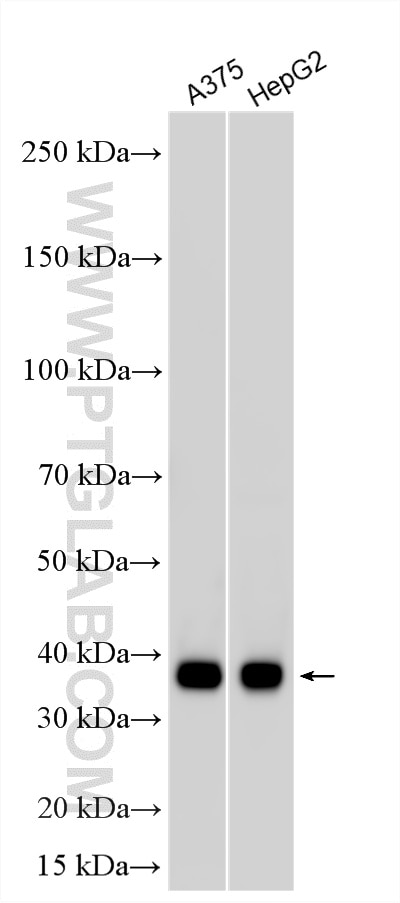



Tested Applications
| Positive WB detected in | A375 cells, HepG2 cells |
| Positive IHC detected in | mouse liver tissue Note: suggested antigen retrieval with TE buffer pH 9.0; (*) Alternatively, antigen retrieval may be performed with citrate buffer pH 6.0 |
| Positive IF/ICC detected in | PC-3 cells |
Recommended dilution
| Application | Dilution |
|---|---|
| Western Blot (WB) | WB : 1:2000-1:10000 |
| Immunohistochemistry (IHC) | IHC : 1:50-1:500 |
| Immunofluorescence (IF)/ICC | IF/ICC : 1:50-1:500 |
| It is recommended that this reagent should be titrated in each testing system to obtain optimal results. | |
| Sample-dependent, Check data in validation data gallery. | |
Product Information
22765-1-AP targets SPRY4 in WB, IHC, IF/ICC, ELISA applications and shows reactivity with human, mouse samples.
| Tested Reactivity | human, mouse |
| Cited Reactivity | human |
| Host / Isotype | Rabbit / IgG |
| Class | Polyclonal |
| Type | Antibody |
| Immunogen |
CatNo: Ag18574 Product name: Recombinant human SPRY4 protein Source: e coli.-derived, PGEX-4T Tag: GST Domain: 1-165 aa of BC125095 Sequence: MEPPIPQSAPLTPNSVMVQPLLDSRMSHSRLQHPLTILPIDQVKTSHVENDYIDNPSLALTTGPKRTRGGAPELAPTPARCDQDVTHHWISFSGRPSSVSSSSSTSSDQRLLDHMAPPPVADQASPRAVRIQPKVVHCQPLDLKGPAVPPELDKHFLLCEACGKC Predict reactive species |
| Full Name | sprouty homolog 4 (Drosophila) |
| Calculated Molecular Weight | 299 aa, 33 kDa |
| Observed Molecular Weight | 35-38 kDa |
| GenBank Accession Number | BC125095 |
| Gene Symbol | SPRY4 |
| Gene ID (NCBI) | 81848 |
| RRID | AB_2879163 |
| Conjugate | Unconjugated |
| Form | Liquid |
| Purification Method | Antigen affinity purification |
| UNIPROT ID | Q9C004 |
| Storage Buffer | PBS with 0.02% sodium azide and 50% glycerol, pH 7.3. |
| Storage Conditions | Store at -20°C. Stable for one year after shipment. Aliquoting is unnecessary for -20oC storage. 20ul sizes contain 0.1% BSA. |
Background Information
SPRY4, also named as Protein sprouty homolog 4, is a 299 amino acid protein, which contains one SPR (sprouty) domain and belongs to the sprouty family. SPRY4 Suppresses the INS receptor and EGFR-transduced MAPK signaling pathway, but does not inhibit MAPK activation by a constitutively active mutant Ras. Probably impairs the formation of GTP-Ras. SPRY4 has a cellular function to regulate the actin cytoskeleton, independent of its inhibitory activity on the Ras/MAP kinase signalling. SPRY1, SPRY2, SPRY3, SPRY4, are central and complex regulators of the receptor tyrosine kinase (RTK) signalling pathway.
Protocols
| Product Specific Protocols | |
|---|---|
| IF protocol for SPRY4 antibody 22765-1-AP | Download protocol |
| IHC protocol for SPRY4 antibody 22765-1-AP | Download protocol |
| WB protocol for SPRY4 antibody 22765-1-AP | Download protocol |
| Standard Protocols | |
|---|---|
| Click here to view our Standard Protocols |
Publications
What published studies show
The SPRY4 Polyclonal antibody (Cat# 22765-1-AP) has 8 citations published in journals including Nature Communications, Molecular Cell, Journal of Clinical Investigation, Cell Death & Disease, Cancer Letters, International Journal of Biological Macromolecules, Adipocyte, and American Journal of Reproductive Immunology. Research fields span oncology (lung, pancreatic, ovarian, hepatocellular, and thyroid cancers), bone development and scoliosis, adipogenic differentiation, and reproductive immunology, with applications primarily in WB, IHC, and IF.
| Species | Application | Title |
|---|---|---|
Nat Commun AXL confers intrinsic resistance to osimertinib and advances the emergence of tolerant cells.
| ||
Mol Cell HDAC5 depletion promotes hyper-acetylation of FOXA1 and potentiates HIF1α transcriptional activation in pancreatic cancer. | ||
J Clin Invest Targeting enhancer reprogramming to mitigate MEK inhibitor resistance in preclinical models of advanced ovarian cancer.
| ||
Cell Death Dis SPRY4 is responsible for pathogenesis of adolescent idiopathic scoliosis by contributing to osteogenic differentiation and melatonin response of bone marrow-derived mesenchymal stem cells.
| ||
Cancer Lett Coupling HDAC4 with transcriptional factor MEF2D abrogates SPRY4-mediated suppression of ERK activation and elicits hepatocellular carcinoma drug resistance.
| ||
Int J Biol Macromol CircPFKP orchestrates a novel competing endogenous RNA network to regulate SPRY4/p38-MAPK signaling and modulate papillary thyroid carcinoma aggressiveness.
|


