



Tested Applications
| Positive WB detected in | mouse brain tissue, human heart tissue, human brain tissue, BxPC-3 cells, rat brain tissue |
| Positive IHC detected in | human lung cancer tissue Note: suggested antigen retrieval with TE buffer pH 9.0; (*) Alternatively, antigen retrieval may be performed with citrate buffer pH 6.0 |
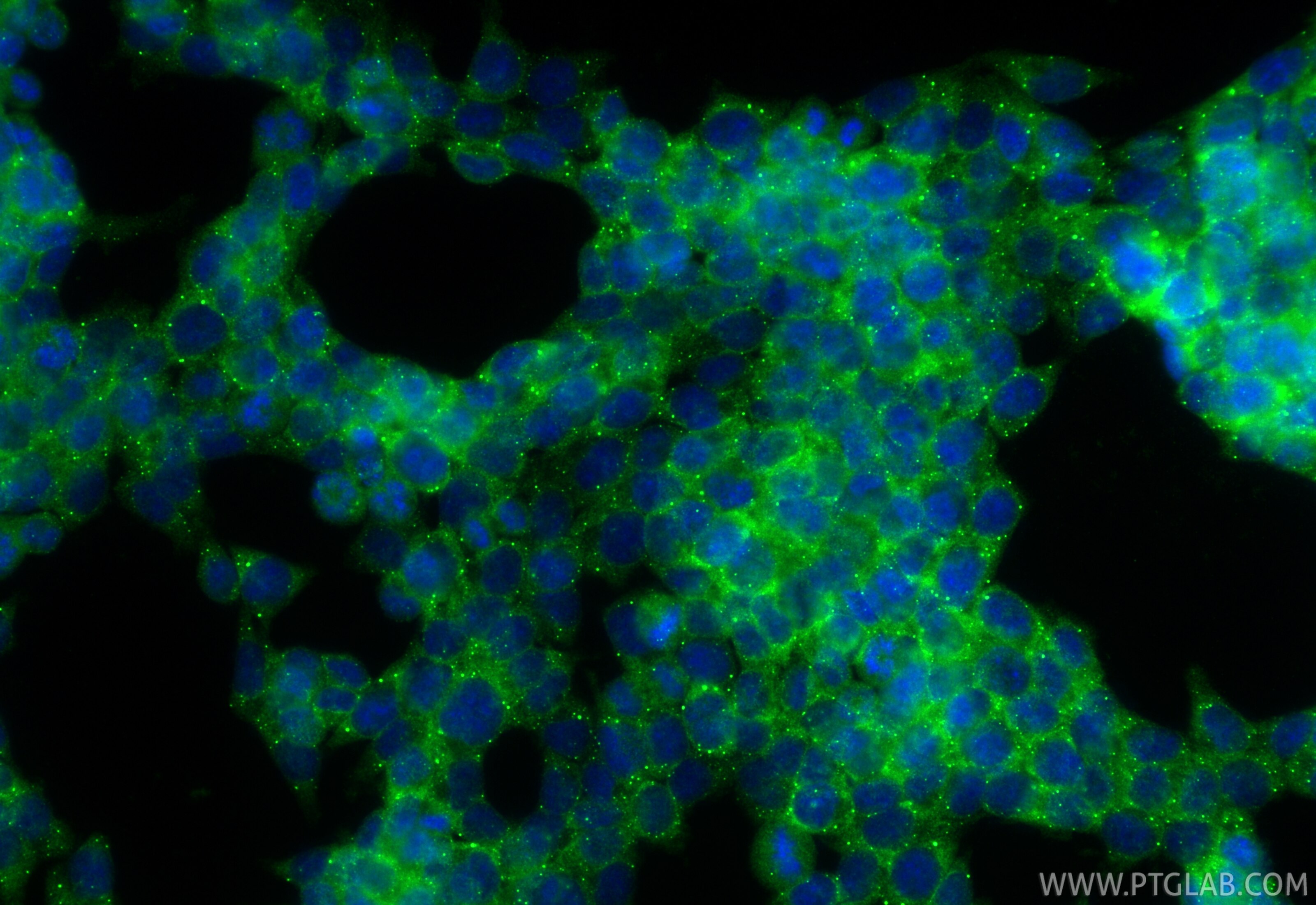
| Positive IF/ICC detected in | HCT 116 cells |
Recommended dilution
| Application | Dilution |
|---|---|
| Western Blot (WB) | WB : 1:2000-1:10000 |
| Immunohistochemistry (IHC) | IHC : 1:50-1:200 |
| Immunofluorescence (IF)/ICC | IF/ICC : 1:50-1:500 |
| It is recommended that this reagent should be titrated in each testing system to obtain optimal results. | |
| Sample-dependent, Check data in validation data gallery. | |
Product Information
10976-4-AP targets STXBP6 in WB, IHC, IF/ICC, ELISA applications and shows reactivity with human, mouse, rat samples.
| Tested Reactivity | human, mouse, rat |
| Cited Reactivity | human, mouse, rat |
| Host / Isotype | Rabbit / IgG |
| Class | Polyclonal |
| Type | Antibody |
| Immunogen |
CatNo: Ag1427 Product name: Recombinant human STXBP6 protein Source: e coli.-derived, PGEX-4T Tag: GST Domain: 1-210 aa of BC009499 Sequence: MSAKSAISKEIFAPLDERMLGAVQVKRRTKKKIPFLATGGQGEYLTYICLSVTNKKPTQASITKVKQFEGSTSFVRRSQWMLEQLRQVNGIDPNGDSAEFDLLFENAFDQWVASTASEKCTFFQILHHTCQRYLTDRKPEFINCQSKIMGGNSILHSAADSVTSAVQKASQALNERGERLGRAEEKTEDLKNSAQQFAETAHKLAMKHKC Predict reactive species |
| Full Name | syntaxin binding protein 6 (amisyn) |
| Calculated Molecular Weight | 25 kDa or 45 kDa |
| Observed Molecular Weight | 28-30 kDa |
| GenBank Accession Number | BC009499 |
| Gene Symbol | STXBP6 |
| Gene ID (NCBI) | 29091 |
| RRID | AB_2197002 |
| Conjugate | Unconjugated |
| Form | Liquid |
| Purification Method | Antigen affinity purification |
| UNIPROT ID | Q8NFX7 |
| Storage Buffer | PBS with 0.02% sodium azide and 50% glycerol, pH 7.3. |
| Storage Conditions | Store at -20°C. Stable for one year after shipment. Aliquoting is unnecessary for -20oC storage. 20ul sizes contain 0.1% BSA. |
Background Information
STXBP6 encodes syntaxin binding protein 6, a SNARE-family factor that regulates exocytosis and contributes to cell-cell adhesion. It has cadherin binding activity and is located at the adherens junction, linking adhesion-related and membrane-trafficking functions. Its domain architecture includes a PH domain and SNARE domain, consistent with a role in membrane-associated fusion control.
Protocols
| Product Specific Protocols | |
|---|---|
| IF protocol for STXBP6 antibody 10976-4-AP | Download protocol |
| IHC protocol for STXBP6 antibody 10976-4-AP | Download protocol |
| WB protocol for STXBP6 antibody 10976-4-AP | Download protocol |
| Standard Protocols | |
|---|---|
| Click here to view our Standard Protocols |
Publications
What published studies show
STXBP6 Polyclonal antibody (10976-4-AP) has 3 total citations. It appears in BMC Medicine, where it was used in Western blotting to study a functional variant (rs912304) regulating proinflammatory cytokine-responsive STXBP6 expression in late-onset type 1 diabetes, a diabetes/islet function research field. It also appears in Biochemical and Biophysical Research Communications, used in immunohistochemistry to explore hippocampal neuronal alterations linked to anxiety and depression-like behaviors in an IBD mouse model (immunology/gut-brain axis field). Additionally, it appears in Research Square, used in IHC for spatial transcriptomic analysis of hippocampal pathology in aged controls, primary age-related tauopathy, and Alzheimer's disease (neurodegeneration field).
| Species | Application | Title |
|---|---|---|
BMC Med A functional variant rs912304 for late-onset T1D risk contributes to islet dysfunction by regulating proinflammatory cytokine-responsive gene STXBP6 expression | ||
Biochem Biophys Res Commun A single-nucleus transcriptomic analysis reveals hippocampal neuronal alterations linked to anxiety- and depression-like behaviors in IBD model mice. | ||
Res Sq Novel Pathological Mechanisms Revealed by Spatial Transcriptomic Analysis of Hippocampus in Aged Control, Primary Age-Related Tauopathy, and Alzheimer's Disease. |


